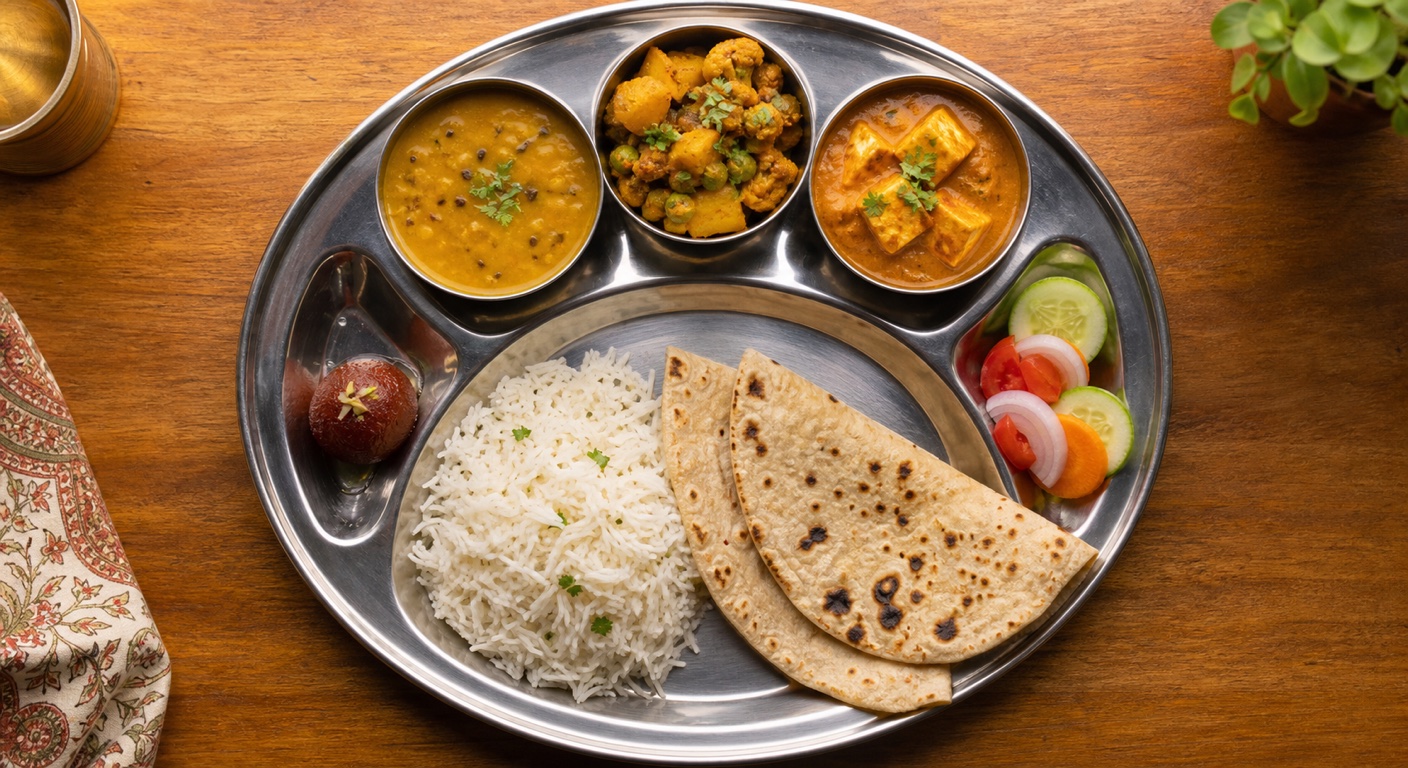
The thali illusion - can you really control portions when everything's on one plate?
Dal, sabzi, roti, rice, curd and a sweet, all served together - it feels either automatically balanced or completely uncontrollable, depending on who you ask. Neither instinct is quite right. Here's what the actual research on plate design, portion perception and variety says about the thali.
The thali is one of the oldest ideas in Indian eating: instead of one big dish, you get several small ones, arranged together so you get a taste of everything in a single sitting. That format gets read two completely opposite ways - as proof the meal is automatically balanced ('look, there's dal, sabzi, curd, everything!'), or as proof portion control is hopeless once six dishes land in front of you at once. Both reactions skip the actual evidence on how plates, bowls and variety shape what and how much we eat - evidence that says the thali format itself is neither your enemy nor your safety net. What matters is how you use it.
"A thali is automatically a balanced meal because it has a bit of everything."
partly truePartly true - it depends entirely on what's on it and how much of each.
ICMR-NIN's 2024 'My Plate for the Day' guidance, the official Indian dietary reference, spells out real proportions: roughly half the plate should be vegetables, fruits and greens, cereal intake should stay within about 45% of total daily energy, and pulses/eggs/flesh foods together should contribute around 14-15% of energy, with fats capped near 30%. A home thali built with a modest katori of dal, a generous sabzi portion, curd, and a controlled serving of rice or roti can genuinely land close to those proportions - which is exactly why the format has survived for generations. But a restaurant or wedding-style 'unlimited' thali very often skews the other way, with extra rice and puris, more fried sides, and a sweet included as standard - moving it a good distance from ICMR-NIN's own recommended shares. The thali format doesn't guarantee balance; the specific dishes and portions placed on it do.
"You lose all portion control once everything is served together on one plate."
mythMyth - the thali's own design can work for portion control, not against it.
The eye judges portion size relative to its container, not just its absolute amount - an effect called the Delboeuf illusion. A 2013 study found people overestimated the same food portion's diameter by about 5% and its visual area by about 10% when it sat on a wide-rimmed plate rather than a thin-rimmed one. A compartmentalised thali plate with individual katoris is, in effect, a set of small, well-rimmed containers - a modest serving of dal looks fuller in its own katori than the same amount would look lost in the middle of one large plate. Separately, a major review pooling 61 studies and over 6,700 people found people reliably eat more when given larger tableware and larger portions, and less with smaller ones - meaning it's the size of your katori and your rice mound, not the fact that six dishes share one plate, that mainly decides how much you eat. Used deliberately, small katoris and controlled portions make the 'everything together' format an asset.
"Refilling rice or roti once or twice at a thali meal doesn't really add up."
mythMyth.
Research on what's called 'unit bias' shows people treat one serving unit - one roti, one ladle of rice, one refill - as the natural, appropriate amount to eat or take, largely regardless of that unit's actual size, and they consistently eat more when offered in bigger units without fully registering the extra quantity. The same logic applies directly to 'just one more roti' at an unlimited thali meal: each top-up feels small and forgettable in isolation, but two or three of them, unnoticed as a single decision because they arrived as separate small units, add up to a full extra roti or rice serving's worth of calories. The trick isn't to refuse refills - it's to count them the way you'd count any other second helping.
"The more variety on your thali, the better and more balanced you're eating."
partly truePartly true - more variety brings more nutrients, but it also makes you eat more of everything.
In a landmark 1981 study, 36 people ate about a third more food when offered sandwiches with four different fillings in succession than when offered the same filling repeatedly. The mechanism is called sensory-specific satiety: your appetite for a specific taste fades as you eat it, but a new flavour renews your interest in eating, even if you're already fairly full. A thali's dal-sabzi-curd-achar-mithai spread, built around the six classic Ayurvedic tastes, is a real-world version of exactly that experiment - the diversity of flavours is a genuine part of why it delivers varied nutrients and doesn't feel monotonous, but that same diversity is precisely what nudges total intake upward. Balanced nutrition and higher total intake can both be true of the same plate at the same time - variety is a reason to control portion size more carefully, not a reason to stop watching it.
Small tips that add up
- Ask for (or serve yourself) dal, sabzi and rice/roti into separate small katoris rather than one heaped combined plate - the Delboeuf illusion then works for you, not against you.
- Fill roughly half the thali space with sabzi, salad and curd before rice and roti go on, mirroring ICMR-NIN's own 'half the plate' guidance, instead of defaulting to restaurant-style extra rice.
- Count refills the way you'd count a second helping anywhere else - 'just one more roti' three times over a meal is a full extra roti's worth of food, whether you noticed eating it as one meal or three.
- Enjoy the mithai as one small katori-sized portion at the end of the meal, not a running side dish through it - the same unit-bias logic applies to sweets as to rice and roti.
The bottom line
A thali isn't automatically balanced, and it isn't automatically out of control either - both instincts hand the plate's format more power over your eating than it actually has. It's balanced when the proportions on it roughly mirror what ICMR-NIN recommends, and it stays controllable through the same tools that work for any other meal - katori size, portion size, and counting refills honestly - the multi-dish format doesn't remove your ability to use them.
Best-case recipe, computed independently: Build the plate half vegetables/salad/curd, a modest katori each of dal and rice/roti, and treat any extra helping - rice, roti or mithai - as a deliberate choice you count, not a freebie just because it came from the same thali.