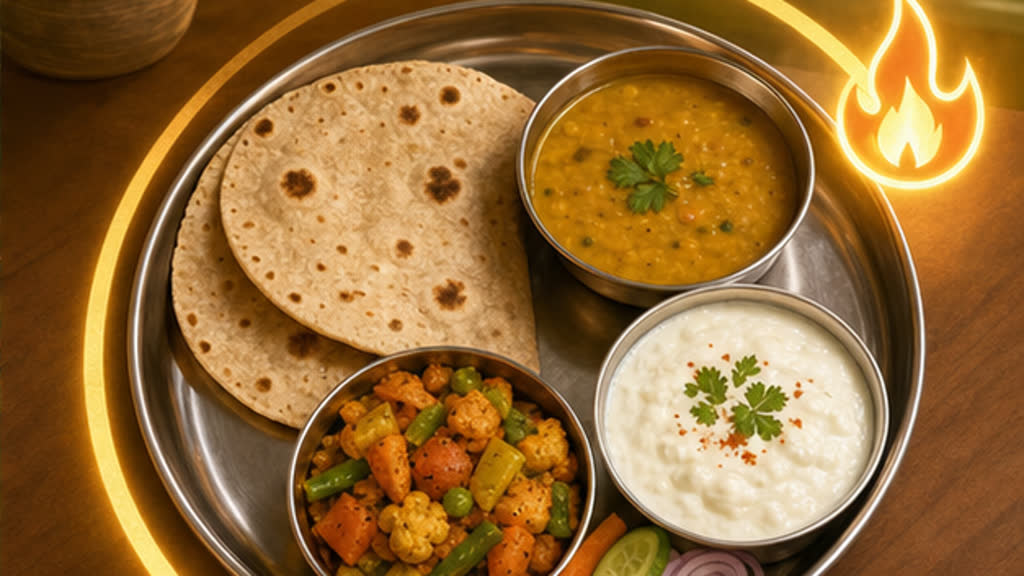
The thermic effect of food - calories you burn just eating
About 10% of the calories you eat get burned just digesting and processing that food. Protein nudges it up a little, but it is a small lever - the deficit does the work.
Your body burns calories all day, even when you are not moving. One surprising place you burn them is while eating. Digesting, absorbing and storing your food takes work, and that work costs energy. Scientists call this the thermic effect of food, or TEF. It is not a magic weight-loss trick. But it is a real part of your calorie math, and knowing how it works helps you stop chasing silly myths and focus on what actually matters.
TEF is about 10% of what you eat
On a normal mixed diet, TEF is about 5 to 15% of your total calories, with around 10% being typical. So if you eat 2000 kcal in a day, roughly 200 kcal get burned just processing that food. The rest of your energy out goes to two bigger buckets: your basal metabolic rate (BMR), which keeps you alive at rest, and your daily activity and exercise. TEF is the smallest of the three buckets. It is real, but it is never going to out-work a bad diet.
Assumptions: A 2000-kcal mixed diet with a typical mix of protein, carbs and fat; TEF near the ~10% average.
Which food burns the most to digest?
Not all foods cost the same to process. Protein is the hardest work for your body to break down and store, so it has the highest TEF. Carbs are easier, and fat is the easiest of all. The numbers below are the TEF percentage for each macronutrient, with a worked kcal figure for a 500-kcal portion of that single macro so you can compare like with like.
Some foods are 'negative-calorie' - your body burns more digesting them than they contain.
falseFalse. TEF is always a percentage of the food's own calories, never more than 100%. Even protein, the highest-TEF macro, only burns 20-30% of its calories during digestion - you still absorb 70-80%. Celery, cucumber and other water-rich veggies are very low in calories, but they are not negative. There is no free lunch.
A little more protein is the one TEF lever worth pulling
Keep your protein around 25-30% of calories (roughly 1.6-2.0 g per kg of your target body weight), fill the rest with whole carbs and healthy fats, and let TEF take care of itself.
If you shift your mix from a typical 15% protein up to around 30% protein (and trim refined carbs to make room), your TEF goes up a little. On a 2000-kcal day the extra protein adds roughly 50 kcal of burn - small, but it stacks on top of protein's bigger benefit: it protects your muscle while you lose fat and keeps you full. This is the only TEF move that actually pays off in real life. Do not expect a big number; think of it as a small bonus on top of a smart food choice.
Assumptions: 2000-kcal diet; protein raised from ~15% to ~30% of calories with refined carbs reduced to compensate; baseline TEF ~200 kcal.
Practical ways to nudge TEF up (without obsessing)
- Eat enough protein - about 25-30% of your calories. It is the one TEF lever that genuinely moves the needle, and it also keeps you full and protects muscle.
- Pick less-processed foods when you can - whole-grain roti over white bread, whole fruit over juice, home-cooked dal over packaged snacks. One study found a whole-food meal burned nearly double the TEF of an equal-calorie processed meal.
- Add fibre-rich veggies and legumes - they take a little more work to process and fill you up cheaply. Eat them for the fullness, not for a TEF miracle.
- Skip the 'negative-calorie food' lists - they do not exist. TEF is always a small slice of the food's own calories, never more.
- Do not bother with chilli, green tea or coffee for TEF - their effect is tiny (a few tens of kcal at best) and not worth the effort for fat loss.
The bottom line
TEF is real but small - about 10% of what you eat, and the only part you can meaningfully nudge is by eating a bit more protein and choosing less-processed foods. Even then, you are talking about a few tens of extra calories a day, not a transformation. So do not obsess over it. The calorie deficit does the heavy lifting. Log your food in Burnie, watch your deficit, hit your protein, and let TEF be a quiet bonus on the side.