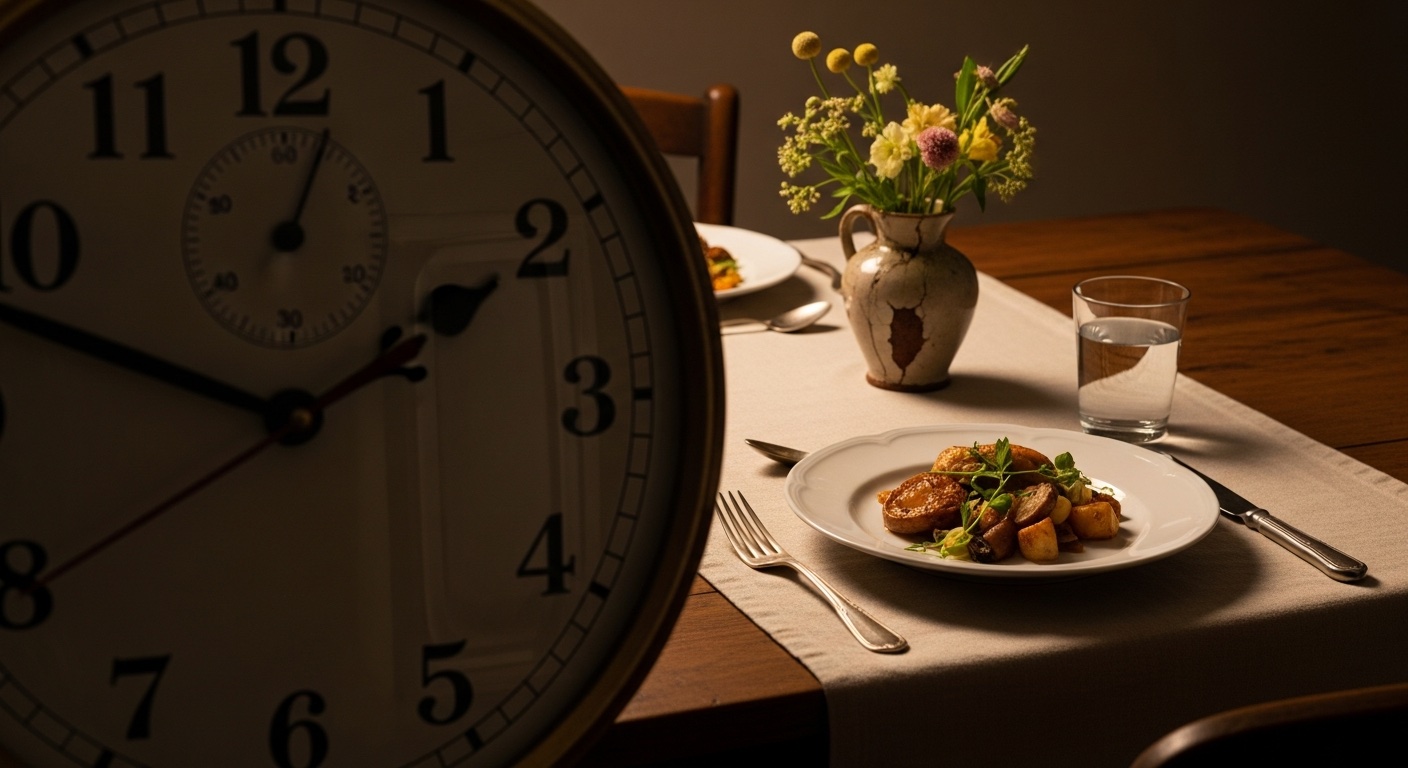
When you eat matters (a little) - the truth about meal timings
You've probably heard that eating after 8pm makes you fat, that you must 'eat breakfast like a king', and that six small meals stoke your metabolism. Here's the honest version from the actual research: what and how much you eat over the whole day decides your weight far more than the clock does. Timing has a small, real effect - mostly on hunger and habits, not on some magic fat-burning switch. If you eat a late Indian dinner, you are not doomed. Get the total and the protein right first; treat timing as fine-tuning.
Meal-timing advice is everywhere, and a lot of it is louder than the evidence behind it. This article goes claim by claim with the honest verdict - true, partly true, or myth - and the real studies named. The short version: calories come first, protein and fullness second, timing a distant third. Good news if your family eats dinner at 9 or 10pm, like many Indian households do.
"Eating late at night makes you gain weight."
partly truePartly true - but mostly a myth the way people mean it. The clock doesn't add calories; your whole day does. Late eating can nudge hunger and how much you burn, and it often means MORE total eating - that's the real risk.
A calorie at 10pm isn't worth more than one at 6pm. Studies that hold total calories fixed and only shift timing (isocaloric studies) find late eating doesn't magically create fat. A careful crossover trial by Vujovic (2022) found something subtler: eating the same meals late made people hungrier, burned slightly fewer calories, and shifted fat-tissue behaviour - reasons late eating can make it HARDER to stay in control, not proof the hour itself adds weight. McHill (2017) found people eating later in their body's day carried more body fat - but that's an association, and late eaters often just eat more overall (the second dinner, the midnight Maggi, the mindless TV snacking). The honest takeaway: a normal, sensible late dinner is fine. The real danger is that late-night eating is when extra, unplanned calories sneak in.
"Eat breakfast like a king, dinner like a pauper - front-loading your calories melts fat."
partly truePartly true, and usually overstated. Shifting more food to earlier in the day gives a small edge in some studies, mostly by controlling hunger. But it is not a magic rule, and forcing a big breakfast you don't want can just add calories.
There's a grain of truth here. Jakubowicz (2013) put women with metabolic syndrome on the same 1,400 calories a day, one group front-loaded to breakfast, the other to dinner - the big-breakfast group lost more (8.7 kg vs 3.6 kg over 12 weeks). Young (2023) also finds earlier calories help a little. BUT a large meta-analysis by Sievert (2019) found breakfast itself gave NO weight-loss advantage - breakfast eaters ate ~260 more calories a day, and skippers lost slightly more. The catch: the timing benefit only helps if it makes you eat less overall. If you're not hungry in the morning, forcing a heavy breakfast just adds calories. Front-load if it curbs evening hunger - but don't treat 'breakfast like a king' as a law of physics.
"Eating 6 small meals a day stokes your metabolism and burns more fat than 3 meals."
mythMyth. If the calories and protein are the same, whether you eat 3 meals or 6 makes essentially no difference to your weight or metabolism.
Sounds scientific, doesn't hold up. Your body burns a few calories digesting food (the 'thermic effect'), but that scales with TOTAL intake, not meal count - splitting the same food into six plates instead of three doesn't raise your daily burn. Schoenfeld, Aragon & Krieger's (2015) meta-analysis found the apparent benefit of eating more often disappeared once one outlier study was removed - no real effect on body fat. Eat 3, 4, or 6 meals - pick whatever keeps your hunger steady and total intake in check. Just don't believe more meals 'speed up' anything.
"A shorter eating window (intermittent fasting, like 16:8) beats a normal diet for weight loss."
partly truePartly true - it can help, but through calories, not the clock. Squeezing your meals into a window works mainly because it often makes you eat less overall, not because fasting has a special fat-burning magic.
Time-restricted eating (an 8-hour window) is popular and can work - but head-to-head trials show it isn't magic. The TREAT trial (Lowe, 2020) found a 16:8 window gave no more weight loss than eating normally. A year-long trial by Liu (2022) found an 8-hour window plus calorie-cutting lost about the same as calorie-cutting alone - the window added nothing extra. Where timing does earn its keep is metabolic health: Sutton's (2018) early-window study improved insulin sensitivity and blood pressure in pre-diabetic men EVEN WITHOUT weight loss. So a shorter, earlier window can be genuinely useful - a simple way to stop late-night grazing - but the weight loss comes from eating less, not the fast itself.
Small tips that add up
- Put your energy in the right order: total calories first, protein and fullness second, timing a distant third. Fixing timing while ignoring the total is polishing the doorknob on a house that's on fire.
- A late Indian dinner is not the enemy. If your family eats at 9 or 10pm, that's fine - just keep the portion normal and don't add a second round of snacking on top of it.
- The real 'late-night' trap is extra, unplanned food - the post-dinner sweet, the midnight Maggi, mindless nibbling in front of the TV - not the hour on the clock.
- More meals do not speed up your metabolism. Choose the number of meals that keeps your hunger steady, whether that's 3 or 6.
- If you want to try front-loading, do it by moving calories earlier, not adding a big breakfast on top of everything else.
The bottom line
The honest bottom line: when you eat matters a little, but what and how much you eat matters far more. No meal schedule burns fat on its own - get your total calories and protein right, and you've won most of the battle; timing is fine-tuning. Three tweaks do have real evidence behind them: leave a couple of hours between your last big meal and sleep (cuts late-night grazing, supported by the isocaloric and early-window studies); if evenings are your danger zone, shift more food - especially protein - to breakfast and lunch; and keep eating to a sensible daily window instead of grazing morning to midnight. None of this requires giving up a late family dinner. The one habit that reliably helps: stop the after-dinner grazing - that's where the clock quietly costs you.
Best-case recipe, computed independently: Not applicable (timing article). The 'best case' is behavioural: get total calories and protein right, then add the three evidence-backed tweaks - a gap before bed, a bit more food earlier if nights are your weak spot, and a sensible eating window instead of all-day grazing.