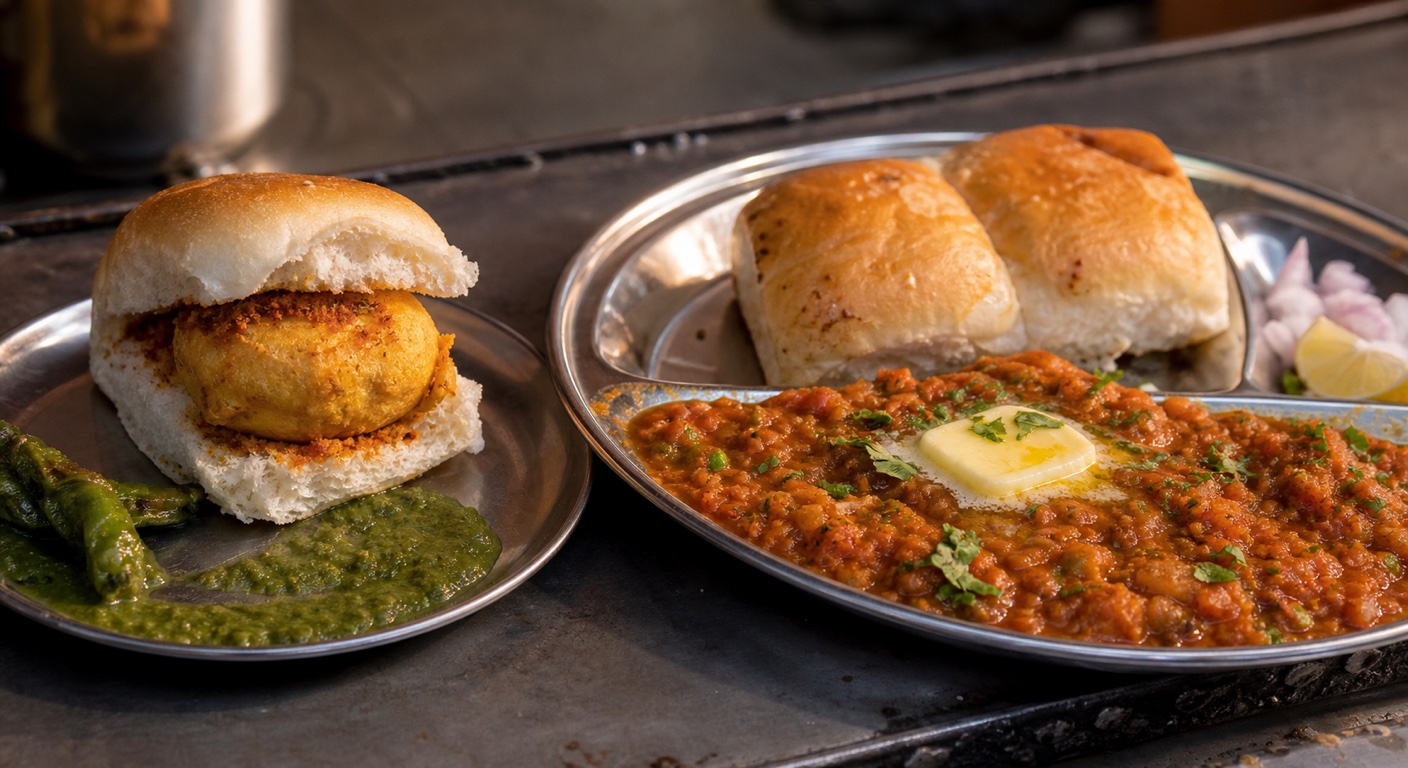
I love vada pav and pav bhaji - how do I lighten them without giving up Mumbai street food?
You don't have to skip vada pav or pav bhaji. A regular vada pav is about 300 kcal and a standard pav bhaji plate about 400 kcal - and almost all of the extra calories on a bad day come from how much oil the vada sat in, how much butter went into the bhaji and the pav, and how many pieces you had.
Vada pav and pav bhaji aren't the problem - the oil tray and the butter knife are. A fried potato fritter in a bun, and mashed vegetables with buttered bread, both have honest, countable calorie numbers. See where those numbers actually come from, and you can keep eating both without treating every stall visit as a splurge. Every figure here comes from a real nutrition source, rounded and given as honest ranges.
Your regular vada pav
One standard street-style vada pav - a deep-fried, besan-coated potato fritter in a soft pav bun - comes to about 300 kcal. That's before a vendor uses extra oil or you order a second one.
Assumptions: 1 vada pav, ~150 g total (deep-fried potato vada ~80 g + pav bun ~70 g), typical street-style oil absorption in the fritter; ~12 g fat per serving.
Ask for a freshly-fried vada, not one that's been sitting in the oil tray
A vada that's been resting in hot oil at a stall keeps absorbing it. A freshly fried vada - or a home-style air-fried one - comes in closer to 200 kcal instead of 300.
If it's pav bhaji, say 'kam makhan' - go easy on the butter in the bhaji
Street-style pav bhaji leans hard on butter cooked into the bhaji itself - 3-4 tablespoons per serving isn't unusual at busy stalls. Asking for less, or making it at home with controlled butter, brings a plate down from a street-style ~650 kcal to about 375 kcal.
This is a separate baseline - a full pav bhaji plate (bhaji + 2 pav), not the vada pav above. Street-style with heavy butter ~600-700 kcal vs. home-style with controlled butter ~350-400 kcal.
Dry-roast the pav instead of butter-toasting it
A pav toasted in butter on the tawa runs roughly double the calories of a dry-roasted one - about 155 kcal each buttered vs. 75 kcal each dry. Across the usual two pav that come with a plate, that's a real difference.
Delta compares a standard pav bhaji plate with 2 dry-roasted pav (~240 kcal total) against the same plate with 2 butter-toasted pav (~400 kcal total, the standard-plate baseline above) - a separate comparison from the vada pav baseline.
Have one pav, not two
Pav bhaji is usually served with 2 pav. Having one dry-roasted pav instead of two, and filling up on the bhaji itself, drops the plate further still.
Delta is measured against the dry-roasted-pav plate above (~240 kcal with 2 dry pav), not the original 400 kcal standard plate.
Order one vada pav, not two - and fill up on onions and chutney
If you'd usually order a second vada pav, ask for extra onions and the free chutney instead. One vada pav with a generous side of onions and chutney is a lot lighter than two vada pav.
Delta compares 1 vada pav plus onions/chutney (~320 kcal) against 2 vada pav (~600 kcal).
Small tips that add up
- The oil the vada was fried in and the butter in pav bhaji matter more than the vegetables or the bread itself.
- Don't stack every change at once - cutting the butter in the bhaji already does most of the work; you don't also need to skip the pav entirely.
- Ask for 'kam tel' (less oil) on the vada and 'kam makhan' (less butter) on the bhaji and pav - most stalls will do it if you ask.
- One vada pav or one plate of pav bhaji, eaten properly, is still a full meal.
The bottom line
A regular vada pav is about 300 kcal, and a standard pav bhaji plate about 400 kcal - both can climb well past that with extra oil or a heavy hand on the butter. The two changes that matter most: ask for less oil on the vada, and less butter on the bhaji and the pav.
Best-case recipe, computed independently: One freshly-fried vada pav (~200 kcal, homemade air-fried), computed independently. Paired with a pav bhaji made with about 1 teaspoon of butter instead of 3-4 tablespoons, and one dry-roasted pav instead of two, for the fuller meal.