Can dal and paneer really build muscle? The truth about vegetarian protein in India
Every gym in India has an uncle insisting vegetarians can't build muscle without eggs or whey. Here's what the actual protein research says.
India has the largest vegetarian population on earth, and also one of the loudest protein-shaming cultures around it. Ask about building muscle on a veg diet and someone will tell you it's impossible without eggs, chicken, or a tub of whey. This article checks that belief, claim by claim, against real nutrition research - naming the actual studies - so you can stop worrying and start eating smarter.
"Vegetarians can't get enough protein without eggs or meat."
mostly mythMostly myth - only diets that are almost all cereal with very little pulses or dairy actually fall short.
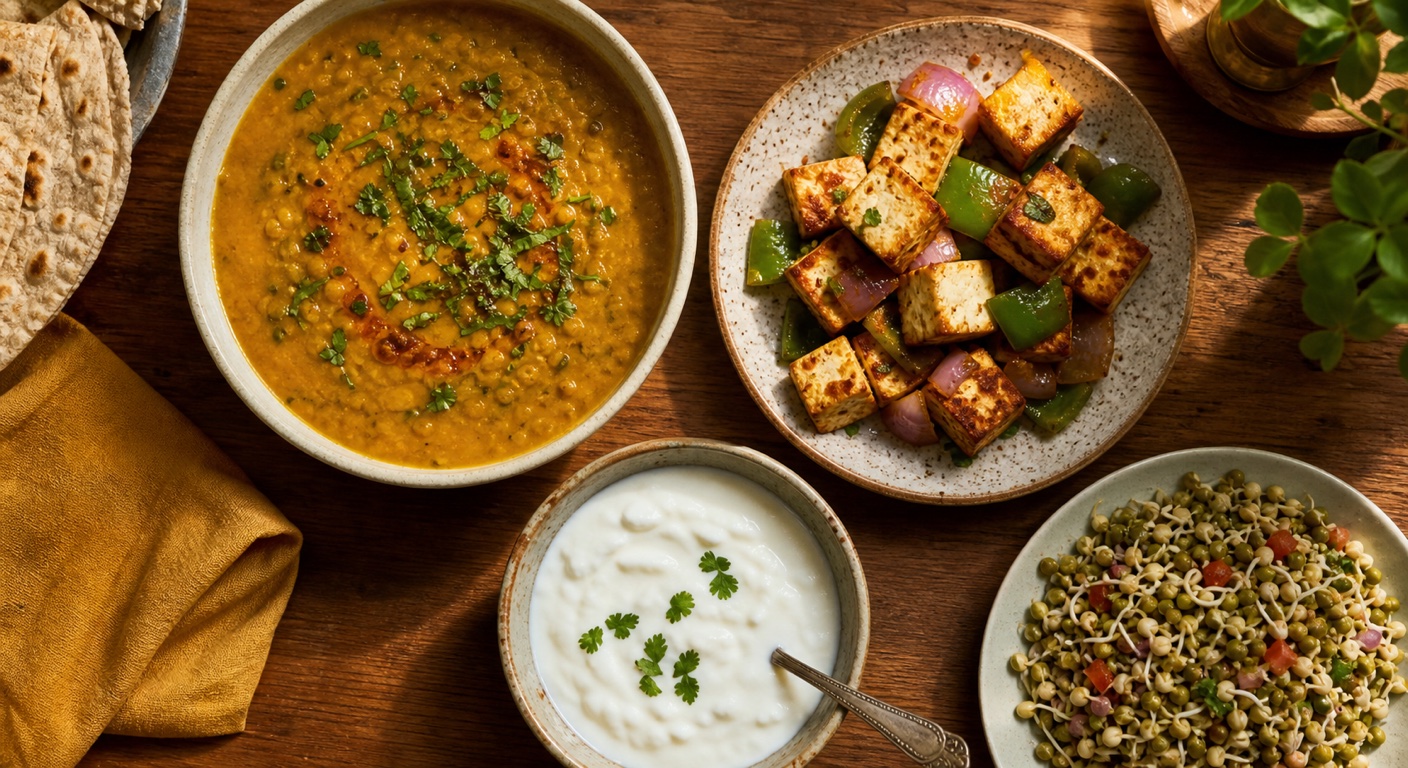
The Indian Council of Medical Research's National Institute of Nutrition (ICMR-NIN) set the 2020 RDA for protein at about 0.83 g/kg body weight per day for a mixed diet, rising to roughly 1 g/kg/day only for diets built almost entirely around cereals with very little pulses or dairy, since that pattern lowers the average protein quality of the day's food. A 65 kg adult eating a normal vegetarian thali - a cup of cooked dal, 100g paneer or a bowl of curd, and roti or rice - comfortably clears 50-60g of protein before counting anything else, without an egg or a chicken breast anywhere near the plate.
"Dal and rice have to be eaten in the same meal, or the protein doesn't 'complete' properly."
mythMyth.
This idea traces back to Frances Moore Lappe's 1971 book Diet for a Small Planet, a position she herself walked back in later editions. The definitive scientific rebuttal came from Vernon Young and Peter Pellett's 1994 review in the American Journal of Clinical Nutrition, which laid out how the body maintains a circulating pool of amino acids and draws on it across the whole day, not meal by meal. A dal at lunch and a roti at dinner combine perfectly well inside you, even if they never touch the same plate.
"You need whey protein powder to actually build muscle as a vegetarian."
mythMyth - whey is convenient, not necessary.
A 12-week randomized trial by Lynch and colleagues (2020) had men and women resistance-train while drinking either whey or soy protein isolate matched for leucine content, and found no significant difference in muscle growth or strength gains between the two groups. Zooming out further, a 2025 meta-analysis of 43 randomized trials in Nutrition Reviews by Reid-McCann and colleagues found animal protein has only a statistically significant but practically trivial edge on muscle mass over plant protein, and no meaningful difference at all in strength or physical performance. Whey is a fast, low-volume way to hit a high protein number on a busy day - it isn't a biological requirement for a vegetarian to grow muscle.
"Plant protein is lower quality, so it doesn't really 'count' the same as animal protein."
partly truePartly true, but easy to fix with variety.
Using the modern DIAAS scoring system, most pulses and legumes do score lower than dairy or soy protein isolate because they're relatively short on the sulfur amino acids methionine and cysteine, while cereals tend to be short on lysine instead - a 2020 review by Herreman and colleagues in Food Science & Nutrition maps this out food by food. But soy protein isolate itself scores close to the top of the scale, on par with whey and eggs, and dairy staples like paneer and curd already sit in the high-quality band. Practically, a vegetarian Indian diet that mixes pulses with soy, paneer, or curd through the week evens out any single ingredient's amino acid gaps - no one food has to be 'perfect' on its own.
Small tips that add up
- Anchor two meals a day around a pulse plus a dairy or soy food (dal with curd, rajma with a paneer sabzi, chana with soy chunks) rather than chasing one giant 'protein meal.'
- If you train hard, aim above the general RDA - roughly 1.2-1.6 g/kg/day supports muscle-building resistance training, and is easily reached with paneer, curd, dals, soy chunks, and sprouts.
- Sprouted moong or chana digests faster and is easier to eat in volume than an equivalent amount of raw dried dal.
- Use whey or soy protein powder to close a real gap on high-training days - not because 'vegetarian food isn't enough' on its own.
The bottom line
The honest bottom line: a well-built Indian vegetarian diet gives you all the protein you need to build muscle, recover from training, and stay healthy - no meat or whey required, just enough total food and a bit of variety across pulses, dairy, and soy.
Best-case recipe, computed independently: For a 65kg vegetarian: 1 cup cooked dal (~9g protein) + 100g paneer (~18g) + 1 cup curd (~7g) + 2 rotis and a cup of rice (~8g) + a handful of sprouts or soy chunks (~12g) adds up to roughly 50-55g of protein from ordinary thali food alone - already most of the way to a muscle-building target, no supplement tub required.