Walking: how many calories per kilometre
Walking costs about 0.5 kcal for each kilogram of your body for each kilometre you walk. So a 70 kg person burns about 35 extra kcal per km, and about 300 kcal for 8-9 km. It is the easiest, cheapest burn most Indians can do daily.
You do not need a gym to burn calories. You already own the machine that does it: your legs. Walking is the simplest burn tool most Indians have. After dinner, to the metro, the evening round the colony, the walk to the vegetable vendor. This article tells you honestly how many calories each kilometre of walking gives you, where the number comes from, and how pace, slope and a backpack change it. The short answer: about half a kcal per kilogram of your body per kilometre. The rest is fine-tuning.
The baseline: about 0.5 kcal per kg per km
On flat ground, at a normal-to-brisk pace, the energy your muscles add to move your body one kilometre is about 0.5 kcal for each kilogram you weigh. This is the NET cost, the extra burn above sitting. It comes from the ACSM walking equation: the horizontal part costs 0.1 mL of oxygen per kg per metre walked. Convert oxygen to kcal (about 5 kcal per litre of oxygen) and you get 0.1 x 0.005 x 1000 = 0.5 kcal per kg per km. The neat thing: this net per-km cost barely changes with walking speed, because you cover each metre with roughly the same effort. So a 70 kg person burns about 35 extra kcal per km, whether that km takes 12 minutes or 15 minutes. The GROSS number, counting the resting metabolism you would burn anyway during that time, is a bit higher, around 0.8 kcal/kg/km at an easy pace. But the part that matters for your deficit is the extra 0.5.
Assumptions: 70 kg adult, level ground, moderate pace (about 5 km/h), net energy above resting. Heavier people burn proportionally more per km because they move more mass.
Brisk walking burns way more calories per kilometre than slow walking.
mostly falseMostly false for the per-km number. The net energy to move your body one kilometre is about the same whether you walk that km in 12 minutes or 15 minutes, because each metre costs roughly the same effort. What pace changes is how FAST you burn, and the gross total (counting resting metabolism during the walk) is slightly higher at slower speeds because you spend more time on the road. Brisk walking (5-6 km/h) does raise the burn a little, because form gets less efficient at higher speeds, but it is a modest bump, not a doubling. The real win of brisk walking is you finish more kilometres in the same time, so total kcal in 30 minutes goes up. Same per km, more km per hour.
Add an incline or a light backpack for a small extra burn
If you want a bit more burn per kilometre without walking farther, take a route with gentle slopes, or carry a light backpack. The ACSM vertical term (1.8 x speed x grade) means a 5% uphill grade adds roughly 0.45 kcal per kg per km on top of the 0.5 baseline, nearly doubling the net cost for that climb. A loaded backpack raises the moving mass, so a 5 kg bag adds roughly 2-3 extra kcal per km. These are real but modest gains. The honest view: a flat 8 km walk already gives you about 280 extra kcal if you weigh 70 kg. Slope and load are bonus, not the engine. Burnie logs your food and shows your deficit, that is the engine. Walking is the cheap, reliable way to widen that deficit.
Assumptions: 70 kg adult, gentle uphill (about 5% grade) or a 5 kg backpack, moderate pace. Delta shown is a typical extra from slope or light load, not both stacked.
Make walking actually stick
- Walk after meals. A 10-minute walk after lunch and dinner is 2 km, about 70 extra kcal for a 70 kg person, and it helps blood sugar too.
- Use your commute. Get off one metro stop early, or park the two-wheeler 1 km away. Two such walks a day is ~70 kcal without finding extra time.
- Aim for 8-9 km a day only if it fits your life. That is about 280-300 extra kcal for a 70 kg person, enough to matter for a deficit, but do not jump there on day one. Build up.
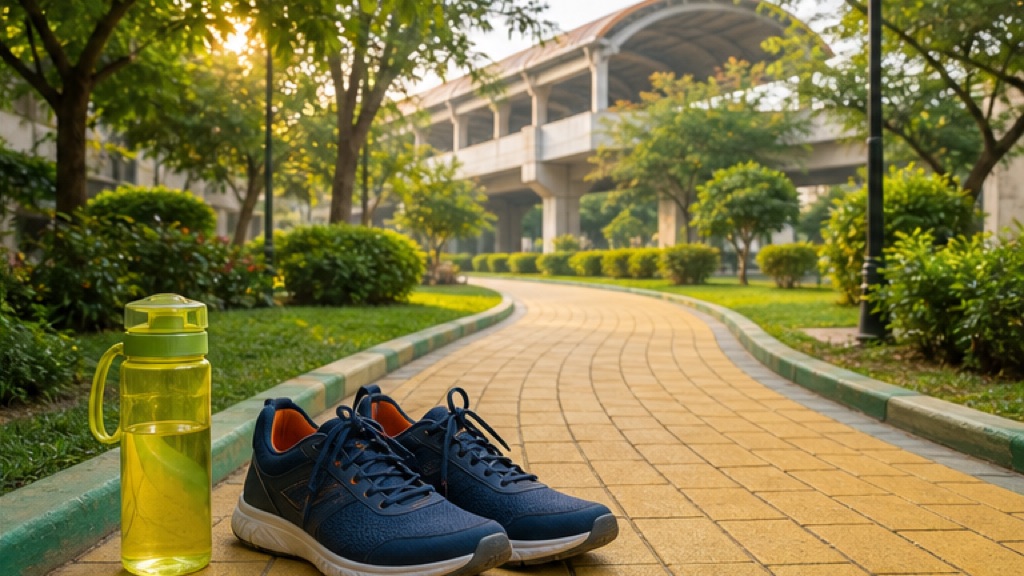
- Wear any comfortable shoes. You do not need special walking shoes to start. You need to start.
- Carry water in summer, walk in shade where you can. Heat does not burn more fat, it just tires you faster and cuts your walk short.
- If you want a bit more, add a gentle slope or a 5 kg backpack. Small bonus, not the main event.
The bottom line
Walking gives you about 0.5 kcal per kg per km, so a 70 kg person burns roughly 35 extra kcal per kilometre, about 300 kcal for 8-9 km, and about 100 kcal for a 30-40 minute walk. Pace barely changes the per-km number; slope and a backpack add a little. The big, honest win is that walking is free, gentle on joints, and you can do it every single day without willpower or equipment. That sustainability matters more than any metabolic trick. Log your food in Burnie, see your deficit, and let a daily walk widen that deficit slowly and steadily. That is the whole plan.