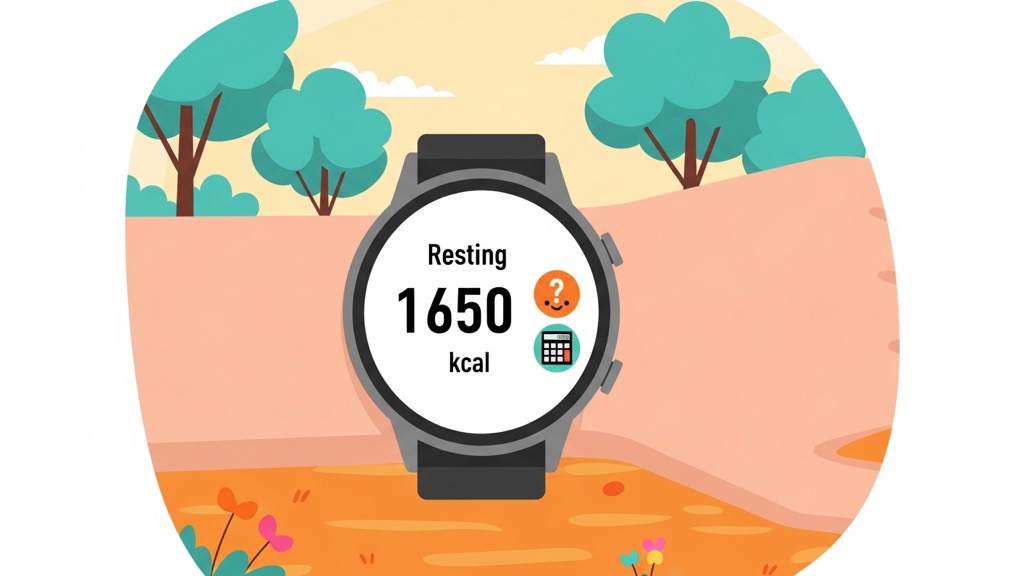
What your smartwatch calls your BMR (and why it is a guess)
Your smartwatch shows a big 'resting calories' number and calls it your BMR. That number is not measured by your pulse. It is a formula guess made from your age, weight, height, and sex. Here is why it wobbles and how to use it well.
You tap your watch. It says 'Resting calories: 1,650.' That looks like a fact your body handed to the watch. It is not. Your watch did not measure those calories. It guessed them from a maths formula. This short read explains what that big number really is. It also shows why two friends the same weight can see very different resting numbers on their wrists.
Your watch's resting number is a formula, not a measurement
Scientists call this number your resting energy expenditure, or REE for short. It is a big deal, because resting energy is about 60 to 70 percent of all the calories you burn in a day. So this one number moves your weight maths the most. But the watch does not catch your calories with a sensor. It uses a predictive equation. That means a maths formula built from people like you, on average. The famous ones have names you may see online: Mifflin-St Jeor, Harris-Benedict, and the WHO equation. Each one takes your weight, height, age, and sex, then gives back a number. The only true way to measure REE is a lab machine called indirect calorimetry. It reads the oxygen you breathe in and the carbon dioxide you breathe out. Your watch cannot do that.
My watch measures my resting calories from my heartbeat.
mostly falsemostly false
Your heartbeat is not part of the resting formula. The standard resting equations take your weight, height, age, and sex. Pulse is not on that list. The watch's optical heart-rate sensor is used more for the active calorie guess, which is even looser than the resting one. What the watch does measure well is movement. Its accelerometer (a tiny motion sensor) counts your steps and motion. That is great for activity, but movement is not rest. So the big 'resting' number on your wrist is a formula estimate, not a heartbeat measurement. Burnie, by the way, never reads your heart rate, sleep, blood pressure, or location at all.
Where your watch's three calorie numbers come from
How to use the resting number wisely
The bottom line
Your smartwatch calls its big number your BMR, but it did not measure it. It used a formula built from your weight, height, age, and sex. Resting burn is about 60 to 70 percent of your whole day, so the guess matters, but it is still a guess. Burnie keeps the maths clean: food calories minus (your BMR plus active calories) equals your deficit. Burnie never reads your heart rate, and it is free. Start with the estimate, watch your weight trend for two weeks, and tune from there.