
The short answer
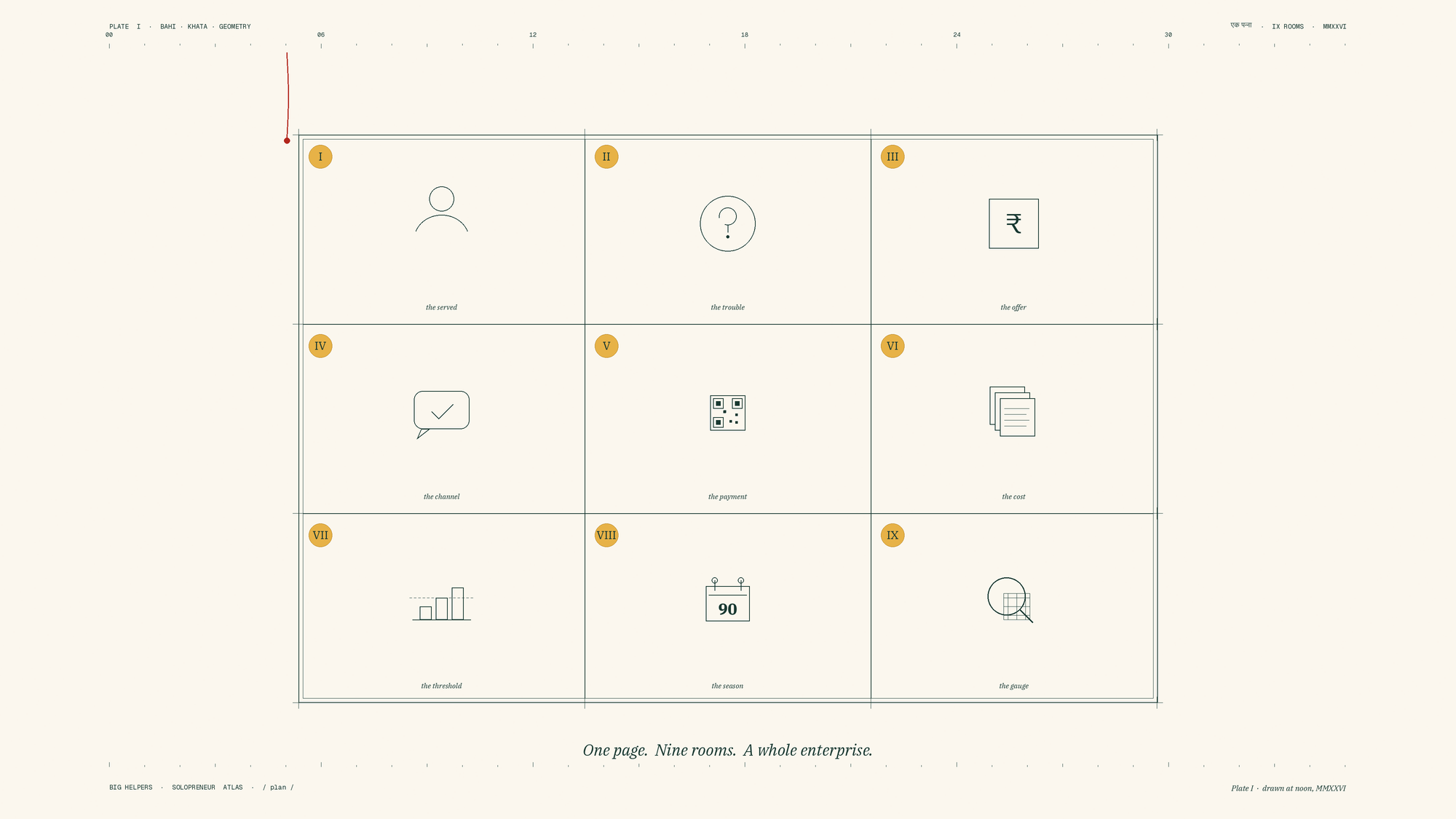
Your business plan is nine boxes on one page. In order:
- Who do I serve? Two sentences.
- What problem? Plain language.
- What do I sell — and at what price? GST-inclusive.
- How do they find me? One or two channels you can post on weekly.
- How do they pay? UPI, card, bank, or cash.
- What does it cost me each month? Rent, raw material, marketing, subscriptions, tax.
- Break-even number. How many units before I'm in profit.
- One 90-day milestone. One number, one date.
- One weekly metric. The number I check every Saturday.
Write it on paper. Stick it on the wall. That's the plan.
Why a 30-page plan doesn't work for solopreneurs
The template you see when you search "business plan India" was built for a different kind of business. It assumes a founding team, an investor reading it, a five-year horizon, and someone — usually an MBA intern — who has time to write a SWOT analysis nobody will ever open again.
That's not your life. You are one person. You are the salesperson, the delivery person, the accountant, the marketing department, and the one who answers the WhatsApp at 9:30 PM. You don't need a plan that explains your business to strangers. You need a plan that helps you decide what to do tomorrow morning.
So we cut. We cut the executive summary (you don't need one — there's no executive). We cut the competitor matrix (you already know who you're competing against). We cut the five-year revenue forecast (it's a guess, and yours won't be more accurate than anyone else's). What's left is nine honest answers to nine honest questions. That's the plan.
The nine boxes
Who do I serve?
the servedWrite it as if you were telling a friend. Not "small businesses in India" — that's a marketing presentation. Try: "Working mothers in Indore who buy birthday cakes for their kids and want eggless options because their parents are vegetarian."
If you can't name them in two sentences, you don't know them yet. That is your first job — not making the product, not building the website. Going and finding ten of them.
What problem am I solving?
the troubleState it in Hindi or English — whichever language you actually think in. Don't dress it up. "The bakeries near her don't deliver, and the ones that deliver use eggs in everything." That's a problem. "Holistic celebration solutions" is not.
If the problem doesn't make someone in your customer's life sigh in recognition, the plan won't survive contact with reality.
What do I sell — and at what price?
the offerOne to three offers. No more. List each one with its GST-inclusive price. If you're under the ₹40 lakh threshold and not voluntarily registered, write "no GST" — but write it down. Money clarity beats money optimism every time.
- Standard 500g cake — ₹650 (no GST, under threshold)
- 1kg custom cake — ₹1,300
- Birthday-party bundle (cake + 12 cupcakes + delivery) — ₹2,400
How do they find me?
the channelPick one — at most two — channels you can actually post on every week. Most solopreneurs lose the first six months trying to be on Instagram, Facebook, YouTube, WhatsApp, LinkedIn, and Google Maps at the same time. The honest answer is usually: one of these, done well, beats all of them done badly.
For most Indian solo businesses serving a local geography, the answer is WhatsApp + Google Business Profile. For creators with national audience, Instagram + one newsletter. Pick yours. Write it down. Don't add a third for at least 90 days.
How do they pay?
the paymentUPI is almost always the right answer in India in 2026 — it costs you nothing, it settles instantly, and your customer already has it on their phone. But decide today whether the QR sits on a paper printout, in your WhatsApp profile, or inside an app, and decide who owns the bank account it goes to.
If you take card or net banking too, you'll need a payment gateway — see our Razorpay vs PayU vs Cashfree comparison for the trade-offs.
What does it cost me each month?
the costAdd up everything — rent, raw material, packaging, fuel, the WhatsApp Business number, the Canva subscription, the accountant once a quarter divided by three. If you work from home, add an honest number for electricity and gas.
Then add 15% — for the things you forgot. There are always things you forgot.
The break-even number
the thresholdTake your monthly cost. Divide by the profit you make on one unit (price minus material cost). That's how many units you must sell every month to not lose money. Round up.
If the number scares you, the plan is doing its job. Better to know in May than in October.
The 90-day milestone
the seasonOne number, one date. Not five. Not "grow the business" — that's not a milestone, that's an attitude.
Examples: "By 25 August, I will have served 40 paying customers." Or: "By 25 August, I will have ₹60,000 in collected revenue." Pick the one you can count without arguing with yourself.
The weekly metric
the gaugeOne number you look at every Saturday morning, before you do anything else. For most product businesses it's units sold this week. For services it's new conversations started. For repeat businesses it's customers who came back.
The point isn't the number. The point is the ritual. Solopreneurs who don't look fail slowly without realising. Solopreneurs who do look adjust early enough to matter.
A worked example: Priya's home bakery, Indore
Nine boxes, one Sunday evening, real numbers
| Box | Priya's answer |
|---|---|
| I — Who | Working mothers in Vijay Nagar with kids under 12, who want eggless cakes for birthdays. |
| II — Problem | Local bakeries use eggs and don't deliver. Eggless options at the big shops taste like cardboard. |
| III — Offer | 500g cake ₹650 · 1kg ₹1,300 · party bundle ₹2,400. No GST (under threshold). |
| IV — Channel | WhatsApp Business + Google Business Profile pinned to her home address. |
| V — Payment | UPI QR printed on the cake-box receipt; bank account in her own name. |
| VI — Monthly cost | ₹14,500 |
| VII — Break-even | ₹14,500 ÷ ₹420 margin per cake = 35 cakes / month |
| VIII — 90-day milestone | By 26 August: 60 paying customers served. |
| IX — Weekly metric | Saturday morning: cakes delivered this week. |
Priya didn't write a 30-page plan. She wrote nine answers on one page and stuck it inside the kitchen cupboard. Six months later, she's at 48 cakes a month and just hired her sister-in-law to handle deliveries on weekends.
The free template
One page, A4, ready to print and write into by hand — the way it works best.
You've planned it. Now run it.
The nine boxes tell you what your business is. BusinessSetu is the phone app that helps you run it — leads (box IV), invoices and GST (box III), UPI payment links (box V), expenses (box VI), break-even and revenue dashboards (box VII), 90-day milestone tracking (box VIII), and a weekly summary every Saturday morning (box IX).
Frequently asked
Do I need a CA to write this?
No. The one-page plan is for you, not for the tax office. A CA is invaluable when you file GST or income tax. For planning, your own hand is enough — in fact, it's better, because you understand your own numbers more honestly than anyone else will.
Is a one-page plan enough for a bank loan?
For a Mudra loan, opening a current account, or a small overdraft — usually yes, when combined with bank statements and Udyam registration. For a working-capital loan above ₹10 lakh, banks generally ask for a 3-year projection. You can write that later; the nine boxes are the foundation it sits on.
How is this different from a Lean Canvas?
The Lean Canvas was built for venture-backed startups looking for product-market fit. The nine-box plan is tuned for Indian solopreneurs running real businesses — it bakes in UPI, GST, WhatsApp, and the fact that you don't have a co-founder to argue with about the customer segment.
What about Udyam registration?
Udyam takes about ten minutes online and is free. You can do it before or after writing your one-page plan — it isn't a planning document, it's a registration. We recommend doing it once you've decided box III (what you sell), because Udyam asks for your NIC industry code.
Can I write this in Hindi or a regional language?
Yes — and you probably should. The plan is for you. Write it in the language you do your mental maths in. Our PDF template is bilingual (Hindi + English) for exactly this reason.
How often should I redo it?
Once a quarter is plenty. If you find yourself rewriting it every week, the issue isn't the plan — it's that you're not sure what business you're in yet. That's fine; the next step is more conversations with the people in box I, not a fresh template.