
In brief
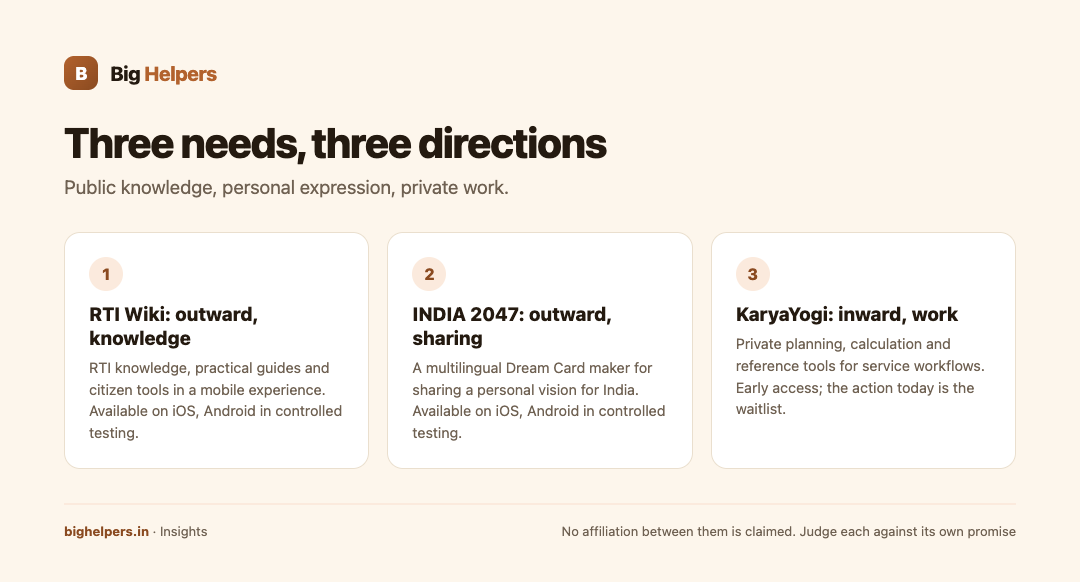
Three Big Helpers apps sit near civic life and service work, and people mix them up: RTI Wiki, INDIA 2047 and KaryaYogi. They answer three genuinely different needs. RTI Wiki serves citizens seeking public information. INDIA 2047 serves individuals who want to express a personal vision for the country's centenary year. KaryaYogi serves people doing service work who need private planning and calculation tools. As of 29 August 2026, RTI Wiki and INDIA 2047 are "Available on iOS. Android is in controlled testing." KaryaYogi is "Early access. The app remains in testing and review lanes."

Need one: "I want reliable public information"
RTI Wiki is described as "RTI knowledge, practical guides and citizen tools in a mobile experience." The audience is the citizen facing a public office: someone drafting a Right to Information request, checking how an appeal works, or learning what a public authority must disclose. The need is informational and the material is public by nature: laws, rules, procedures and guides.
Two things make this need distinct. First, quality matters more than volume; a citizen needs guides that reflect what the law and offices actually require, which is why the RTI Wiki project invests in practical guides rather than scattered snippets. Second, neutrality is structural here. Information about a legal right should explain the process the same way regardless of who is asking, and a knowledge base serves its readers best when it informs rather than campaigns.
Status: "Available on iOS. Android is in controlled testing."
Need two: "I want to express my idea for India's future"
INDIA 2047 is described as "A multilingual Dream Card maker for sharing a personal vision for India." The audience is the individual with something to say: a student, a professional, a retired teacher, anyone who wants to put their hope for 2047 into a card they can share, in their own language.
This need is expressive, not informational. Where RTI Wiki answers "how does the process work?", INDIA 2047 answers "what do I want to say?" The multilingual design matters because a vision in your mother tongue carries a sincerity that English cannot substitute for.
One boundary deserves care. A personal vision is personal: it belongs to the person making the card, and the tool's job is expression, not persuasion at scale. This guide therefore treats INDIA 2047 as a creative and civic-expression tool, not a campaign instrument, and makes no claim about any official, governmental or organisational affiliation for the app. None exists in its published description.
Status: "Available on iOS. Android is in controlled testing."
Need three: "I need quiet tools for my service work"
KaryaYogi is described as "Private planning, calculation and reference tools for service workflows." The audience is the working professional doing service work: planning tasks, running calculations, checking reference material, often with client details in play. The need is operational and the word that carries the description is private.
This need differs from the first two in direction. RTI Wiki faces outward, toward public knowledge. INDIA 2047 faces outward, toward public sharing. KaryaYogi faces inward, toward your own workflow and the discretion it requires. That is why its early-access state matters more here: the product is still being shaped with a small group, and joining the waitlist is the way to take part.
Status: "Early access. The app remains in testing and review lanes."
Comparison table
| Dimension | RTI Wiki | INDIA 2047 | KaryaYogi |
|---|---|---|---|
| Core need | Public information about RTI | Personal expression for India's centenary | Private service-workflow tools |
| Portfolio wording | "RTI knowledge, practical guides and citizen tools in a mobile experience" | "A multilingual Dream Card maker for sharing a personal vision for India" | "Private planning, calculation and reference tools for service workflows" |
| Direction | Outward, knowledge | Outward, sharing | Inward, work |
| Typical user | Citizen interacting with public offices | Individual with a vision to share | Professional in service work |
| Data posture implied | Public knowledge base | Personal creation made for sharing | Private by stated design |
| Availability | Available on iOS. Android is in controlled testing. | Available on iOS. Android is in controlled testing. | Early access. The app remains in testing and review lanes. |
| Action today | App Store link | App Store link | Waitlist |
Choosing between them
Ask which sentence sounds like yours.
"I need to know how to file or appeal." That is RTI Wiki. Install it if you use an iPhone; watch the portfolio page for Android if you do not.
"I have something to say about 2047 and want it in my language." That is INDIA 2047.
"My day is planning, calculations and reference material, and it should stay mine." That is KaryaYogi, and today the action is joining its waitlist.
If your answer is "none of these, my team needs a custom tool for our workflow", that is not an app purchase at all; it is the services conversation, and for public-sector teams our government and PSU page addresses that context directly.
A note on neutrality across the three
The three apps sit on different points of the public-private line, and honesty about that line is the cleanest way to keep trust. RTI Wiki's value depends on explaining a legal right even-handedly. INDIA 2047's value depends on enabling expression without pushing any particular vision; the app's published description speaks of a personal vision, and this guide adds no political framing to it. KaryaYogi's value depends on keeping your working material private. Readers should hold each product to its own promise, not to a blended one.
Your next step
Decide which of the three sentences above is yours, open the apps page, and take exactly one action: install RTI Wiki or INDIA 2047 from their App Store links, or join the KaryaYogi waitlist after reading the waitlist privacy notice.
Disclosure: RTI Wiki, INDIA 2047 and KaryaYogi are Big Helpers products. This guide separates their purposes deliberately and adds no affiliation, endorsement or political claim.
Frequently asked questions
Are the three apps connected?
No connection between them is documented on the portfolio page. They are separate products for separate needs.
Is INDIA 2047 a government or political app?
Its published description is "A multilingual Dream Card maker for sharing a personal vision for India." No government, political or organisational affiliation is claimed anywhere in it, and none should be assumed.
Can KaryaYogi be installed today?
No. Its exact status is "Early access. The app remains in testing and review lanes." The current action is the waitlist.
Does RTI Wiki replace legal advice?
It is described as knowledge, practical guides and citizen tools. Guides help citizens act; they are not a substitute for advice on a specific contested matter.
Which of the three should a working professional pick?
If the need is private planning and calculation for service work, KaryaYogi is the fit. If the need is RTI information for a personal matter, RTI Wiki serves that need regardless of profession.
How do I track their Android releases?
Watch the portfolio page, which carries a dated availability check line, currently 29 August 2026.
Sources & references
- Big Helpers app portfolio page, bighelpers.in/apps/ (app descriptions and status labels, 29 August 2026)
- Big Helpers App Waitlist Privacy Notice, bighelpers.in/apps/privacy/
Pricing in this guide is verified as of the article date. Verify with vendors before committing budget — rates change quarterly.