
The short answer
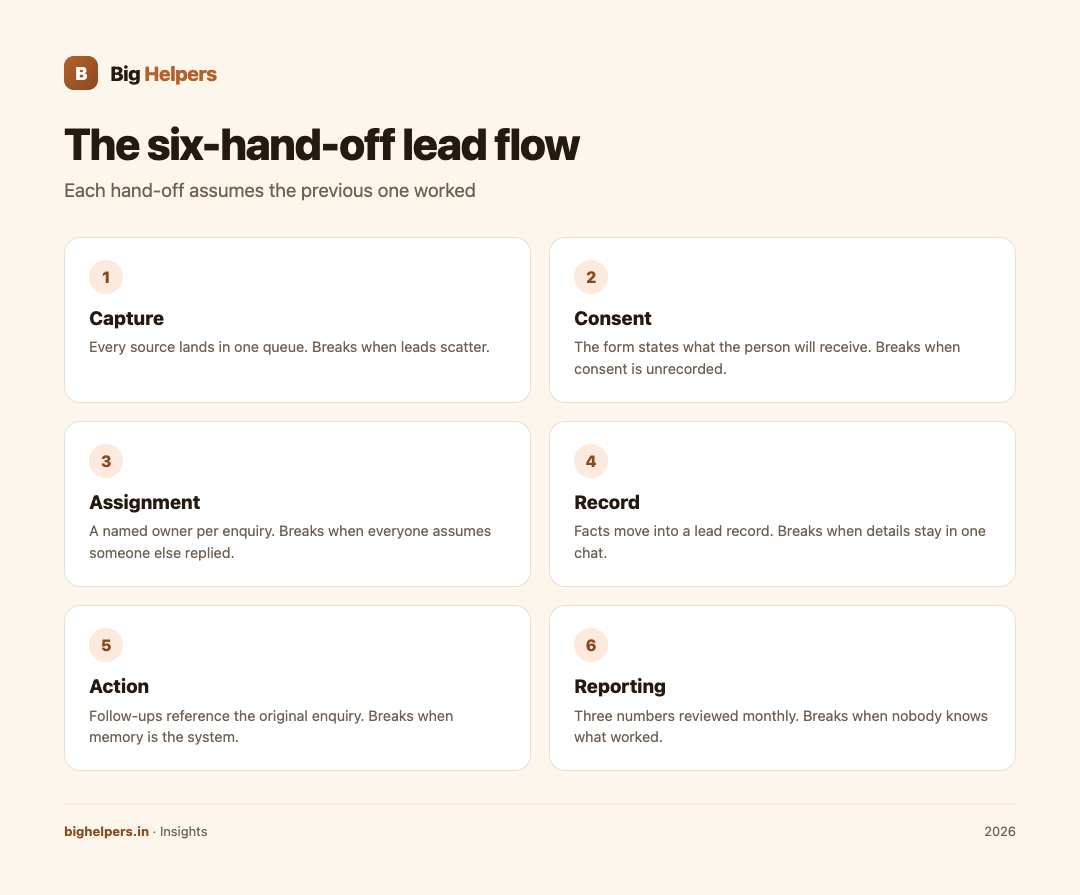
A lead flow is a chain of six hand-offs: capture, consent, assignment, record, action and reporting. Most enquiries are lost at hand-off two or three, not because the website is weak but because nobody was assigned and nothing was recorded. Design the chain end to end, make each hand-off a named step with an owner, and every enquiry either becomes a conversation or a documented no. One boundary holds throughout: follow-up means answering and helping people who contacted you, never messaging people who have not.
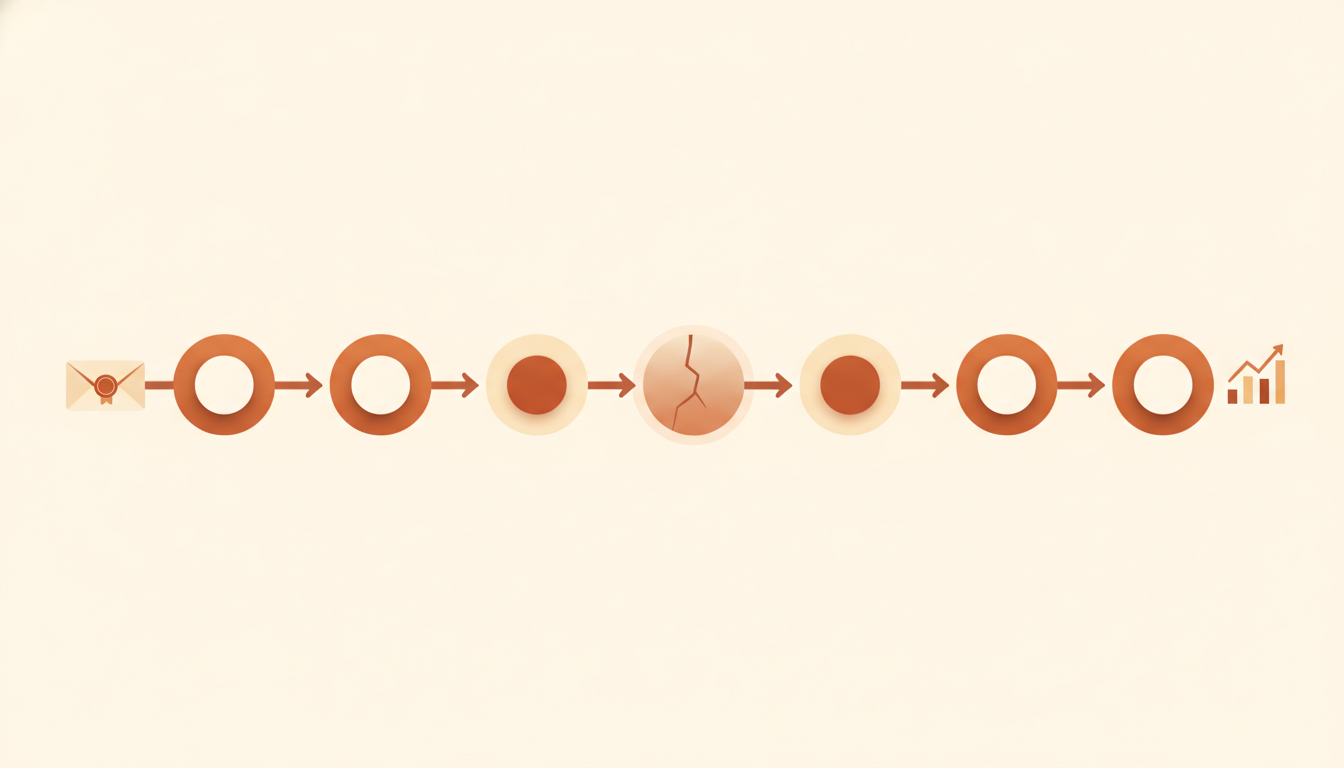
The chain at a glance
| Hand-off | What moves | What breaks |
|---|---|---|
| 1 Capture | Visitor becomes an enquiry | No single destination; leads scatter |
| 2 Consent | Enquiry becomes a permitted contact | Consent not asked or not recorded |
| 3 Assignment | Enquiry gets an owner | Everyone assumes someone else replied |
| 4 Record | Conversation becomes data | Details stay in one person's chat |
| 5 Action | Record becomes a next step | Follow-up depends on memory |
| 6 Reporting | Steps become a number | Nobody knows what worked |
Work through them in order; each assumes the previous one worked.
Hand-off 1: Capture
Every lead source needs one destination. List yours honestly: website form, phone call, WhatsApp click-to-chat, Instagram DM, IndiaMART, walk-in, referral. Seven sources feeding seven inboxes is not a lead flow, it is a lottery.
Two design rules fix capture cheaply:
- One form, few fields. Name, phone, and one qualifying line. Every extra field costs completions, and a phone number plus intent is enough to start a conversation.
- Every source points to the same place. The website form, the ad landing page and your directory listings should all deliver into the same queue, so nothing arrives exclusively in a personal chat.
The form should also state, next to the submit button, what the person is agreeing to receive. That sentence does double duty, which is the next hand-off.
If your site does not yet have a working form that reaches anyone, that is the first build, and it is a small one; the web development service covers exactly this layer with a published range.
Hand-off 2: Consent
Consent is not a legal nicety in this flow; it is the difference between follow-up and spam. Record two things at capture: what the person asked about, and what they agreed to receive.
Practical consent for a small business is a checkbox or a clear sentence: "We will reply on WhatsApp about your enquiry." That covers replies about this enquiry. It does not cover marketing broadcasts next quarter, and it should not be stretched to.
For anything beyond replying to the person who wrote in, use the re-permissioning route: ask, in a normal conversation, whether they would like updates, and record the yes. Bulk importing a contact list and messaging it is the fastest way to lose a WhatsApp Business number, and the rules around business-initiated messaging, including template approval and opt-in requirements, are set out in detail in the WhatsApp Business API setup guide.
Meta's own WhatsApp Business Platform documentation positions business-initiated messaging around categories such as order confirmations, shipping updates and appointment reminders, which is a useful mental model: notifications a customer expects, not broadcasts a business wants. The platform pages are here for reference.
Hand-off 3: Assignment
An enquiry with no owner is a lead with a countdown timer. Assignment answers one question within minutes: who is replying?
Keep it dull and explicit:
- A named owner for every enquiry, visible to everyone.
- A response expectation, even a loose one such as "same working day".
- A visible exception when the owner is unavailable, so cover is real rather than theoretical.
At small scale this can be a shared list with initials beside each row. The mechanism matters less than the visibility. The failure mode this hand-off prevents is the silent one, where the enquiry was seen by two people and answered by neither.
Hand-off 4: Record
The conversation becomes data. After each exchange, four things should exist somewhere durable: who the lead is, what they asked for, what was quoted or promised, and what happens next.
This is the hand-off where WhatsApp-as-channel and WhatsApp-as-record diverge. Keep chatting on WhatsApp, which is where your customers are, but treat the chat as the conversation layer and write the facts into a lead record. BusinessSetu Pro models this directly: leads sit on a board with stages, source, value, notes and a next follow-up date, and WhatsApp opens from the lead's context, as described on the use-cases page. The chat stays human; the record keeps the truth.
Hand-off 5: Action
A record exists so that follow-up can be scheduled rather than remembered. Each lead record should carry one date: when this lead gets its next touch.
Build your follow-up rules around three moments:
- No reply. One polite follow-up after two or three days, referencing the original enquiry.
- Quote sent. A check-in a few days after, asking whether the quote fits.
- Went quiet. A final note, then a clean close with the door open.
Keep the writing human and specific, referencing what the person actually asked. A follow-up message that could have been sent to anyone should not be sent to anyone.
A 22-broker real estate firm illustrates what this hand-off looks like at scale: enquiries from Meta ads, property portals and walk-ins arrived in different places until they were unified into one WhatsApp-connected inbox with a single record per lead. The case study describes how the consolidation worked.
Hand-off 6: Reporting
Reporting closes the loop by answering three questions monthly:
- How many enquiries arrived, from which source?
- How many received a reply within our expectation?
- How many became quoted, won or cleanly closed?
Three numbers, one page. Anything more elaborate belongs to a later phase, once the chain itself holds together. The purpose of this reporting is not analysis; it is to tell you which hand-off to fix next, because the stage with the biggest drop is always the one worth repairing.
The whole flow on one page
- Every source lands in one queue.
- The form states what the person will receive.
- Every enquiry gets a named owner the same day.
- Facts move into a lead record with a next-action date.
- Follow-ups reference the original enquiry, never generic blasts.
- Three numbers are reviewed monthly and point to the weakest hand-off.
Print that list and check your own flow against it. Most businesses find two broken hand-offs in under ten minutes.
Common mistakes
- Buying automation before assignment exists. Automatic distribution into a team that does not reply just accelerates silence.
- Treating consent as a one-time blanket yes.
- Letting quotes live in chat only, so nobody can see what is outstanding.
- Writing the flow for the leads you hope for instead of the volume you have.
- Never closing a lead. An untidy list of forever-open leads stops being usable within a quarter.
- Confusing responsiveness with persistence. Two thoughtful follow-ups beat six nudges.
Frequently asked questions
Do I need the WhatsApp Business API for this flow?
For replying to people who wrote in, your own WhatsApp is enough, ideally with the free WhatsApp Business app for a proper profile and quick replies. The API matters when volume, multiple agents or automated notifications enter the picture. The setup guide covers the comparison and the costs.
Can I follow up with someone who filled my form?
Yes, that is the core of this flow: reply about what they asked. Keep the follow-up tied to their enquiry, and record what they consented to at capture.
How many follow-ups are appropriate?
Two or three touches tied to the original enquiry, then a courteous close. Past that, follow-up becomes pressure and pressure loses customers.
What is the cheapest first fix for a broken lead flow?
Usually hand-offs 3 and 4: a shared list with owners and next-action dates. It costs nothing and reveals whether software is even needed.
Where does a CRM fit?
At hand-offs 4, 5 and 6, once volume makes a shared list strain. A WhatsApp-connected CRM keeps the conversation in WhatsApp while the record, actions and reporting live in one place; see the WhatsApp CRM service for that pattern.
Should the lead flow send reminders about unpaid bills too?
Collections follow the same chain with the same consent logic, and it is usually the easier flow to fix first because the relationship already exists. Just keep reminders factual: bill number, amount, and how to pay.
Your next step
Walk your own chain this week: submit a test enquiry on your own website and see what happens at each of the six hand-offs. Whatever breaks first is your first fix. If the break is on the website side or in connecting WhatsApp conversations to proper records, Big Helpers builds both layers, with published INR ranges and a free 20-minute call to map your flow before anything is quoted.
Sources & references
- Web development service: the capture layer with a published range.
- WhatsApp CRM service: chat in WhatsApp, records in one place.
- WhatsApp Business API setup guide: opt-in, template approval and cost detail.
- Case study: WhatsApp lead management: the 22-broker real estate example.
- BusinessSetu use cases: lead board with stages, value and next follow-up.
- Meta WhatsApp Business Platform documentation: business-initiated messaging categories.
Pricing in this guide is verified as of the article date. Verify with vendors before committing budget — rates change quarterly.