
Quick answer
A gate pass is proof that a specific person or item was expected, allowed in, and allowed out. Guests need resident approval, deliveries need a resident reference, service staff need a schedule or job description, and move-in or move-out needs office-level verification with an item list. Each pass should carry the minimum identifying detail, an authorising resident or office action, and a validity window.

What a pass actually is
Think of a gate pass as three facts bound together: who or what is passing, who authorised it, and when it expires. Whether the pass is a paper slip, a QR code, or a register line, those three facts do all the work. Everything else on the slip is either convenience or over-collection.
Four scenarios, four different passes
1. Guest passes
A guest arrives because a resident wants them there. The pass rests on the resident's approval: live, by call or app, or pre-registered earlier in the day. The guard verifies the guest against the expectation, notes the flat, and marks entry and exit. The data is minimal: name, phone, flat, time. Guests should not be asked for identity documents; the resident's invitation is the authority.
2. Delivery passes
Couriers, food delivery and grocery riders pass many times a day. The useful reference is the resident's order: a flat number and a one-time code or the resident's confirmation. The rider's personal details belong to the platform that employs him; the society needs the company, the flat and the time. Peak-hour discipline matters most here: a delivery pass should take seconds, because a queue of riders is the most common gate failure in Indian apartments.
3. Service and maintenance passes
This covers plumbers, electricians, carpenters, technicians sent by brands, and domestic staff. Two sub-cases differ:
- Resident-arranged work. The flat's resident raises the pass with a short job description ("AC service, 4 to 6 pm"). The guard checks the person against that expectation.
- Society-arranged work. Lift maintenance, generator servicing or painting in common areas is authorised by the office, often as a recurring pass for a team, with a supervisor's name and a validity period.
Daily domestic staff deserve a special mention: they should move to a standing, month-level list after the first visit, not queue for a fresh pass every morning.
4. Move-in and move-out passes
Shifting homes is the highest-stakes pass at any gate, and it is verified by the society office, not by the resident alone. Standard practice includes: written intimation to the office with dates; clearance of maintenance dues; an item list for furniture and large goods; a lift booking with protective padding; and a gate pass checked both ways, on the way in for a move-in and on the way out for a move-out. Because items, not people, are the focus, the pass should describe the consignment, the flat, the transporter and the authorised resident. This article describes the pass types societies commonly run; the exact rules are set by each society's own bye-laws and office.
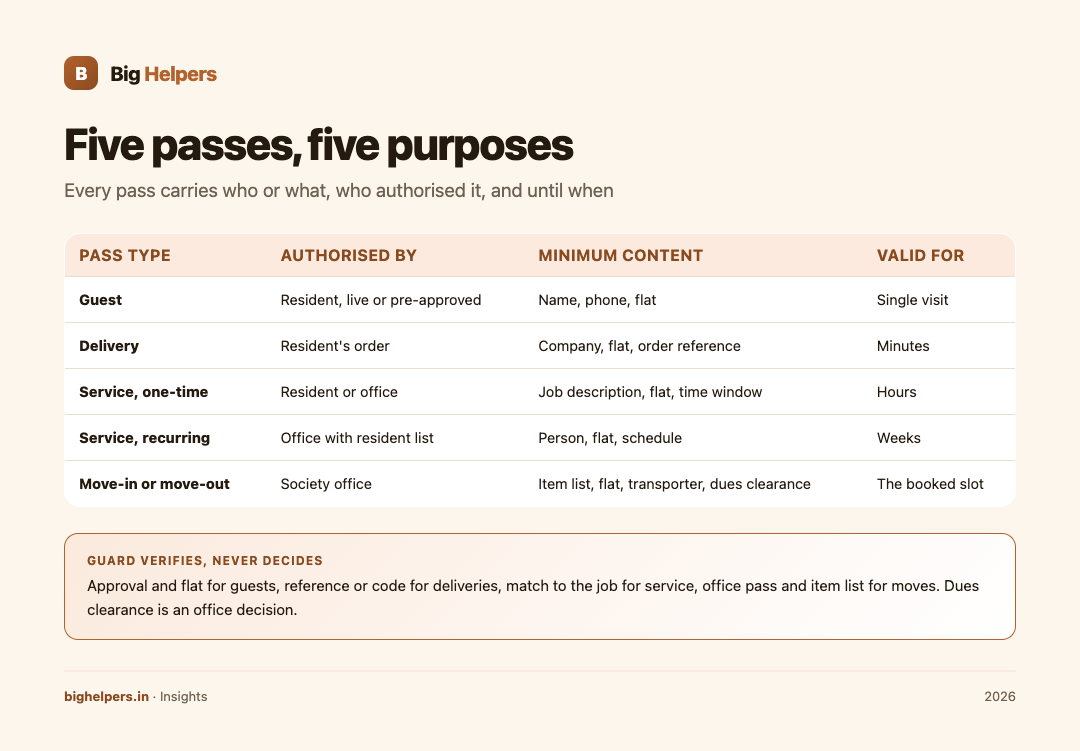
The comparison table
| Pass type | Authorised by | Minimum content | Validity | Guard verifies |
|---|---|---|---|---|
| Guest | Resident, live or pre-approved | Name, phone, flat | Single visit | Approval and flat |
| Delivery | Resident's order | Company, flat, order reference | Minutes | Reference or code |
| Service, one-time | Resident or office | Job description, flat, time window | Hours | Match to the job |
| Service, recurring | Office with resident list | Person, flat, schedule | Weeks | Standing list |
| Move-in or move-out | Society office | Item list, flat, transporter, dues clearance | The booked slot | Office pass and list |
Where Agman fits, and where it does not
Agman by Big Helpers covers residential society and visitor workflows. Its store listing confirms, for residents, approval of visitors in real time, pre-approval of expected guests, a rotating signed gate pass, and management of family members and vehicles. At the gate, the listing confirms recording of visitors, couriers and temporary passes, and verification of signed gate passes even when the network is unavailable. Office bearers can map blocks, floors and flats, import a resident roster, manage guards and review society and gate MIS.
The listing does not describe move-in or move-out passes, item lists or dues clearance, so do not assume those exist in the app. For shifting day, the society office's own procedure and paperwork remain the authority, with Agman's temporary-pass recording available for the people involved. Agman is available on iOS. Android is in controlled testing. Related guides for community offices sit in the insights library.
Common mistakes
- One pass format for everything. Guests and goods are different problems; a single over-stuffed slip serves neither.
- Asking guests for identity cards. The resident's approval is the authorisation; a photocopy of a guest's Aadhaar adds risk, not security.
- No validity window. A pass that never expires becomes a permanent key.
- Exit passes skipped for goods. Items leave buildings too. A move-out without a checked item list is how disputes about damage and theft start.
- Blocking daily helpers behind fresh passes. Standing lists are safer and faster than daily interrogation.
- Guard judgement on office matters. Dues clearance and move-out approvals are office decisions. Guards should verify, not decide.
One next step
Classify your society's passes into the four types this week and check each slip for the three essentials: who or what, who authorised, and until when. Agman's verified gate-pass features and its current status are listed on the Big Helpers apps page.
Frequently asked questions
What should a resident do before a guest arrives?
Send a pre-approval if your society's tool supports it, or simply tell the guard the name and time window. Pre-approval removes the queue and the missed call.
Do delivery riders need to sign the visitor register?
Only the minimum: company, flat and time. The order reference or code from the resident replaces any personal interview.
How are recurring staff passes renewed?
By a short monthly review: the resident confirms the person still works for the flat, and the office refreshes the list. A dated refresh keeps the standing list honest.
Who owns the move-out item check?
The society office, with the resident present. The list is signed at the gate on the way out, so both sides hold the same record.
What happens when a pass is presented offline, with no network?
Agman's listing notes that signed gate passes can be verified even when the network is unavailable. For paper systems, the printed pass and the office register serve the same role.
How long should pass records be kept?
Routine entries for weeks; move-in and move-out records longer, since they relate to property handover. Your society's bye-laws and any legal advice take precedence over any general norm.
General guidance on society practice, not legal advice. Each society's bye-laws and office decisions govern its own gate rules.
Sources & references
- Big Helpers apps page, store availability checked 29 August 2026
- Agman App Store listing, official Apple iTunes metadata (id6794254109)
Pricing in this guide is verified as of the article date. Verify with vendors before committing budget — rates change quarterly.