
Quick answer
Record only what a payroll or emergency genuinely needs: attendance, pay, and one phone number for emergencies. Skip identity photocopies, family details and photos unless there is a real, stated reason. Store the record in one place with an access control, tell the worker what you keep, and delete what you no longer need. Collecting less is the strongest privacy protection a household can practise.
Why a kitchen drawer of photocopies is a liability
Many households keep a folder of their helpers' Aadhaar photocopies, photographs, address proofs and reference letters "just in case". The folder sits in a drawer, or in a phone gallery, for years after the reason has passed. If it leaks, is photographed by a visitor, or travels with a lost phone, the person harmed is the worker, not the household. India's Digital Personal Data Protection Act, 2023 pushes organisations to collect only what a stated purpose needs, to protect it with reasonable safeguards, and to erase it when the purpose is served. A household is not a company, but the principle travels well: purpose first, minimum data, then protection and deletion.
The keep-skip matrix
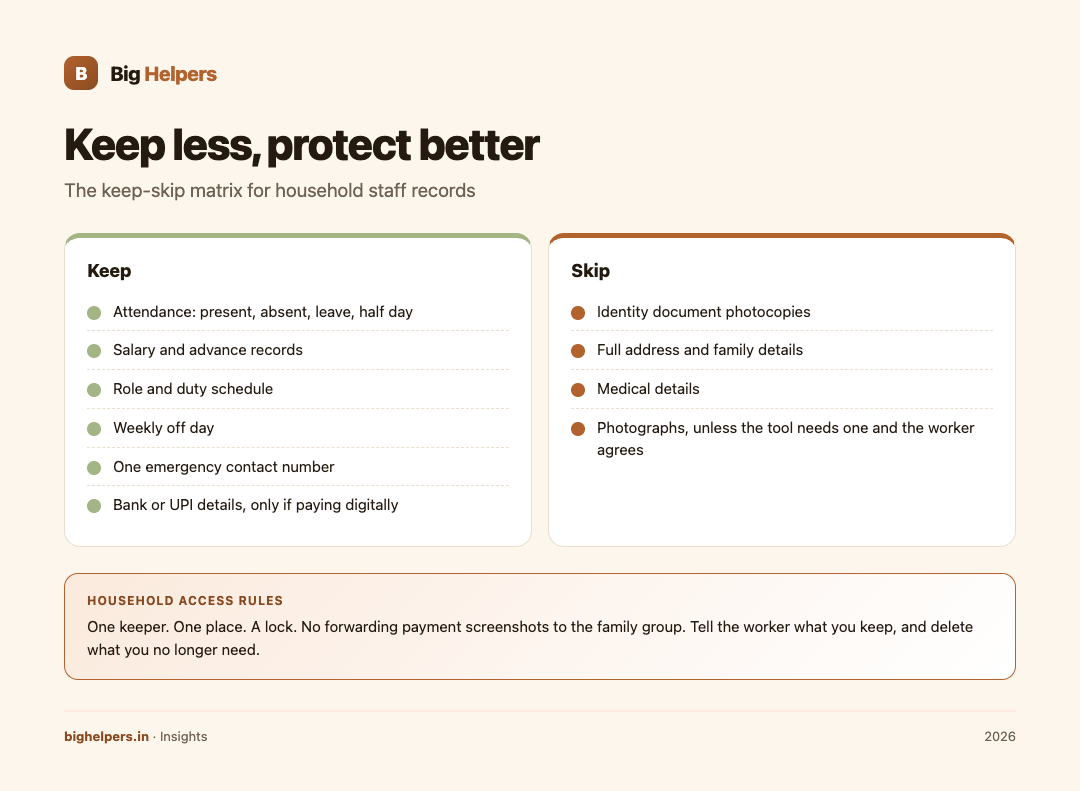
Work through each field your household actually uses. The test is simple: can you name the purpose, and would the worker agree the purpose is reasonable?
| Field | Keep? | Purpose it serves | Handling note |
|---|---|---|---|
| Attendance (present, absent, leave, half day) | Yes | Fair pay settlement | Keep 1 to 2 years |
| Salary and advance records | Yes | Proof of payment, dispute resolution | Keep 1 to 2 years |
| Role and duty schedule | Yes | Clarity on the work agreed | Update when duties change |
| Weekly off day | Yes | Scheduling and leave fairness | Part of the agreement note |
| Emergency contact number | Yes | Reaching family in a genuine emergency | One number is enough |
| Own phone number | Optional | Routine coordination | Ask, do not insist |
| Bank or UPI details | Optional | Only if paying digitally | Store where payments are made, not in chat history |
| Identity document copies | Skip unless a stated purpose requires | Rare for households | If truly needed, note the reason and a return date |
| Full address and family details | Skip | No household purpose | Emergencies need a phone, not a family tree |
| Photographs | Optional | Recognition inside one app | Consent first; never for monitoring |
| Medical details | Skip | Not yours to store | Respect confidentiality; keep only what the worker volunteers for emergencies |
Two patterns stand out. First, the fields that matter for money are few: attendance, pay, one contact. Second, the risky fields, identity copies and family details, rarely serve the household at all. When a society or an employer of the helper genuinely needs a document, the worker can show it herself at that moment, rather than leaving a copy in your drawer.
Access controls a household can actually apply
- One keeper. Name one person who maintains the record. Others in the family may see summaries, not the full file.
- One place. A single app or a single notebook. Scattered notes in three chat groups are how private numbers end up everywhere.
- A lock. A phone with a passcode, or a drawer that is not the common one. Physical files deserve the same discipline as digital ones.
- No forwarding. Payment screenshots and contact details stay with the keeper; they are not for the family group.
- Tell the worker. Say what you record and why. It sounds formal once and respectful forever.
Retention: the polite delete
Set a rough calendar. Attendance and pay records earn their keep for a year or two, because festival history and advance recoveries get questioned later. Identity copies, if a household ever held one for a genuine purpose, should leave when the purpose ends, shredded or deleted, with a word to the worker that it is gone. Old chat threads holding a helper's number and transfers are worth cleaning once a year. Deleting is not hostility; it is the natural end of a purpose.
Common mistakes
- Photocopying Aadhaar by default. It is the single most common over-collection habit, and the least necessary.
- Storing contacts under roles in shared phones. "Maid" in a shared family phone invites casual forwarding. Store under a name, in the keeper's phone.
- The family-group payment screenshot. It exposes a helper's banking details to every member and every forwarded phone.
- Keeping medical stories. A hospital visit the household helped with is the worker's private matter, not a record.
- Permanent retention "for safety". Safety needs a phone number and an emergency plan, not a biography.
- Secret records. A register the worker does not know about turns a payroll into surveillance. Transparency is what keeps record-keeping legitimate.
Where Grihini fits
Grihini by Big Helpers keeps attendance, leave, salary and payment records for household staff, and its design matches the matrix above. Its store listing confirms it stores each helper's role, salary, duty schedule, weekly off, phone number and emergency contact, with a profile photograph only if you choose. It also states that data travels over secure HTTPS, sensitive identity fields are encrypted, there is no advertising or tracking SDK, and you can delete your account from inside the app. Note what is absent by design: no demand for identity document copies. Grihini is available on iOS and Android. When you evaluate any household tool, it is fair to read the maker's own position; see the Big Helpers trust page.
One next step
Audit your household file this week: keep attendance, pay and one emergency number; shred or delete the rest. Grihini is available on iOS and Android, and its current status is listed on the Big Helpers apps page.
Frequently asked questions
Do I need my helper's Aadhaar copy to pay her?
No. For paying a salary by cash, UPI or bank transfer, a photocopy of an identity document is not something this article can find a purpose for. Collect documents only when a specific, stated requirement exists.
What if our society asks for domestic staff details?
Give the society what its stated rule requires, no more, and let the worker know what was shared. Societies typically need a name and a photo pass, not identity copies. If unsure, ask the society office to state its purpose.
How long should payment records stay?
One to two years covers festival history, advance recoveries and most disputes. Beyond that, keep only annual summaries if you want a longer view.
Is a photo needed for recognition?
Only inside the tool your household uses, only with the worker's agreement, and never for monitoring. Grihini makes the photograph optional, which is the right default.
What about the emergency contact of the worker: is that over-collection?
One number, kept for genuine emergencies, is the classic minimum-necessary case. Tell the worker you keep it and why.
Does the DPDP Act apply to households keeping staff records?
This article does not give a legal opinion on any household's position. The Act's principles, purpose limitation, reasonable security and erasure when the purpose ends, are simply good practice for household records. For an organisation-side view, see our DPDP compliance guide for Indian websites.
General privacy practice guidance, not legal advice. Questions about a specific legal obligation belong with a lawyer or the relevant authority.
Sources & references
- Big Helpers apps page, store availability checked 29 August 2026
- Grihini App Store listing, official Apple iTunes metadata (id6791213662)
- Digital Personal Data Protection Act, 2023 (Act 22 of 2023), indiacode.gov.in
- Big Helpers insights: DPDP Act compliance for Indian websites
Pricing in this guide is verified as of the article date. Verify with vendors before committing budget — rates change quarterly.