
The short answer
Spreadsheets and WhatsApp are excellent tools and this article is not an argument against either. The sign that you have outgrown them is not that they feel old. It is that the same information now has to be maintained in more than one place by more than one person, and mistakes have started to cost money. When two or three of the six signs below are true for you, a simple billing-and-leads product is usually enough. When four or more are true, custom work starts to justify itself.
That is the short version. Now the detail.

Why the tools themselves are not the villain
A spreadsheet is a fine database for one person with a stable list. WhatsApp is a fine communication channel and, for many Indian businesses, the channel customers actually prefer. Both are free, instant and familiar.
The problem is that neither was designed to be a system of record. A chat is ordered by time, not by customer. A sheet is ordered by whoever last edited it. Neither tells you what is pending, who owns it, or what happens next. So businesses quietly build a second brain out of memory, and the second brain is the thing that eventually fails.
The six signs below describe that failure in the order it usually appears.
Sign 1: The same customer exists in three places
The customer's name is in your phone contacts, in a sheet, and in a chat thread, and the three disagree about what they last ordered or what they owe.
This is the earliest sign and the easiest to ignore, because each copy still works alone. The cost appears the day you need one reliable answer. If "what does this customer owe us" requires two apps and memory, the record has outgrown the tool.
Sign 2: Someone has become the human reminder system
A specific person, often the owner, is the only one who knows that a payment is due, a quote was sent, or a follow-up was promised.
Test it directly. Ask what is overdue today. If the answer comes from one person's head rather than from a list, your follow-up depends on attendance. Businesses discover this during a hospital week, a wedding season or a festival rush, which is the worst possible time.
A basic lead board fixes this at low cost. BusinessSetu Pro, for example, keeps every lead on a board with a stage, a value and a next follow-up date, so the answer to "what is due today" is a screen rather than a person. The use-cases page describes the flow.
Sign 3: Month-end takes more than a day
If closing a month means reconciliation between the sheet, the chat payment confirmations and the bank statement, and it takes more than a working day, you are paying a hidden salary for record-keeping.
The specific culprit is usually part payments. Full payments are easy to tick off. Part payments leave a running balance that must be adjusted by hand every time, and hand-adjusted balances drift. Drifted balances mean you either chase people who have paid, which is embarrassing, or wait on people who have not, which is expensive.
Sign 4: New staff take weeks to become useful
When records live in chats and personal habits, onboarding means transferring habits rather than handing over a process. New staff cannot see pending work, so they ask, and the asking is the training.
A system of record shortens onboarding because work becomes visible instead of remembered. If you will stay one or two people forever, ignore this sign. If you intend to hire, move early, before habits calcify.
Sign 5: You have lost a lead or a payment and cannot say how
This is the sign that converts inconvenience into money. An enquiry that arrived during a busy Friday and was never answered. A payment someone claimed to have made, which you could not verify against a bill. A quote sent twice with different numbers.
One such incident is bad luck. A second is a pattern. At this point the absence of a record is not a paperwork problem, it is a revenue problem.
Sign 6: You want to grow but the current setup cannot absorb the volume
Doubling enquiries with your current records would not double revenue. It would double chaos, because every enquiry needs the same manual handling that today's volume already strains.
Growth is when many owners assume they need custom software immediately. Often they do not; read the next section first.
When a simple product is enough
A ready product is the right answer when your needs are the common ones: customers, quotes, bills, GST or simple invoicing, UPI payments, part payments, expenses and reminders. That is the shape of most Indian service businesses, and it is what BusinessSetu Pro covers in its base plan, with optional add-ons listed separately on the pricing page, so you pay only for what you switch on.
Choose a simple product when:
- One or two people handle most customer contact.
- Your processes are close to the standard shape: quote, bill, collect, remind.
- You want to test habits before committing to a build.
- You prefer a predictable monthly cost over a one-time project.
This path also buys you something subtler: a clean dataset. If you later commission custom work, you will know your real volumes, your real stages and your real exceptions, which makes the brief dramatically cheaper to write correctly.
When custom CRM work is justified
Custom work earns its cost when your workflow has shape that standard products do not have. Typical triggers:
- Multiple staff with roles, approvals and hand-offs, not just one owner doing everything.
- Workflow that spans departments: sales to operations to delivery to accounts, with each hand-off needing its own view.
- Integration that must be built, not switched on: an existing Tally setup, a dealer portal, a specific report your CA or management insists on.
- Reporting requirements tied to how your business is judged, such as branch-wise or project-wise profitability.
The comparison between custom work and packaged options such as Salesforce or Zoho, including the honest cases where each wins, is covered in Custom CRM vs Salesforce vs Zoho. The short rule: buy packaged when your process can bend to the product, build when the product must bend to your process.
For reference, one 60-person distribution business replaced six mismatched sheets, Tally and WhatsApp with a custom CRM in eight weeks; the case study shows the project shape. Note the scale: a three-person business with the same sheets usually needs a product, not a project.
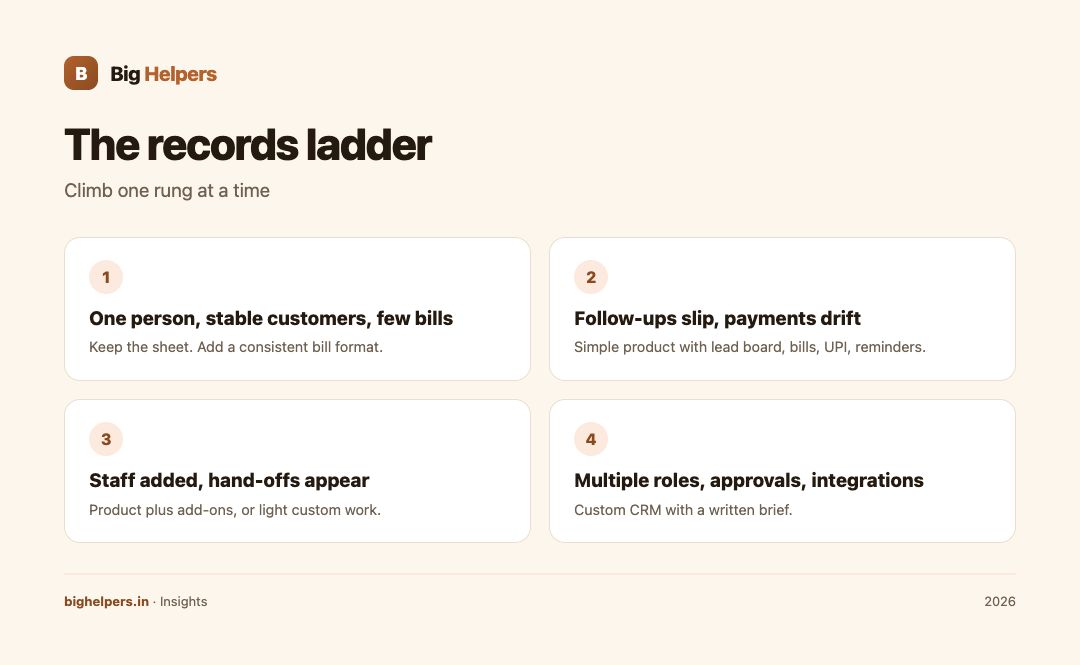
The ladder, in one table
| Rung | Situation | Right move |
|---|---|---|
| 1 | One person, stable customers, few bills | Keep the sheet. Add a consistent bill format |
| 2 | Follow-ups slip, payments drift | Simple product with lead board, bills, UPI, reminders |
| 3 | Staff added, hand-offs appear | Product plus add-ons, or light custom work |
| 4 | Multiple roles, approvals, integrations | Custom CRM with a written brief |
Climb one rung at a time. Skipping rungs is how businesses end up paying for software their process cannot yet use.
Common mistakes when moving off spreadsheets
- Migrating everything. Move open customers and unpaid bills; archive the rest.
- Buying for the team you hope to have. Buy for the team you have.
- Abandoning the tool in week two because habits feel slower. New records always feel slower for a fortnight.
- Choosing a product that cannot export. Whatever you pick, your data must be able to leave.
- Skipping a trial. BusinessSetu and most sensible products offer one; use it on real bills, not toy data.
Frequently asked questions
Is WhatsApp itself the problem?
No. WhatsApp remains the best channel for talking to Indian customers. The problem is using the chat history as the only record of what is owed and what is pending.
How many signs must be true before I act?
Two or three suggests a simple product. Four or more, especially with multiple staff, suggests you should at least scope custom work.
What does a simple option cost per month?
BusinessSetu Pro lists its base plan and each add-on publicly on its pricing page, so you can total your own configuration before paying anything.
Can I start with a product and move to custom later?
Yes, and it is usually the cheapest sequence. A product proves your volumes and stages, which makes any later brief sharper and cheaper.
Your next step
Count how many of the six signs are true for you today. If the answer is two or three, start a BusinessSetu trial and move your open bills into it this month. If the answer is four or more, write down your staff roles and hand-offs first, then talk to Big Helpers about a custom CRM scoped to the way your team actually works.
Sources & references
- BusinessSetu use cases: lead board with stage, value and next follow-up date.
- BusinessSetu pricing: base plan, add-on modules and the 14-day free trial.
- Big Helpers custom CRM service: for multi-role workflow with hand-offs.
- Custom CRM vs Salesforce vs Zoho: the buy-versus-build comparison referenced above.
- Case study: SME CRM replacement: the 60-person distribution example.
Pricing in this guide is verified as of the article date. Verify with vendors before committing budget — rates change quarterly.