
The short answer
Neither choice is automatically safer. Using one partner concentrates your risk in a single relationship; using several specialists multiplies your coordination work and spreads accountability until nobody owns an outcome. What changes is where the risk sits, and this article maps that across six areas so you can decide with open eyes rather than by instinct. There is no universal answer, and anyone who tells you otherwise is selling one of the two.

The two models, stated fairly
One partner delivers your website, your CRM, your app and your automation, with a single point of contact and one contract.
Several specialists means a website studio, a CRM builder, an app team and an automation consultant, each with a separate scope and invoice.
Both work. Both fail. They fail differently, which is the useful thing to know.
Risk area 1: Coordination
With one partner, coordination is their problem, and their internal stand-ups absorb it. With several specialists, coordination is yours, and you become the integrator even if you never wanted the job.
Ask yourself honestly: do you have the time and the vocabulary to run three vendors through one launch? If no, lean toward one partner. If a team member can own vendor management as an actual job, specialists become viable.
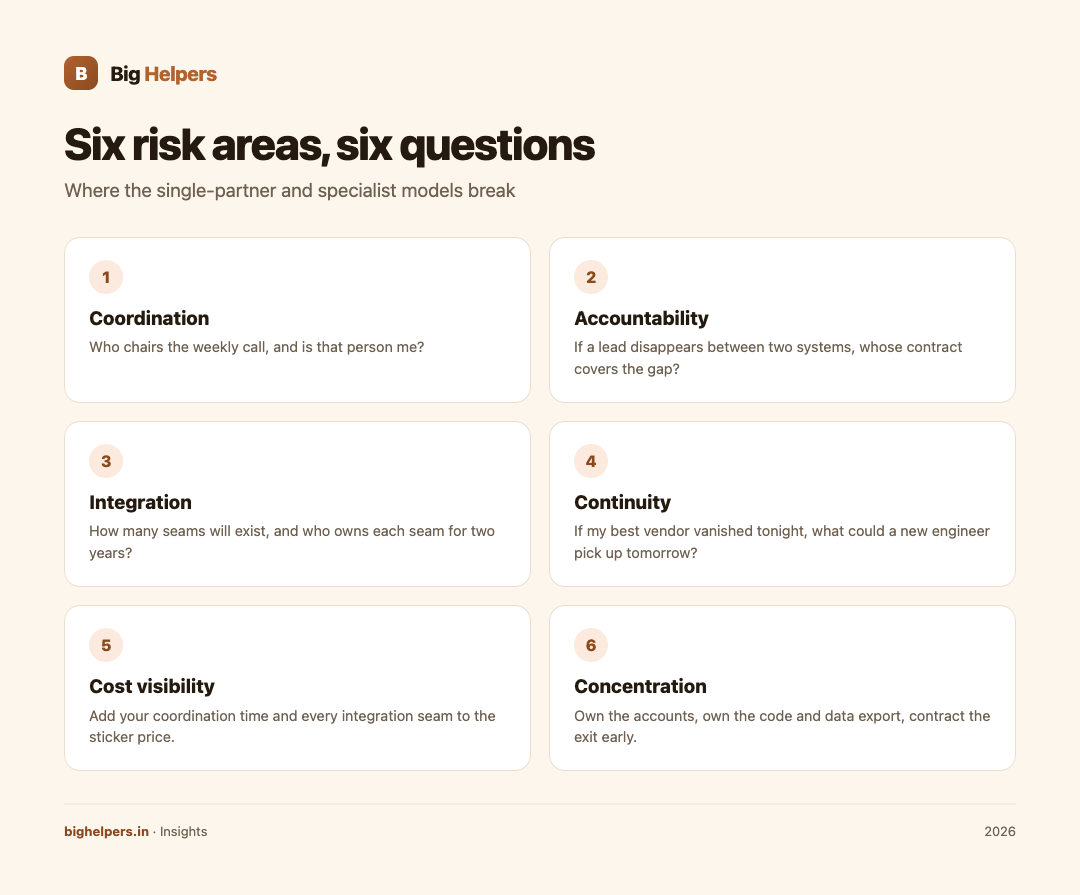
The checklist question: who chairs the weekly call, and is that person me?
Risk area 2: Accountability
When the enquiry form silently fails and the CRM never receives a lead, one partner cannot blame anyone else. That is the strength of the single model: the buck stops at one desk.
With specialists, the same failure produces a triangle: the website team says the form works, the CRM team says nothing arrived, and the automation consultant says the webhook was never in their scope. All three may be technically correct and the lead is still lost.
The checklist question: if a lead disappears between two systems, whose contract covers the gap? Write the answer down before signing anything, because it will not resolve itself later.
Risk area 3: Integration
Integration is where specialists get expensive. Each connection between two vendors' work is a negotiation about who builds it, who tests it and who maintains it. Three vendors can mean two or three such seams, each a permanent maintenance surface.
A single partner carries the seams internally. The trade-off is subtler: integration built by one team is only as good as that team's breadth. A brilliant web studio that has never connected a payment gateway will learn on your invoice.
The checklist question: how many seams will exist between pieces of work, and who owns each seam for the next two years?
Risk area 4: Continuity
This cuts in an uncomfortable direction for the single-partner model. If your one partner closes, refocuses or simply stops answering, everything pauses at once. Specialists fail one at a time, which is painful but survivable.
Continuity is not really about partner count, though. It is about portability. With clean repository access, credentials in your name and current documentation, either model can be rescued. Without them, neither can. The protections in the code ownership guide matter more than the number of vendors you sign.
The checklist question: if my best vendor vanished tonight, what could a new engineer pick up tomorrow?
Risk area 5: Cost visibility
One partner gives you one invoice, which is easy to read and easy to overpay, because bundled pricing hides which parts carry margin.
Specialists give you several invoices, each individually competitive, plus the hidden salary of your own coordination time. The sticker price drops and the true cost can rise.
The honest comparison adds three lines most SMEs omit:
| Cost line | One partner | Several specialists |
|---|---|---|
| Contracted fees | Single, bundled | Multiple, each visible |
| Your coordination time | Low | High, and unbilled |
| Integration build and upkeep | Usually included | Usually extra |
| Switching cost per vendor | One large exit | Several smaller exits |
Published, per-service INR ranges reduce the bundling problem, which is why Big Helpers lists each service with its own range on the services page rather than one opaque project number. Whatever model you choose, insist on the same transparency.
Risk area 6: Vendor concentration
Concentration is the serious argument against the single-partner model, and it deserves respect rather than dismissal. If one relationship carries your website, your customer records, your app and your automation, you have built a dependency that grows every year you add to it.
Three guardrails keep concentration survivable:
- Own the accounts. Domain, hosting, repositories, app store, payment gateway, all in your company's name from day one.
- Own the code and the data export. A monthly exported backup you have actually opened, not a promise.
- Contract the exit while things are good. A knowledge-transfer clause and a documentation obligation cost nothing to include at signing and are expensive to request during a dispute.
With those three in place, concentration becomes a manageable preference rather than a trap.
A scoring approach for your situation
Score each statement 1 to 5, where 5 is strongly true:
- I have someone who can manage vendors as a real part of their job.
- My pieces of work are technically independent, with few seams.
- I can tolerate one relationship holding most of my digital estate, given protections.
- My budget is tight enough that per-service price comparison matters.
- I value one accountable throat to choke when something breaks.
High scores on 1, 2 and 4 push toward specialists. High scores on 3 and 5 push toward one partner. A tie is common and is usually resolved by team capacity: if nobody can chair the coordination, take the single partner and buy the protections instead.
Where the hybrid sits
Many Indian SMEs land on a hybrid: one main partner for the core build, plus a specialist for one genuinely distinct discipline, often SEO content or a specific compliance integration. The hybrid works when the main partner explicitly accepts an integration role and the specialist's scope has a clean boundary.
It fails when the main partner is expected to maintain code another vendor wrote. Few teams will do that cheerfully, and none should be asked to do it silently. If you plan a hybrid, put the maintenance boundaries in writing at the start.
Common mistakes
- Choosing specialists to save 15 percent, then spending the difference on coordination.
- Choosing one partner for comfort, then skipping the ownership protections that make comfort safe.
- Splitting work between two vendors who each expected to win the whole project.
- Never revisiting the choice as the business grows past the model that fit at five staff.
- Assuming a big name removes concentration risk. It does not; it only changes the failure mode.
Frequently asked questions
Is vendor lock-in worse with one partner?
Only if you skip ownership protections. Lock-in comes from missing credentials and unowned code, not from vendor count.
How do I check a single partner can really do all of it?
Ask for live work in each discipline from the last twelve months, the same discipline-specific check described in the agency vetting checklist.
Does hiring freelancers change this analysis?
The same six areas apply, with coordination risk higher still, because freelancers rarely absorb integration work. For a comparison of hiring routes and cost realities, see Hiring developers in India vs Toptal and Upwork.
Can I start with one partner and split later?
Yes, and it is a reasonable path. Start with one, own everything from day one, and split off specialisms when a genuine specialist need appears.
What is the minimum protection whatever I choose?
Repository access in your account, credentials in your company's name, a documentation pack and a data export you have tested. Everything else is negotiable; those four are not.
Should the agency host my site?
Managed hosting is fine as a service, provided the domain and the code are yours and you have a written exit path. Hosting you cannot leave is not a service, it is a leash.
Your next step
Write your five scores and check them against the three continuity guardrails. If the single-partner model fits your capacity, choose one partner that publishes per-service INR ranges and works with weekly demos on a staging URL, the working pattern described in how Big Helpers works, and put the ownership protections in the contract before the first advance.
Sources & references
- Big Helpers services: per-service INR ranges rather than one bundled number.
- The Indian developer agency vetting checklist: the pre-hire questions this article assumes are done.
- Hiring developers in India vs Toptal and Upwork: hiring-route comparison referenced above.
- How Big Helpers works: weekly demos on a staging URL.
- Code ownership: what to demand in your developer contract: the portability protections both models need.
Pricing in this guide is verified as of the article date. Verify with vendors before committing budget — rates change quarterly.