
The short answer
For most Indian small businesses the answer is the website first, then the CRM, then the portal, and the mobile app last. Build in that order unless your customers reach you mainly through a staff-run process rather than through discovery, in which case the CRM comes first. The sequence matters because each layer produces the data and the habits the next layer needs. This article gives you a decision tree to place yourself correctly, then a build order you can defend to a partner or a bank.
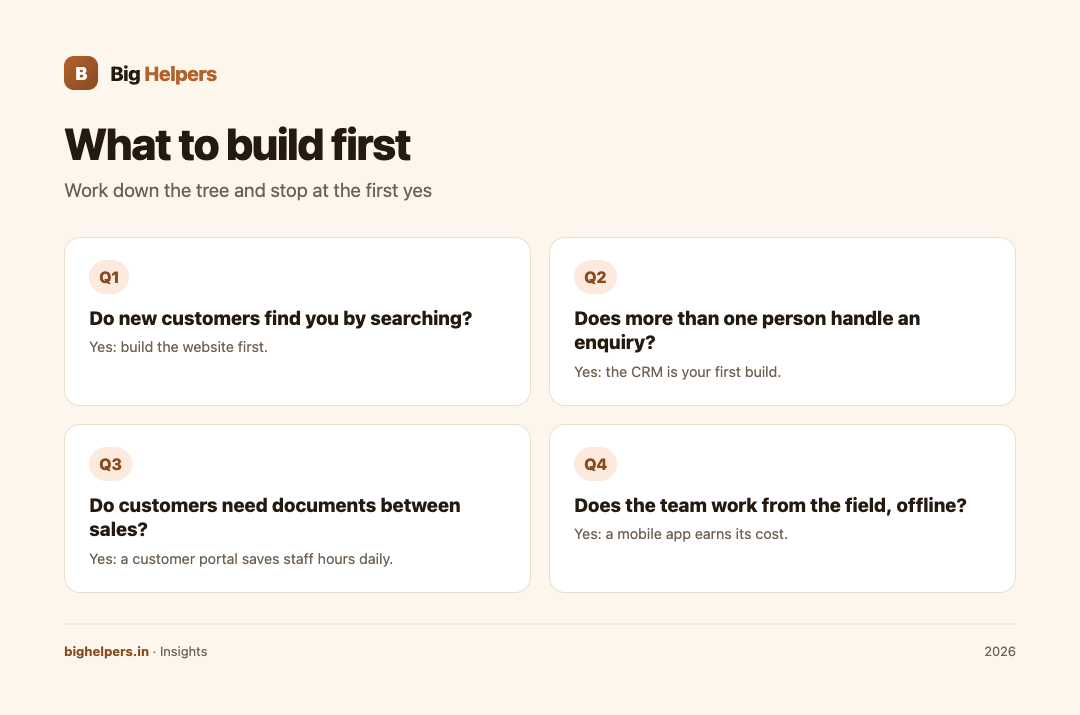
Four options, one honest question each. Work down the tree and stop at the first yes.
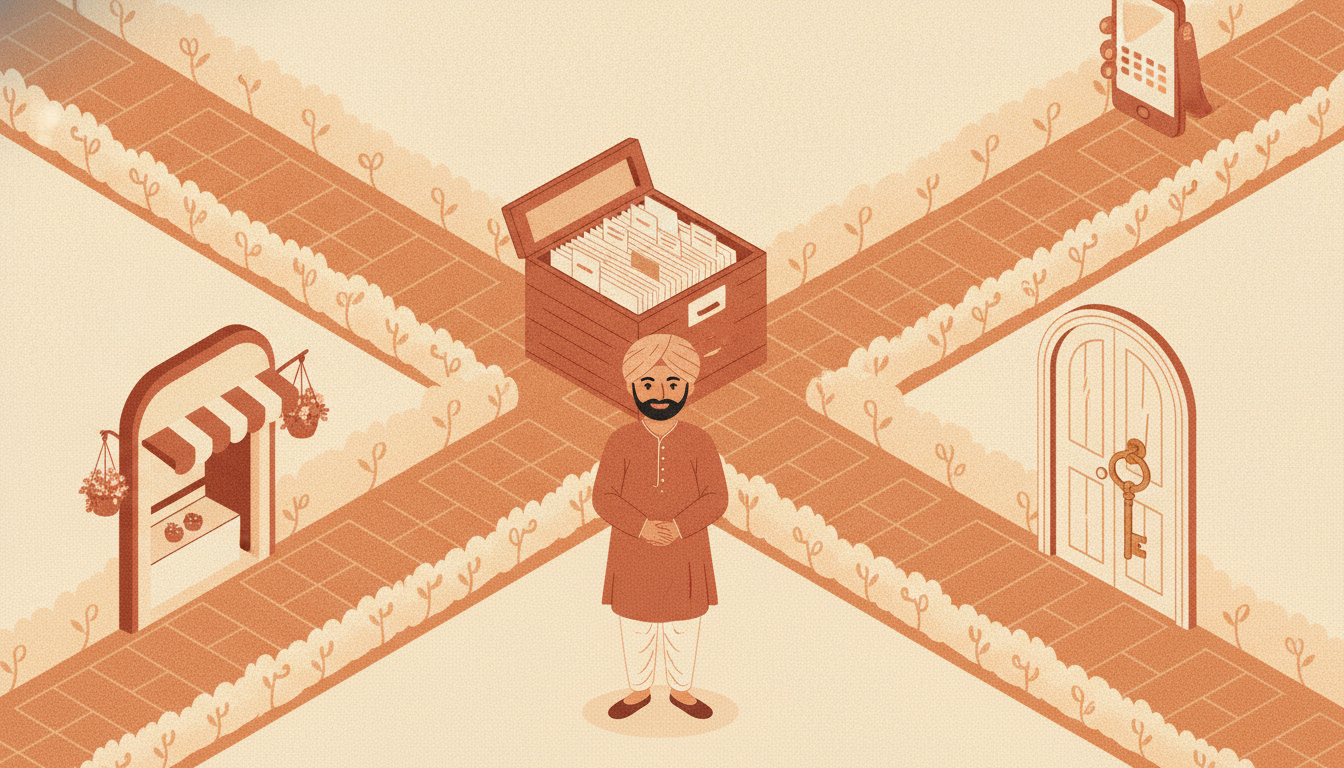
The decision tree
Question 1. Do new customers find you by searching, asking around, or being shown your name?
If customers discover you, you need a discoverable surface first. That is a website. Almost every business, including referral-run ones, gets checked online before the first call. A business that looks abandoned online loses enquiries it never hears about.
If customers never search for you because they are contracted, referred by a network, or walk past your shop, skip to Question 2.
Question 2. Does more than one person handle an enquiry before it becomes a sale?
If yes, your bottleneck is coordination, and the CRM is your first build. A website would only pour more enquiries into a process that already drops them. Fix the pipe before widening the funnel.
If one person handles everything start to finish, a CRM can wait. Go to Question 3.
Question 3. Do your customers repeatedly need something from you between sales: documents, statements, order history, bookings, downloads?
If yes, and they ask for it by phone or message every time, a customer portal saves staff hours daily. Build the portal after capture is solved, because a portal without a clean record behind it just exposes your mess to customers.
If customers transact and disappear, a portal is decoration. Go to Question 4.
Question 4. Does your team need to work from the field, offline, or with the camera and notifications as core parts of the job?
If yes, a mobile app earns its cost. If your team works from desks and a browser, an app is an expensive way to reach the same screen. Note the distinction carefully: customers being on phones does not mean you need an app; a good mobile website serves customers well. Staff doing fieldwork is the genuine app case.
Why build order matters more than build choice
Each option produces something the next one consumes:
- A website produces enquiries, and enquiries need somewhere to live.
- A CRM produces records, and records make a portal worth logging into.
- A portal produces self-service, which reduces the phone load that justified an app.
Build in the wrong order and you pay twice: once for the thing you cannot feed yet, and again later to connect it. A portal with no records behind it becomes a static page. An app with no workflow behind it becomes a brochure on a phone.
Four profiles, four different first builds
Profile A: the referral-run professional. Customers arrive through recommendations. One person handles the whole relationship. First build: a clean website with a working form and a WhatsApp click-to-chat, because the referral always checks you online before calling. Budget entry point is the lowest of the four, within the range published for web development.
Profile B: the growing services firm. Three to fifteen staff, leads from website, ads and marketplaces, quotes and approvals by hand. First build: CRM. The website probably exists and is fine; the leaks are in hand-offs. The custom CRM service addresses exactly this shape of problem.
Profile C: the supplier or clinic with repeat interactions. Customers return monthly and keep asking for statements, invoices or order status. First build after capture is a customer portal, because every self-service view is a phone call your staff no longer takes.
Profile D: the field-run operation. Staff visit sites, capture photos and record work on the move. First build: a simple mobile workflow app, ideally the smallest version that covers one complete field task. The mobile app development service covers native Android, iOS, React Native and Flutter routes.
The three factors that override the tree
The tree assumes average conditions. Three factors can flip it.
Staff workflow beats customer desire. Owners often want an app because competitors have one. If your staff process cannot yet support the app's promise, customers will download it once and abandon it. Fix internal flow first.
Data ownership beats feature count. Whatever you build, the account and the records must belong to you. A cheaper build where your enquiries live in someone else's platform is more expensive than it looks the day you want to leave. Demand repository and hosting handover in writing before signing.
Budget honesty beats phasing ambition. Published ranges on the services page run from tens of thousands for a marketing site to several lakhs for a full web and mobile build. Sequence your spend so each phase delivers a working thing, not a partial everything.
A practical build-order worksheet
Answer with a number from 1 to 5, where 5 is strongly yes.
- Customers search for my kind of service online before buying.
- Enquiries currently reach more than one staff member.
- Customers ask us for the same documents again and again.
- Staff work outside the office and record work on the move.
- We already keep enquiry records somewhere central.
Scoring guide: if statement 1 scores 4 or 5, the website is your first build regardless of the rest. If statement 2 scores 4 or 5 while statement 5 scores 1 or 2, the CRM comes before any new marketing spend. Statements 3 and 4 set your second and third builds. Statement 5 tells you whether you can afford to skip a step.
What not to build first
- A mobile app for customers when your website is not yet mobile-friendly. Fix the cheaper surface.
- A portal when your records still live in chats. The portal will faithfully display the chaos.
- A CRM configured for forty fields when your staff record five things today. Start with the five.
- An internal tool nobody asked for while the enquiry form is broken. Capture eats everything.
For a deeper comparison of the app-versus-bot question specifically, which this tree treats as one leaf, read Custom mobile app vs WhatsApp bot.
Common mistakes
- Building all four in one project. Four small builds with acceptance after each beat one large build with acceptance at the end.
- Copying a competitor's build order. Their customer behaviour, not yours, produced it.
- Letting the vendor choose. A vendor who only sells apps will find an app problem.
- Skipping the written scope. Every phase should have one, with a fixed INR range, before work starts.
- Treating maintenance as free. Each layer adds a small recurring cost; plan for it.
Frequently asked questions
Can a website and CRM be built together?
Yes, and it is often sensible when the website's form feeds the CRM directly. Just insist on separate acceptance for each, so one being late does not hold the other hostage.
Do customers prefer apps or websites?
For discovering and evaluating a business, customers use the web and search. Apps suit repeat, logged-in use. Most Indian small businesses need the first before the second.
Is a portal only for big companies?
No. Even a single-page login showing invoices and payment status can remove a large share of routine customer calls for a supplier, clinic or service firm.
What if I can only afford one build this year?
Choose the one that removes the largest leak today, using the worksheet. For most businesses that is the website, because every other build assumes enquiries exist.
How long does a sensible first build take?
Marketing sites are quickest; full builds with mobile and automation take longest. Big Helpers publishes timelines per service, for example MVP development at six to ten weeks, on the services page.
Should the app be native or cross-platform?
Decide after the app is genuinely first in your build order. If you are not yet sure staff will use it, start with the smallest testable version rather than the most complete one.
Your next step
Write down your four worksheet scores and the one build they point to. If you want that choice pressure-tested, Big Helpers offers a free 20-minute discovery call and quotes a written scope with a fixed INR range before any work starts, which is the correct way to begin whichever build comes first.
Sources & references
- Web development service: static, WordPress and custom builds with a published range.
- Custom CRM service: for hand-off-heavy enquiry handling.
- Mobile app development service: native and cross-platform routes.
- Big Helpers services page: per-service ranges and published timelines.
- Custom mobile app vs WhatsApp bot: the deeper dive on one leaf of the tree.
Pricing in this guide is verified as of the article date. Verify with vendors before committing budget — rates change quarterly.