
The short answer
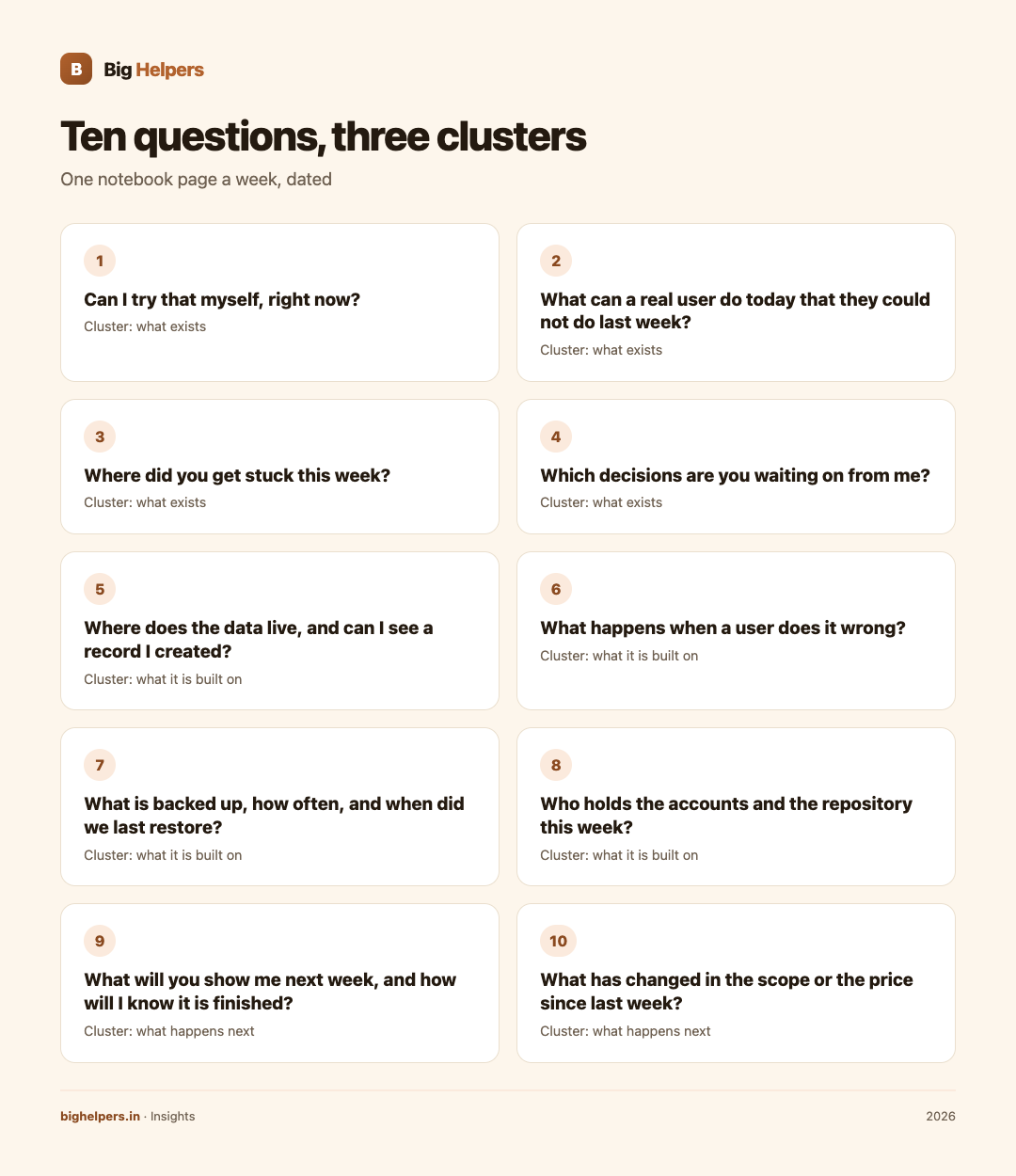
A weekly demo is an evidence session, not a slideshow. Ask the same ten questions every week, write the answers in one notebook, and by week four you will know more about your project's true state than most owners learn by launch. The questions need no technical knowledge; they need only to be asked consistently, because a question asked every week is hard to answer with decoration.

These are the questions for after you have hired. The questions for before you hire are a different set, covered in the Indian developer agency vetting checklist.
Keep a physical notebook for this. One page per week, ten short answers, dated. The notebook becomes your project's memory and, if a dispute ever comes, your timeline.
Cluster one: what exists
1. Can I try that myself, right now?
The single most valuable question in the set. Anything demonstrated can be handed over for thirty seconds of your own clicking. A feature that only works under the developer's hands is not finished, and a team that will not hand over the wheel is telling you something.
Good answer shape: the device turns towards you, or a staging link arrives in your inbox during the call.
2. What can a real user do today that they could not do last week?
This question defeats the illusion of cumulative progress, the feeling that things are moving because you have seen the same screens twice. Progress means new completed paths, not polished old ones. If the honest answer is "the same, but tidier", that is a legitimate answer some weeks, and worth recording as such.
3. Where did you get stuck this week?
Every build has friction. A team that reports none is not reporting. This question, asked warmly and without blame, surfaces the technical debt, the third-party delays and the unclear decisions while they are still cheap to fix. It also teaches your team that honesty is safe with you, which is worth more than any single answer.
4. Which decisions are you waiting on from me?
Delays are more often caused by the client's inbox than the developer's calendar. Asking this every week clears your own blockers, and it keeps you honest about your share of the timeline.
Cluster two: what it is built on
5. Where does the data live, and can I see a record I created?
Ask to see the actual database row, export or admin view containing something you entered yourself. This makes the data real rather than abstract, and it quietly verifies that your records are accumulating somewhere you can reach. Repeat this monthly; watch a record you created weeks ago still exist.
6. What happens when a user does it wrong?
Enter nonsense. Submit twice. Use the back button. Ask what the system does. Software quality lives less in the happy path than in the handling of mistakes, and this question schedules error handling into the build rather than leaving it as a launch-week surprise.
7. What is backed up, how often, and when did we last restore?
A weekly habit of asking this turns backup from an assumption into a routine. The answer you want to hear evolves over the project: a plan early, a schedule mid-build, and at least one witnessed restore before launch. If the answer never becomes specific, treat that as a finding rather than a footnote.
8. Who holds the accounts and the repository this week?
A quiet administrative question with large consequences. Domain, hosting, repository, payment gateway, app store. The right trajectory is that ownership moves to you progressively, not in a single dramatic handover at the end. For the contractual side of this, read Code ownership: what to demand in your developer contract; for the acceptance-day tests, the handover checklist approach is the operational companion.
Cluster three: what happens next
9. What will you show me next week, and how will I know it is finished?
This question converts a plan into a commitment with a test attached. "We will do payments" is a plan. "Next Friday you will create a bill, mark it part-paid, and see the pending amount on the dashboard, yourself" is a commitment. Record both versions in your notebook and notice which one you usually get.
10. What has changed in the scope or the price since last week?
A weekly audit of scope drift, asked neutrally. Small additions are normal and often good; unacknowledged additions are how budgets double. Pair this with the written scope from the start: Big Helpers fixes a written range before work begins and states that the range moves only when the scope moves, with payment structured as milestones against working software, as published on the pricing page. Whatever your arrangement, the question keeps the drift visible weekly instead of at invoice time.
The notebook habit
One page per week, three columns:
| Question number | Short answer | Confidence, high, medium or low |
|---|
Your confidence column is the private magic. Most owners feel unease weeks before they can articulate it, and the confidence marks make the pattern visible: three straight weeks of medium confidence on the same topic is a conversation to have deliberately rather than a surprise to absorb at launch.
Before each demo, reread last week's page. Referencing last week's answers is the difference between a review and a ritual.
Red flags across weeks
- The demo is always a screen recording, never a live system.
- "You will be able to try it at the end" repeated for several weeks.
- No question of yours has ever changed the plan.
- The same bug appears in three consecutive demos.
- Scope questions get answered with enthusiasm but never with numbers.
- Nobody can say where the data lives.
Any one flag is a conversation. Three together warrant pausing the next milestone payment and asking for the written state of the project.
Common mistakes
- Only attending demos when convenient. The weekly rhythm is the mechanism; intermittent attendance breaks the record.
- Nodding through technical answers. Say "explain that to me like a customer" whenever needed; it is your project.
- Using the demo only to request new features. Additions belong on a list for later phases, not slipped into the current week.
- Never asking question 9. Without a next-week commitment, weeks become indistinguishable.
- Keeping the answers in your head. The notebook is the whole point.
Frequently asked questions
What if my developer does not hold weekly demos?
Ask for them. Weekly demos on a staging URL are a standard, reasonable working pattern, and most professional teams already work this way. A refusal to show intermediate work is a serious signal.
I am not technical. Will these questions annoy the team?
Consistent, specific questions from an owner who writes down the answers tend to earn respect rather than irritation, because they make acceptance predictable for both sides.
How long should a weekly demo take?
Thirty minutes is plenty: fifteen of demonstration, fifteen of your questions. Longer sessions drift.
What if I miss a week?
Ask for the demo anyway, even briefly, and fill the notebook page from a recorded session. Do not skip the page; gaps in the record are where disputes breed.
Should staff who will use the software attend?
Yes, at least monthly, and ideally for the questions in cluster one. The people doing the work will spot what a demo audience never will.
What is the single best moment to start this notebook?
The first demo, this week. The how Big Helpers works page describes the weekly staging demo rhythm these questions are designed for.
Your next step
Copy the ten questions into a notebook tonight and take them to your next demo, whichever vendor is building. If you are choosing a team and want this rhythm from week one, Big Helpers works with weekly progress demos on a staging URL, written scope with a fixed INR range and milestone payments; start on the contact page with a free 20-minute call.
Sources & references
- How Big Helpers works: the weekly staging-demo rhythm these questions are designed for.
- Big Helpers pricing: written scope with a fixed range; milestone payments.
- The Indian developer agency vetting checklist: the pre-hire question set.
- Code ownership: what to demand in your developer contract: the contractual side of question 8.
Pricing in this guide is verified as of the article date. Verify with vendors before committing budget — rates change quarterly.