
Quick answer
A single weighing reflects salt, carbohydrates, fluids, digestion and the time of day as much as any real change. Cleveland Clinic notes daily fluctuations of a few pounds are common and normal, with an average window of about 5 to 6 pounds a day even in healthy adults. What informs you is the trend: the average of many readings taken the same way, reviewed weekly or monthly, with unexplained sharp changes discussed with a clinician.
What the scale actually measures
The number on a scale is your total mass at that instant: bone, muscle, fat, water, and whatever is in your stomach and intestines. Water and digestive contents shift by the hour, so the number moves for reasons that have nothing to do with body fat.
Cleveland Clinic's patient guidance explains short-term fluctuations as mostly fluid retention, with a high-carbohydrate or high-sodium meal, hormonal changes, medicines and some medical conditions all causing the body to hold water temporarily. A heavy meal still being digested also adds honest, temporary mass. Their summary figure is worth internalising: even for people in a healthy weight range, the average day-to-day window is about 5 to 6 pounds, roughly 2 to 3 kilograms in each direction. In other words, a one-kilogram change from yesterday is inside ordinary noise.
This is why one reading cannot tell you whether yesterday's choices worked. It can only tell you where your body's water happened to be.
Why the trend is the honest signal
Body fat changes slowly, over weeks of consistent habits. Fluid changes daily. If you want the slow signal, you must filter out the fast one, and the simplest filter is repetition: many readings, taken under the same conditions, averaged.
A trend answers the questions a single reading cannot:
- Is my weight drifting up, down, or flat over the last month?
- Did the festive fortnight leave a lasting change, or just a splash of water?
- Is the plan I am following producing the gradual change it should?
The World Health Organization frames weight management as energy balance over time, with total energy intake balanced against expenditure. Balance is a weeks-long concept, so the tool that measures it must look at weeks too.
A consistent weighing protocol
If you weigh, weigh the same way every time. Consistency, not frequency, is what makes readings comparable:
- Same time of day, most people prefer morning.
- Same situation: after the bathroom, before food, chai or water.
- Same clothing or none.
- Same scale, on a hard, level floor; scales moved around the house disagree with each other.
- Record every reading, even the odd ones. The odd ones make the average honest.
Whether you weigh daily, thrice a week or weekly is your choice. Daily weighing suits people who can treat each number calmly as data. If a daily number instead decides your mood, weekly same-condition weighings give you the trend without the rollercoaster.
The maths of a trend, in one small example
Take morning readings over two weeks:
| Day | Reading (kg) | 7-day average ending |
|---|---|---|
| Mon | 72.4 | |
| Tue | 72.8 | |
| Wed | 72.2 | |
| Thu | 72.6 | |
| Fri | 72.0 | |
| Sat | 72.9 | |
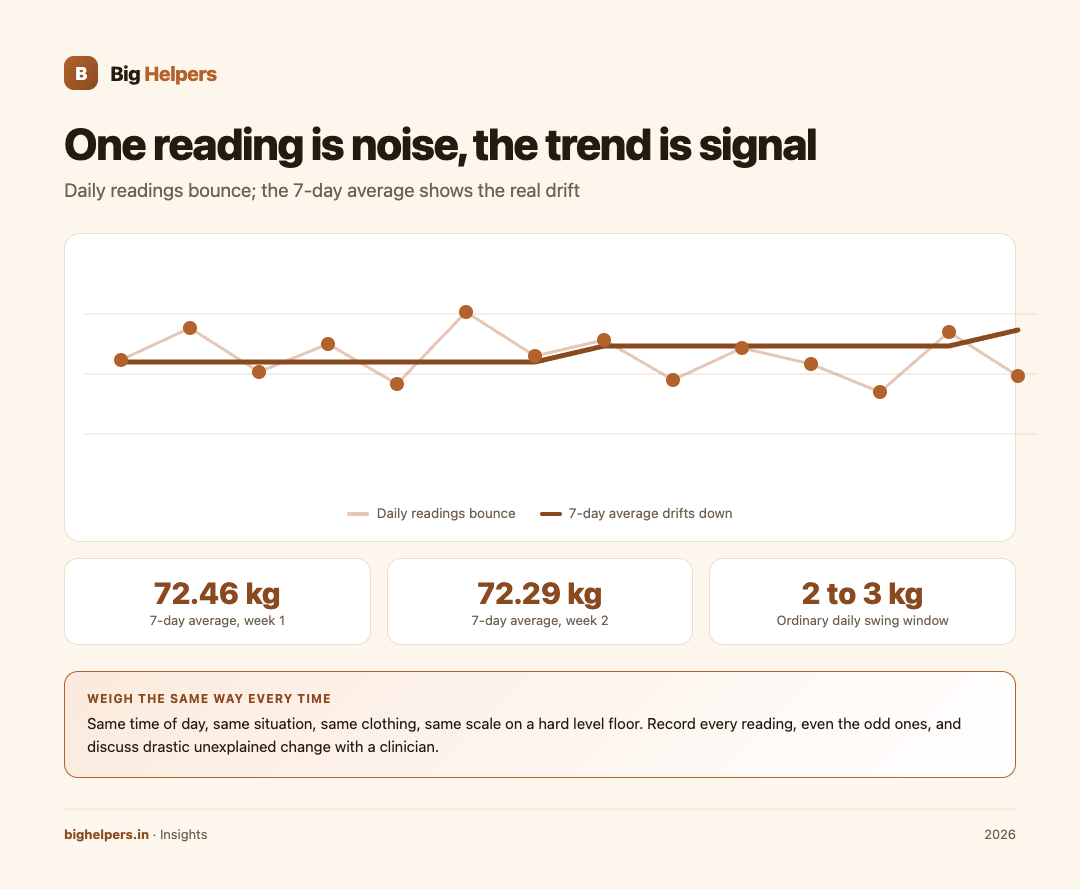
| Sun | 72.3 | 72.46 |
| Mon | 72.5 | |
| Tue | 72.1 | |
| Wed | 72.7 | |
| Thu | 72.2 | |
| Fri | 71.9 | |
| Sat | 72.6 | |
| Sun | 72.0 | 72.29 |
Daily numbers bounce across half a kilogram without any pattern you can act on. The two Sunday averages, 72.46 and then 72.29, tell the real story: a gentle drift down. That is the kind of change worth noticing, and it is invisible in any single row.
Where Burnie fits
Burnie by Big Helpers is an Indian calorie, food logging and weight-trend companion, and its design leans toward the trend rather than the day. Its store listing confirms weekly and monthly views that let you compare your logged deficit, your weigh-ins and your intended pace, weight milestones and history, and a metabolism view that appears after enough logged days and weigh-ins, comparing a formula-based estimate with your real trend. With your permission it can also read supported metrics like body weight from Apple Health, and you choose each permission. Burnie is available on iOS. Android is in controlled testing. Related health-tracking guides sit in the insights library.
Common mistakes
- Weighing after dinner one day and before breakfast the next, then comparing the two. Different conditions, meaningless comparison.
- Reacting to a Tuesday. A single up reading that follows a salty Monday is water, not verdict.
- Moving the scale around. Tiles, carpets and bathroom corners give different zeroes.
- Dropping weigh-ins after a bad week. Gaps hide the trend and, often, the reassurance.
- Treating the app's trend as a diagnosis. A trend is an observation. What it means is a conversation with a clinician.
- Ignoring large unexplained changes. Cleveland Clinic advises discussing drastic weight change without an apparent cause with a healthcare provider; this is not something to watch quietly for months.
One next step
Choose your weighing conditions, morning, after the bathroom, before chai, and stick to them for three weeks. Burnie is available on iOS, with Android in controlled testing; its current status and store link are listed on the Big Helpers apps page.
Frequently asked questions
How much daily change is normal?
Fluctuations of a few pounds a day are common and normal, and Cleveland Clinic cites an average window of about 5 to 6 pounds (roughly 2 to 3 kg) across the day even in healthy adults. Regular swings beyond that, or any persistent change you cannot explain, belong with a doctor.
Is daily weighing harmful?
Not inherently; it depends on your relationship with the number. If daily readings make you anxious or lead to harsh decisions, weigh weekly under identical conditions instead.
Which day's reading should I record?
All of them, if it is convenient. The trend works with every reading included, odd ones included.
What about after a festival or a wedding week?
Expect water and food weight for a few days. Give the trend two ordinary weeks before drawing any conclusion.
Does muscle weigh more than fat?
A kilogram is a kilogram; muscle is denser, so a fitter body can weigh the same while looking leaner. The scale is one measure among several, and strength, waist fit and energy matter too.
When should I see a doctor about my weight?
Whenever change is drastic, rapid or unexplained, or whenever weight is tied to a condition, medicine, pregnancy or an eating concern. The trend is information for that conversation, not a substitute for it.
This article is general health information, not medical advice, and claims no diagnosis or outcome. For concerns about your weight, fluids, medicines or any condition, consult a qualified clinician.
Sources & references
- Cleveland Clinic, patient guidance on daily weight fluctuations
- World Health Organization, healthy diet fact sheet
- Big Helpers apps page, store availability checked 29 August 2026
- Burnie App Store listing, official Apple iTunes metadata (id6791818637)
Pricing in this guide is verified as of the article date. Verify with vendors before committing budget — rates change quarterly.