
Quick answer
Log meals with household measures, one honest estimate per item, and the same method every day, rather than chasing exact calories. Count the cooking oil, the between-meal snacks and the drinks, because those unlogged edges are where Indian food logs usually go wrong. Review the week's pattern, not the day's number. A consistent, slightly rough log teaches you more than a perfect log you abandon in ten days.
Why precision is the wrong goal
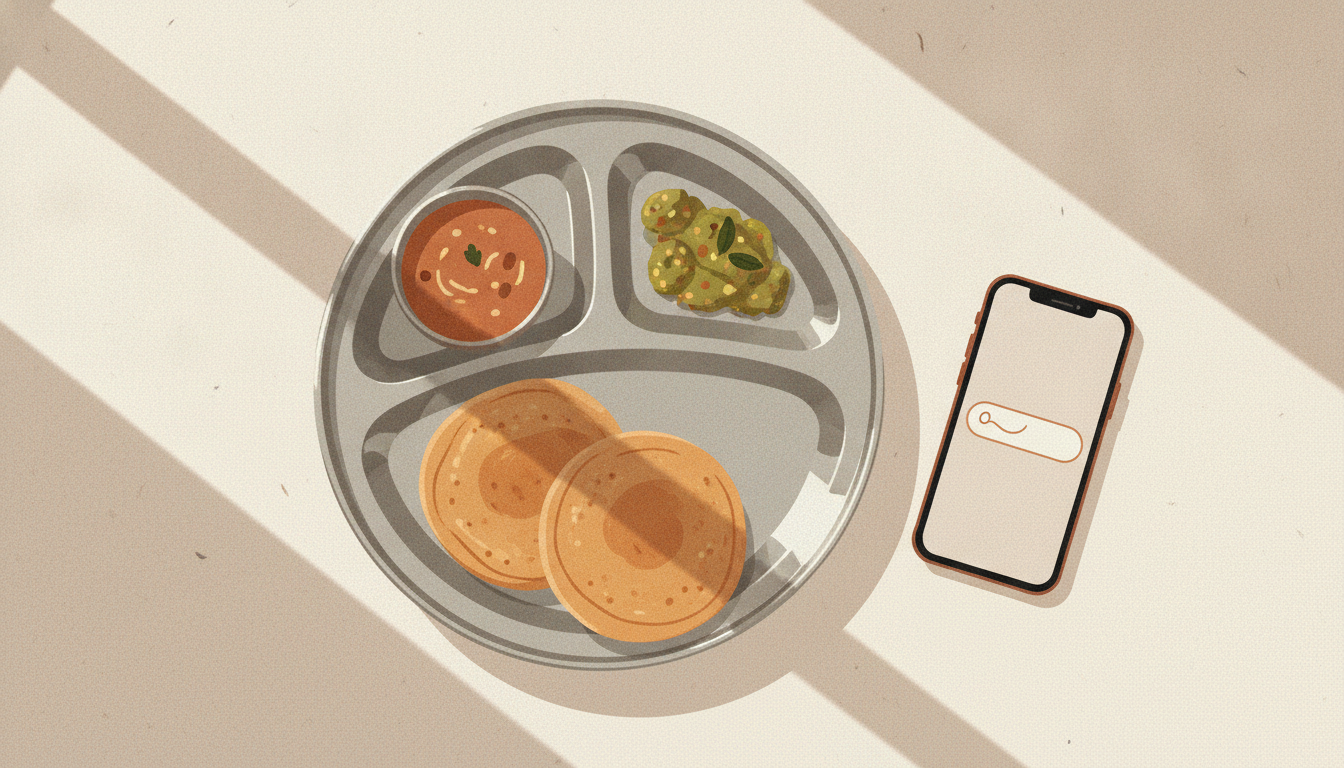
Indian home food resists precision. Your dal changes with the tadka. The sabzi's oil depends on who cooked today. A restaurant paneer dish and a home paneer dish are different foods with the same name. A packaged biscuit has a label; your mother's mathri does not.
The useful question is not "exactly how many calories was that?" It is "what did I actually eat today, roughly, and how does this week compare with last week?" The ICMR-National Institute of Nutrition's Dietary Guidelines for Indians, 2024, built its guidance on food groups and portions, on what a day's plate looks like, not on decimal-point calories. That is the right spirit for a personal food log too: consistent estimates, honestly recorded, reviewed as a pattern.
Set up your measures once
Before your first log, fix your personal vocabulary of portions. Ten minutes, once:
- Katori size. Measure your usual katori with water. Knowing it holds about 150 ml turns "one katori dal" into a repeatable unit.
- Roti size. Note whether your rotis are small phulkas or larger ones, and whether oil or ghee is brushed on.
- Glass and cup. Your chai glass, your water glass, your coffee cup.
- Serving spoon. How much rice your usual serving spoon carries cooked.
You never need a kitchen scale to start. You need the same bowl and the same words each day.
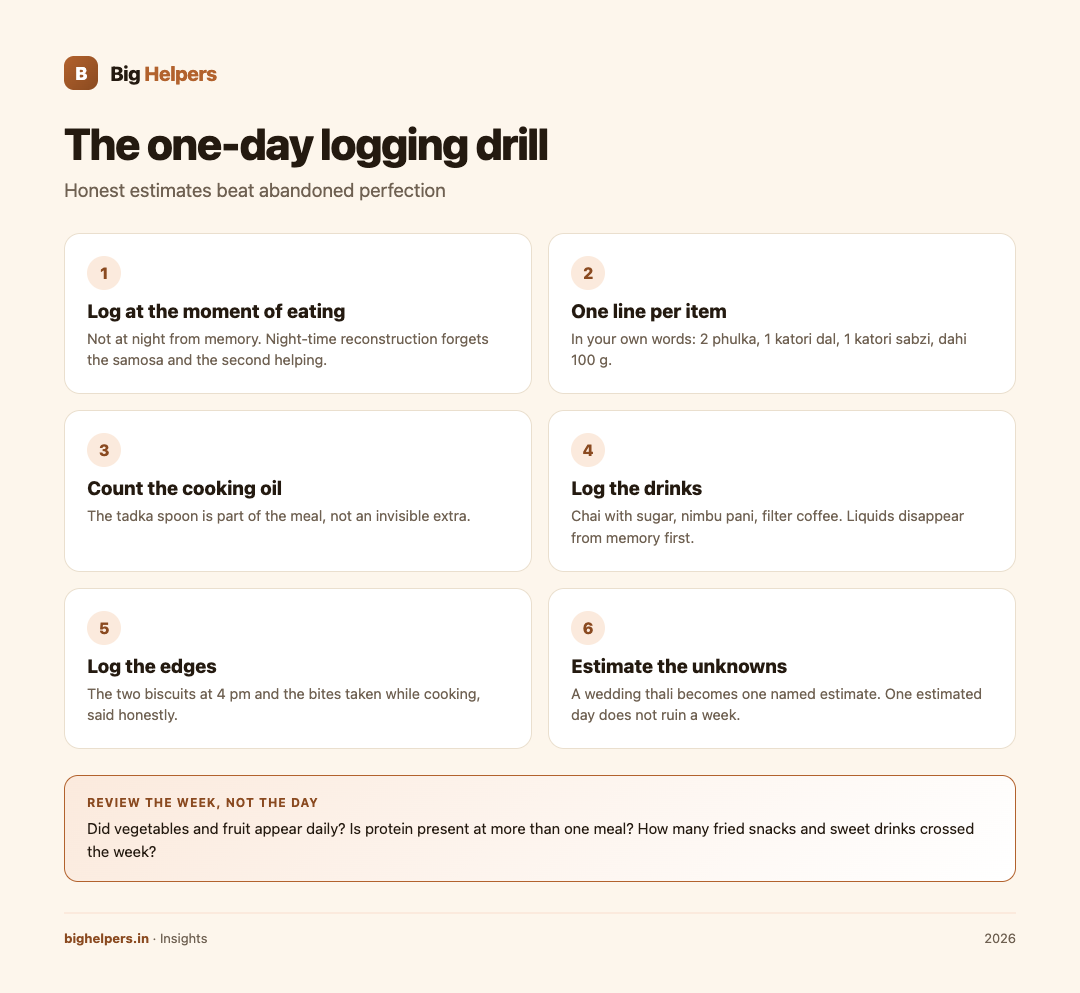
The logging drill for one day
- Log at the moment of eating, not at night from memory. Night-time reconstruction forgets the samosa and the second helping.
- One line per item, in your own words. "2 phulka, 1 katori dal, 1 katori lauki sabzi, dahi 100 g".
- Count the oil you cooked with, not just what sat on the plate. One teaspoon of oil for the tadka is part of the meal.
- Log drinks. Chai with sugar, nimbu pani, filter coffee, cold drinks. Liquids disappear from memory first.
- Log the edges. The two biscuits at 4 pm, the namkeen while watching television, the bites taken while cooking. Say them honestly; nobody else reads your log.
- When a meal is mixed or unknown, like a wedding thali, log it as a named estimate and move on. One estimated day does not ruin a week.
Where Indian logs usually go wrong
| Slip | Why it happens | The fix |
|---|---|---|
| Cooking oil never logged | Oil goes in the kadai, not the plate | Note teaspoons or spoons used per dish |
| "One roti" varies wildly | Sizes differ by household | Fix your roti's description once |
| Snacks forgotten | Eating standing up feels like not eating | Log edges before dinner |
| Sugar in chai invisible | Three small cups feel like nothing | Count cups and sugar per cup |
| Restaurant meals skipped | No label, no idea | Log a named estimate the same day |
| Perfect weekdays, blind weekends | Weekends feel like a holiday from logging | Log weekends with the same honesty; that is where patterns hide |
The review that matters: the weekly pattern
At the end of each week, read your log like a report, not a verdict. Three questions:
- Did vegetables and fruits appear daily? The ICMR-NIN 2024 guidelines note that Indians eat only about 100 to 200 g of vegetables and fruits a day against a recommended 500 g, so most of us have exactly one clear upgrade available.
- Are dal, curd, paneer, eggs or other protein foods present at more than one meal? The guidelines suggest pulses, eggs and flesh foods together around 14 to 15 per cent of the day's energy, and protein at every meal is the practical version of that.
- How many fried or packaged snacks and sweet drinks crossed the week? Not to judge, but to see. The first snack you notice is the easiest one to swap.
Do this for three weeks and your own log will teach you more about your food than any generic chart, because the data is yours.
Where Burnie fits
Burnie by Big Helpers is an Indian calorie, food logging and weight-trend companion, and its design accepts estimates openly. Its store listing confirms you can search familiar Indian dishes with practical serving sizes, take a food photo and review its calorie estimate, describe a meal in everyday language, scan a packaged food's barcode, and save meal groups for combinations you eat often. The listing is explicit that photo and AI results are estimates, not fake precision, and that you review the suggested foods before they enter your day, correcting details an image cannot show, such as recipe, oil or portion size. It also offers logging reminders you control and short Academy guides on Indian food and habits. Burnie is available on iOS. Android is in controlled testing. More practical guides sit in the insights library.
Common mistakes
- Abandoning the log after one imperfect day. The imperfect day is the data.
- Logging to punish yourself. A log that produces shame will not last a fortnight. Record, review, adjust, kindly.
- Copying someone else's portions. Your katori and your roti are the units that matter.
- Skipping the oil. In many Indian homes, oil is the single largest invisible contributor.
- Logging only Monday to Friday. The weekend is half your eating life.
- Chasing the app instead of the habit. Ten days of tool-hopping teaches nothing; three weeks of honest, rough logging teaches plenty.
One next step
Tonight, log one meal in one honest line, including the oil. Burnie is available on iOS, with Android in controlled testing; its current status and store link are listed on the Big Helpers apps page.
Frequently asked questions
Do I need to weigh food to log usefully?
No. Household measures used consistently carry most of the learning. Weighing helps occasionally, to recalibrate what your katori holds.
How do I log a mixed dish like khichdi or biryani?
Log it as one named item with a portion estimate, and note the dominant extras separately: ghee, papad, raita. One line, honestly estimated, beats five guessed lines.
What about food cooked by someone else?
Ask one question, "kittne tel mein bana?" (how much oil?), log the estimate, and thank them. That is enough.
Is a photo-based estimate reliable?
No estimate, photo-based or remembered, is exact, and Burnie's own listing says so. The technique works when you review and correct the suggestion, especially oil and portion.
How long before the log shows something useful?
About two to three weeks. The first week is practice; the second and third reveal patterns, like missing vegetables or unlogged evening snacks.
Can I use a food log if I have a medical condition?
Food logging is general wellness information, not medical advice. If you manage diabetes, hypertension, pregnancy, an eating disorder or any diagnosed condition, work with your doctor or a registered dietitian on how you eat.
This article is general information about food logging habits, not medical advice, and does not promise any health outcome. Consult a qualified clinician before changing your diet, especially with any existing condition.
Sources & references
- ICMR-National Institute of Nutrition, Dietary Guidelines for Indians, 2024, nin.res.in
- World Health Organization, healthy diet fact sheet
- Big Helpers apps page, store availability checked 29 August 2026
- Burnie App Store listing, official Apple iTunes metadata (id6791818637)
Pricing in this guide is verified as of the article date. Verify with vendors before committing budget — rates change quarterly.