
In brief
Three Big Helpers apps serve life at home and inside residential communities: Grihini for household staff records, Agman for society and visitor arrivals, and Burnie for everyday food and weight tracking. They solve different problems and should stay separate, because each holds a different kind of personal information about different people. Grihini is "Available on iOS and Android." Agman and Burnie are each "Available on iOS. Android is in controlled testing." This guide helps you pick by situation and handle the data responsibly.
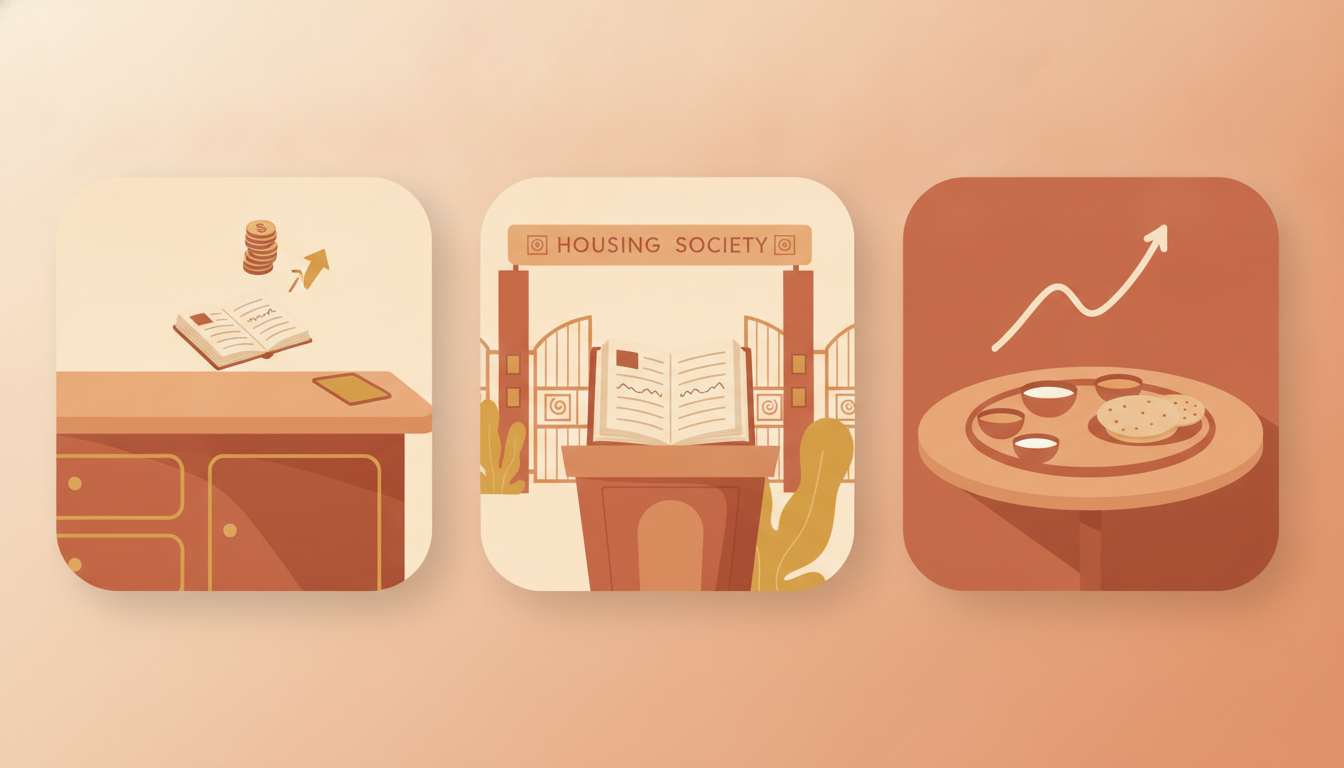
Three situations, three tools
Situation one: "What did we pay Ramesh last month, and did he take leave in June?"
Households that employ staff juggle attendance, leave, salary advances and final settlements, often across two adults' memories and a diary. Grihini is described as "Attendance, leave, salary and payment records for household staff." The job is record-keeping: a shared, checkable trail of what was agreed, taken and paid.
Two honest boundaries. First, Grihini records employment facts; it does not give legal advice on wages, contracts or statutory dues, and this guide will not either. Second, the data involved belongs partly to another person. The person whose attendance and salary you log has a stake in records being accurate, so it is fair to keep entries factual and correct mistakes when they are pointed out.
Status: "Available on iOS and Android." Grihini is the only Big Helpers app with a public Google Play listing today, which matters for households where one adult uses an iPhone and the other Android.
Situation two: "Who is at the gate, and why are they here?"
Apartments and gated communities run on arrivals: delivery riders, guests, technicians, cab drivers. Agman is described as "Residential society and visitor workflows for safer, simpler arrivals." The job is the arrival workflow, capturing who has come and making the entry smooth.
Boundaries again. Visitor management is legitimately useful and also legitimately sensitive: it records movements of neighbours, guests and workers. Use it for genuine arrival management, tell people what is being recorded when that is the practice of your society, and do not stretch a visitor tool into informal surveillance of residents or staff. The description says safer, simpler arrivals; it does not promise security outcomes, and no tool should be assumed to prevent incidents.
Status: "Available on iOS. Android is in controlled testing."
Situation three: "What am I actually eating, and which way is my weight going?"
Everyday health is mostly tracking: what you ate, how the trend looks over weeks. Burnie is described as "An Indian calorie, food logging and weight-trend companion." The job is logging and trend-watching, tuned to Indian food rather than generic Western databases.
The boundary here is medical. Burnie is a companion for logging and trends; it is not a doctor, a diagnostic tool or a treatment plan. Weight and diet changes with health conditions involved deserve a clinician's guidance, and no app substitutes for that. What a tracking companion does well is make visible what otherwise stays guesswork, so your conversation with a professional, if you have one, starts from data instead of impressions.
Status: "Available on iOS. Android is in controlled testing."
Why these three should not merge
It is tempting to imagine one "home super-app" that knows staff payments, visitor entries and the family's meals. Resist the picture. These datasets have different owners, different sensitivity and different blast radius if leaked or misused. Staff salary records concern a person's livelihood. Visitor logs concern many people's movements. Food and weight logs concern your body and health.
Keeping them in separate apps is not a limitation; it is containment. A mistake or breach in one does not cascade into the others, and sharing access, say giving a society committee member visibility, stays scoped to what that person actually needs. Big Helpers keeps the products separate too, and its waitlist privacy notice states the form itself does not collect household records or health information, only your interest in the apps.
Decision table
| Your situation | App | Core job (portfolio wording) | Whose data it holds | Availability |
|---|---|---|---|---|
| Paying and recording household staff | Grihini | "Attendance, leave, salary and payment records for household staff" | The employer's and the staff member's | Available on iOS and Android. |
| Managing society or visitor arrivals | Agman | "Residential society and visitor workflows for safer, simpler arrivals" | Visitors', residents' and workers' | Available on iOS. Android is in controlled testing. |
| Tracking daily food and weight | Burnie | "An Indian calorie, food logging and weight-trend companion" | Yours or your family member's | Available on iOS. Android is in controlled testing. |
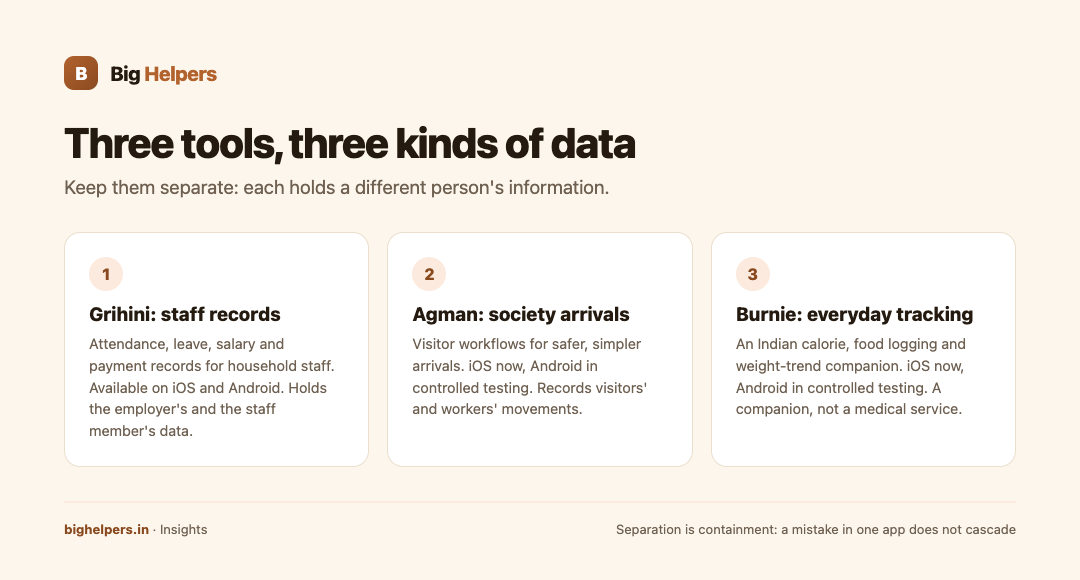
A calm adoption path
- Start with the single most disputed record in your home. For most households that is staff payments, so Grihini lands first, and its dual-store availability lets both adults install it the same day.
- Add Agman when your society or building actually adopts a digital arrival flow; a visitor app used by one flat alone adds little.
- Add Burnie when you have two weeks of willingness to log meals honestly. Trends need data; a week of enthusiasm followed by silence builds nothing.
- Revisit each app's settings after a month and confirm who in the family has access to what.
Your next step
Open the Big Helpers apps page, choose the one situation that causes the most friction in your home this week, and install or waitlist only that app. For household-adjacent business needs, such as a shop or service run from home, our local business page covers that ground separately.
Disclosure: Grihini, Agman and Burnie are Big Helpers products. This guide deliberately avoids employment, security, surveillance and medical claims beyond what their published descriptions state.
Frequently asked questions
Which of the three can Android users install today?
Only Grihini, whose exact status is "Available on iOS and Android." Agman and Burnie have no public Android listing yet.
Does Grihini calculate statutory dues or salaries?
The published description covers attendance, leave, salary and payment records. No claim of statutory calculation is made publicly, so verify in the app before relying on it for compliance figures.
Can Agman secure my building?
The description targets safer, simpler arrivals. It manages arrival workflows; it does not promise to prevent incidents, and societies should keep their usual security practices.
Is Burnie a diet or medical recommendation app?
No. It is described as a calorie, food logging and weight-trend companion. It records and shows trends; it does not diagnose or prescribe.
Do these three apps share data with each other?
No connection between them is documented. They are separate products for separate situations, which this guide recommends preserving.
What should I check before logging another person's details?
Accuracy and fairness. Records about staff, visitors or family members affect real people, so keep entries factual, and know the company's stated practices in the privacy policy and the waitlist privacy notice.
Sources & references
- Big Helpers app portfolio page, bighelpers.in/apps/ (app descriptions and status labels, 29 August 2026)
- Grihini App Store and Google Play listings (both checked 29 August 2026)
- Big Helpers App Waitlist Privacy Notice, bighelpers.in/apps/privacy/
Pricing in this guide is verified as of the article date. Verify with vendors before committing budget — rates change quarterly.