
The short answer
Block 30 minutes this week, open last month's enquiries and bills, and answer five sets of questions. That is the whole audit. By minute 30 you will know which part of your business leaks the most time: capture of enquiries, follow-up, billing, payment collection, or the repeated manual work nobody counts. You do not need software to run it, only a pen, your phone and one honest hour of records.

Most owners skip this because audits sound like consulting projects. This one is shorter than an episode of the news.
Before you start
Collect four things:
- Your last 20 enquiries, from wherever they landed: WhatsApp, phone log, Instagram DM, IndiaMART, or a form.
- Your last 10 bills or invoices, however you raised them.
- A rough count of how many reminders you sent for unpaid bills.
- One task you or your staff did more than twice this week that felt repetitive.
Keep the number 20 fixed. A smaller sample hides the pattern; a larger one eats your evening.
The run sheet
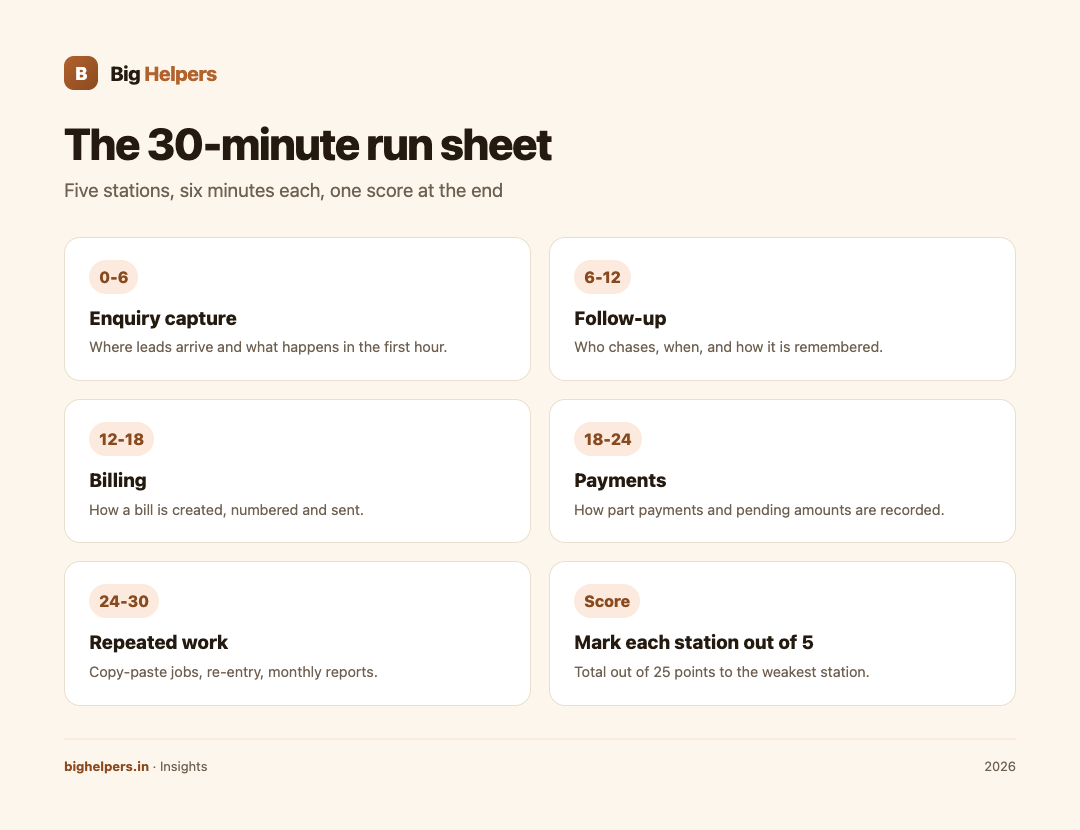
Work through the five stations in order. Each takes about six minutes.
| Minutes | Station | What you look at |
|---|---|---|
| 0 to 6 | Enquiry capture | Where leads arrive and what happens in the first hour |
| 6 to 12 | Follow-up | Who chases, when, and how it is remembered |
| 12 to 18 | Billing | How a bill is created, numbered and sent |
| 18 to 24 | Payments | How you record part payments and pending amounts |
| 24 to 30 | Repeated work | Copy-paste jobs, re-entry, monthly reports |
Set a phone timer. Overrunning one station is itself a finding.
Station 1: Enquiry capture
For each of the 20 enquiries, write down where it came from and whether it is written anywhere other than the chat it arrived in.
You are testing one thing: if the person who received the enquiry left tomorrow, would the business still know the lead exists?
Mark a yes or no per enquiry. More than five "no" answers means your capture is living in personal inboxes. That is the most common first finding in Indian service businesses, and it is fixable without a big build.
Station 2: Follow-up
Now check which of the 20 enquiries got a second touch, and when. Look for three patterns:
- Enquiries answered after a day or more.
- Enquiries never followed up a second time at all.
- Follow-ups that happened only because someone remembered.
Count how many of the 20 had a scheduled, written next action. Not a good intention, an actual date in a calendar or sheet.
The gap between enquiries received and enquiries with a scheduled next step is your follow-up leak. In most audits it is the largest single leak, and it is a process gap before it is a software gap.
Station 3: Billing
Take the 10 bills and answer four questions:
- Can you find the bill number, date and amount in under a minute?
- Does the bill go out as a clean PDF, or as a photographed note or a typed message?
- Are GST details, where applicable, applied the same way every time?
- Is the bill connected to the enquiry and the quote that produced it, or does it live in a separate folder?
Inconsistent numbering and disconnected bills cause most month-end pain. They also make it hard to answer a simple owner question: which customer owes how much?
Station 4: Payments
Payments deserve their own station even though they feel like part of billing, because part payments are where records break.
Check whether you can answer, without opening three apps: who paid this month, who paid partly, how much is pending, and since when.
If the honest answer involves scrolling chat history, your collection memory lives in WhatsApp, and it will fail exactly when you need it during a cash crunch.
A simple structure here is often enough: a bill with a payment status of paid, part-paid or due, a UPI reference recorded against it, and a monthly total. Products such as BusinessSetu Pro do exactly this, with UPI QR on invoices and pending amounts visible without manual notes, as described on the BusinessSetu use-cases page.
Station 5: Repeated work
List every task you did more than twice this week that involved copying information from one place to another. Common ones:
- Retyping a WhatsApp order into a bill.
- Pasting an address from a chat into a delivery note.
- Manually adding up monthly sales.
- Sending the same reminder message from scratch.
- Updating two sheets that should have been one.
Score each task by minutes per week, not by how annoying it feels. A five-minute daily task is over three hours a month. Two or three such tasks is a working day lost, every month.
Scoring your audit
Give each station a mark out of 5, where 5 means records are central, written and repeatable, and 1 means memory and chat history.
Add up the total out of 25, then read the table below. The numbers are a guide to where to spend first, not a verdict on your business.
| Score | What it usually means | Sensible first move |
|---|---|---|
| 20 to 25 | Records are in decent shape | Optimise: fix the weakest single station only |
| 13 to 19 | Mixed: some parts central, some scattered | Fix capture and follow-up before anything else |
| 6 to 12 | Business runs on memory and chats | Move billing and payments into one simple system |
| 0 to 5 | High risk of losing leads and money | Start with a written map of the whole flow |
Matching the finding to the right spend
The point of the audit is to prevent the most expensive mistake in Indian SME digitisation: buying a big build for a small-record problem, or buying a small tool for a workflow problem.
Use this mapping:
- Weak capture and follow-up, decent everything else. Your website is probably not doing its job as a lead capture point, or leads arrive in five places. A lead-ready website with a single form destination is the cheapest fix. The Big Helpers web development service covers static, WordPress and custom builds with published INR ranges.
- Capture is fine, billing and payment records are chaos. You do not need custom software. A simple billing tool with quotes, GST or simple bills, UPI QR, expense receipts and CA-ready reports fits. BusinessSetu Pro starts at a published monthly price with a free trial, so you can verify fit before committing.
- Multiple staff, hand-offs, and no single record. This is a customer relationship management problem, not a billing problem. See the custom CRM and software service.
- The same manual task burns hours weekly. Test whether automation removes it. The business process automation service exists for exactly this, but only automate after the audit shows the hours are real.
One 60-person distribution SME hit this wall and took the custom CRM route; the case study is worth reading before you decide your problem needs the same medicine, because many do not.
Common mistakes in a self-audit
- Auditing a good week. Pick a normal, slightly messy week. Good weeks flatter everyone.
- Counting tools instead of records. Six apps with scattered records scores lower than one sheet kept honestly.
- Skipping the payment station because "billing covers it". Part payments are where the money hides.
- Turning the audit into a shopping list. Finish the score first, then choose one station to fix.
- Never re-running it. Repeat the audit quarterly; it takes 30 minutes.
Example
Example: a two-person home-interiors studio runs the audit. Enquiries arrive from Instagram, a friend's referral and one IndiaMART listing, so capture scores 2. Follow-up happens only when the owner remembers, scoring 1. Billing uses a clean template, scoring 4. Payments are tracked by screenshot, scoring 2. Repeated work includes retyping measurements into quotations, scoring 2. Total: 11 out of 25.
The correct first move is not a custom build. It is consolidating enquiry capture and follow-up, then moving payment records out of screenshots. Custom software would be premature at this stage.
Frequently asked questions
How often should I run this audit?
Once every quarter is enough for most small businesses. Run it again after any big change, such as a new website, a new team member or a new sales channel.
What if I cannot find 20 enquiries?
Use what you have, even if it is 8. A small sample still shows where leads land and whether follow-up is written down. If 8 is genuinely all you have, your audit finding is about lead volume, not workflow.
Is a low score bad?
No. A low score is simply a clear instruction to start with records, not with a large purchase. Most businesses score lower than their owners expect.
Should I audit my staff's work or my own?
Both, but audit your own first. Owners usually control capture and billing, and staff inherit whatever system the owner leaves them.
What if every station scores badly?
Fix in this order: capture, follow-up, billing, payments, then automation. Trying to fix all five at once is how projects overrun.
Your next step
Run the audit this week, note the score, and pick the single weakest station. If you want a second pair of eyes on the result, Big Helpers offers a free 20-minute discovery call to talk through what the score means and what a sensible next build, if any, would cost in INR. You can reach the team on WhatsApp at +91 96305 99557 or through the contact page.
Sources & references
- Big Helpers services: service descriptions with published INR ranges.
- Custom CRM and software service: for multi-staff, hand-off-heavy records.
- Business process automation service: for repeated manual work the audit surfaces.
- BusinessSetu use cases: UPI QR on invoices and visible pending amounts.
- Case study: SME CRM replacement: the 60-person distribution example cited in the article.
Pricing in this guide is verified as of the article date. Verify with vendors before committing budget — rates change quarterly.