
Quick answer
Treat a festival bonus as a planned household decision, not a last-minute envelope. Fix your budget early, set a fairness rule you can explain, record what each person received last year, and give it with a clear, kind word before the festival. Whether any payment is legally due depends on your specific engagement and state law; this article is about making a voluntary gift well.

Voluntary decision, applicable law: keep them apart
Around Diwali, Bhai Dooj, Eid, Christmas and Pongal, most Indian households give household helpers money, sweets, clothes or grain. Two different things often get mixed up in conversation.
The first is a voluntary household decision: you choose to give, and to whom, and how much. Tradition and your own household's practice guide it. The second is anything applicable law provides, which depends on the employment, the state, and sometimes registration or welfare schemes. This article does not claim a universal legal bonus exists for domestic workers, because there is not one simple national answer. If your question is "must I pay this?", that is a question for your state labour department, not for a tradition or a neighbour's practice.
Everything below is about the first kind: planning a gift so it is fair, memorable to your household, and respectful to the person receiving it.
Start with last year's record
Fairness across years needs memory, and memory needs a note. Before this festival season, rebuild a small table for the last two years:
| Person | Role | Years with us | Last year | Form | Given on |
|---|---|---|---|---|---|
| Sunita | Cook | 6 | Rs 3,001 | Cash and sweets | Diwali morning |
| Ramesh | Driver | 3 | Rs 2,001 | Bank transfer and sweets | Diwali morning |
| Asha | Cleaning, part time | 1 | Rs 1,100 | Cash and sweets | Diwali morning |
With this in front of you, three questions answer themselves. Did everyone get something? Did longer service get recognised? Did part-time helpers get a fair share rather than an afterthought? A household that can answer these is already fairer than one that decides at the gate on festival morning.
A fairness rule you can explain
Pick one rule and apply it to everyone, so no one has to guess where they stand:
- Flat rule. Everyone receives the same amount regardless of role or tenure. Simple and dignified.
- Tenure rule. A base amount plus a step for each completed year of service. Explains differences without embarrassment.
- Pro-rata rule for part-time helpers. Half days and weekly helpers receive a defined fraction of the full-time amount, agreed in advance.
Write the rule in your household note. When a new helper asks what to expect, you can answer plainly, and when relatives ask why amounts differ, the rule speaks instead of a vague "it depends".
The planning table for this year
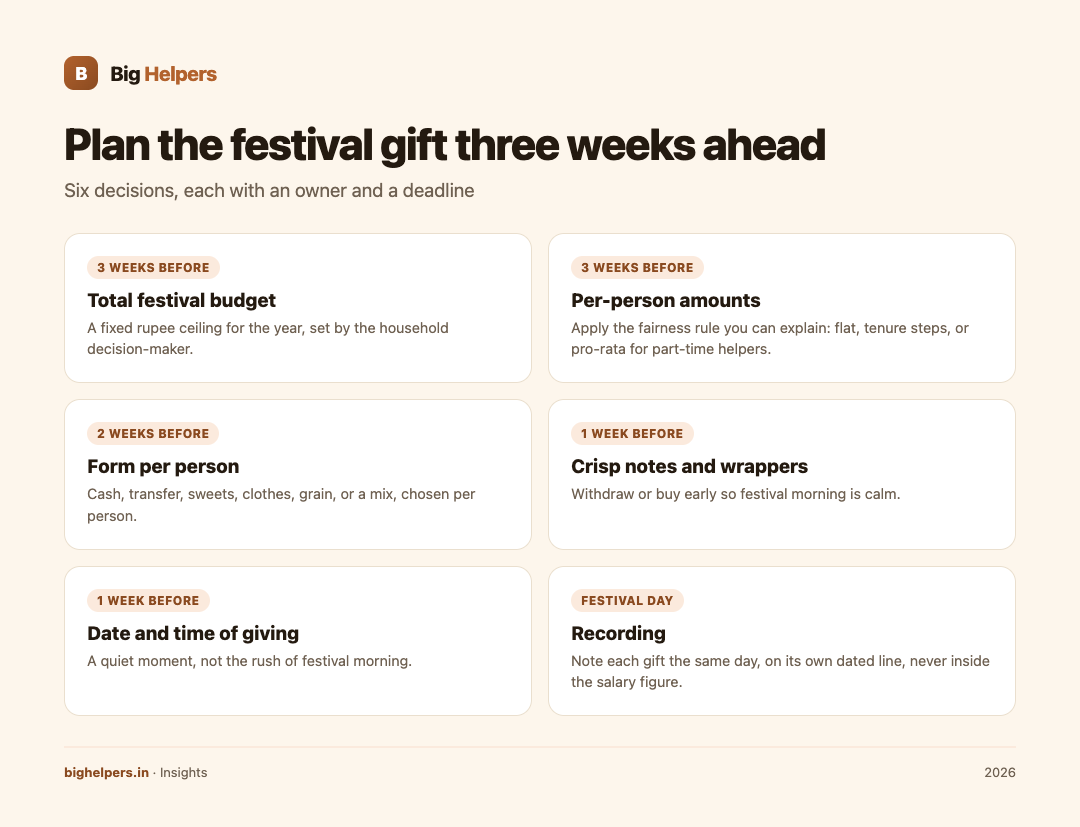
Move from record to plan at least three weeks before the festival:
| Item | Decision | Owner | Done by |
|---|---|---|---|
| Total festival budget | Fixed rupee ceiling for the year | Household decision-maker | 3 weeks before |
| Per-person amounts | Apply the fairness rule to the list | Same | 3 weeks before |
| Form per person | Cash, transfer, sweets, clothes, grain, or a mix | Same | 2 weeks before |
| New crisp notes or wrappers | Withdraw or buy early | Whoever gives | 1 week before |
| Date and time of giving | A calm moment, not the rush of festival morning | All | 1 week before |
| Recording | Note each gift the same day | Whoever keeps records | Festival day |
Planning early also protects the household budget. A festival spend decided in a shop queue is always larger and less even than one decided at a kitchen table.
The conversation, done respectfully
A bonus conversation takes two minutes and should never feel like a favour being weighed in front of someone. When you give:
- Name the occasion and the thanks. "For Diwali, thank you for taking such care of the house this year."
- Say what it is. "This is a small something from us, with sweets for the children."
- Do not quiz the recipient. No questions about how it will be spent, saved or sent home. Once given, it is theirs.
- Avoid comparison commentary. Never explain that someone else received more because of tenure in front of others. If asked privately, the fairness rule answers plainly.
One more practice worth keeping: give the money before the festival rather than after. The point of a festival payment is that it arrives when the expenses do.
Common mistakes
- The invisible raise. Quietly adding festival money to the salary account with no note. Later, no one remembers whether it was a gift, an advance, or arrears.
- In-year drift. One helper helped with a wedding in March and received an extra payment; by Diwali the household has forgotten and the worker remembers. Keep a dated line for every out-of-cycle gift.
- Gifts that become invisible deductions. A bonus given warmly in October and recovered coldly in November. If it is a gift, it never comes back; if it is an advance, say so at the start.
- Unequal surprise. Two helpers with similar work receiving visibly different envelopes with no stated reason. The fairness rule exists precisely to prevent this.
- Only cash. Some households prefer grain, clothes or a utensil; preferences vary and asking respectfully a week ahead is welcome in most homes.
- Skipping new helpers. A helper who joined two months before the festival usually receives a proportionate gift under the fairness rule. Being newest should not mean being forgotten.
Where Grihini fits
Grihini by Big Helpers keeps attendance, leave, salary and payment records for household staff. Its store listing confirms a festival planning feature called Plan for Tyohar: prepare festival cash, gifts, food or clothing for each staff member and share a clear summary with your family. The same app also keeps gifts and bonuses as distinct, dated entries, which supports the year-on-year table this article began with. Grihini is available on iOS and Android. More household guides sit in the insights library.
One next step
Write this year's festival plan into one table today. Grihini is available on iOS and Android, and its festival planning feature is listed on the Big Helpers apps page.
Frequently asked questions
Is a festival bonus legally required for domestic workers?
This article does not claim that, because there is no single national answer for private households. Entitlements depend on the engagement, the state and sometimes welfare registration. For a legal question, check with your state labour department; the Ministry of Labour and Employment portal is a reasonable starting point.
What is a common amount?
Households differ widely, and amounts shift with city and role, so this article deliberately avoids prescribing figures. A useful anchor is your own record: last year's amount, plus any deliberate change under your stated fairness rule.
Should part-time helpers receive the same as full-time staff?
Most households apply a pro-rata rule and say so in advance. The fairness principle is that the rule is known, not that the amounts match.
How do we record gifts of clothes or grain instead of cash?
Record the item and its approximate value, with the date and the occasion. A note like "saree and sweets, Diwali" is enough for household records.
Does a bonus affect the next month's salary statement?
No, as long as it is recorded as a gift. Keep gifts and salary on separate lines so neither the household nor the worker ever has to reconstruct what was earned versus what was given.
Where can helpers themselves access welfare benefits?
The national e-Shram portal (eshram.gov.in) is the Ministry of Labour and Employment's portal for unorganised workers; some welfare measures link to it. Registration is the worker's own choice, and helping her know the portal exists is a kind, non-intrusive gesture.
General planning guidance, not legal advice. Questions about entitlements belong with your state labour department.
Sources & references
- Big Helpers apps page, store availability checked 29 August 2026
- Grihini App Store listing, official Apple iTunes metadata (id6791213662)
- Grihini Google Play listing
- Ministry of Labour and Employment, labour.gov.in
- National e-Shram portal for unorganised workers, eshram.gov.in
Pricing in this guide is verified as of the article date. Verify with vendors before committing budget — rates change quarterly.