
Quick answer
Write down the date, the amount, and the repayment you both agreed, the moment the advance is given. Show the entry to the worker and keep a receipt or acknowledgement. Adjust it as a separate, visible line at month end, never inside the salary figure. Advances recorded this way stay a kindness; advances held in memory become disputes.

Why advances go wrong
A salary advance is a routine, reasonable request. Medical bills, school fees, travel home and festival costs do not wait for payday. What turns a helpful act into a month-end argument is not the money. It is the missing record: no date, no amount in writing, no agreed adjustment, and two different memories by the last day of the month.
The fix is administrative, not personal. Treat an advance as a small, respectful transaction with four fields, and it stops being a source of friction.
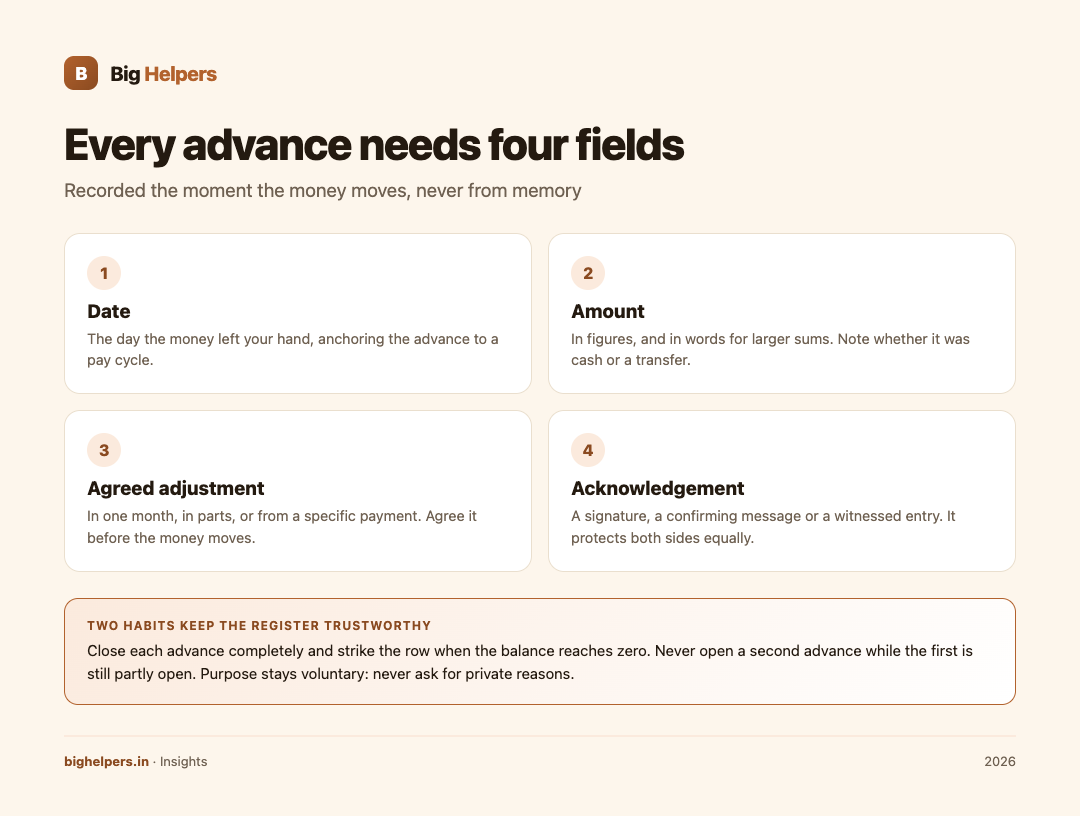
The four fields every advance needs
- Date. The day the money left your hand. The date anchors it to a pay cycle.
- Amount. In figures and, for larger sums, in words. Note whether it is cash or a transfer.
- Agreed adjustment. How and when it comes back: in one month, in parts over three months, or from a specific payment. Agree it before the money moves.
- Acknowledgement. A signature on the entry, a message that says "received", or any form both of you accept. This protects both sides equally.
One more field is optional and private: purpose. Record a reason only if the worker offers it voluntarily. A household register does not need a medical history to justify an advance, and asking for one changes the relationship. "Requested on 12th, agreed over three months" is a complete entry without any private detail.
An advance register you can copy
Keep one row per advance. This register works in a notebook, a spreadsheet, or an app.
| # | Date | Staff | Amount | How given | Adjustment agreed | Acknowledged | Adjusted so far | Balance |
|---|---|---|---|---|---|---|---|---|
| 1 | 05 Jun | Ramesh | Rs 3,000 | UPI transfer | Rs 1,000 a month for 3 months | Yes, message | Rs 3,000 | Rs 0 |
| 2 | 12 Jun | Sunita | Rs 1,500 | Cash | Full, from June salary | Yes, signature | Rs 1,500 | Rs 0 |
| 3 | 02 Aug | Ramesh | Rs 2,000 | Cash | Rs 500 a month from Sept | Yes, message | Rs 500 | Rs 1,500 |
Two habits make this register trustworthy. First, close each advance completely: write the final adjustment date and strike through the row when the balance reaches zero. Second, never open a new advance while one is still partly open unless you have both said so in words, because stacked recoveries shrink a salary month after month and breed resentment on both sides.
A respectful conversation, in four sentences
You can be warm and still be clear. When the request comes:
- "Yes, we can manage that. How much do you need right now?"
- "Let us write it down together, the date and the amount, so neither of us has to remember."
- "Would it be easier to return it in one month, or in parts over two or three months?"
- "I will show you the line in the salary statement each month until it is finished."
Then, at month end, open the statement and point at the line before payment. The advance is not a favour being quietly recalled; it is a visible, agreed item.
Privacy and dignity practices
- Never announce an advance in front of others. Money matters are discussed one to one.
- Do not attach conditions to a private life. The advance is a wage matter; how the worker lives is not part of the register.
- Give the worker the same record. A photograph of the entry, a copy of the statement, or a signed slip. Information asymmetry is where suspicion grows.
- Keep the register where only the household's decision-makers can see it, not on a common table or a shared phone screen.
Common mistakes
- The verbal advance. "I will deduct it somehow" is how a 2,000 rupee advance becomes an argument about 3,000.
- Recovery by surprise. A salary envelope that is simply lighter, with no line item, reads as a penalty rather than an agreement.
- Stacking advances. A second advance before the first closes can take a whole month's pay below what the household itself agreed was fair.
- No receipt. If memory disagrees, the person who gave the cash has no proof and the person who received it has no closure. Both lose.
- Recording the purpose when it was not offered. It invites the worker to share medical or family details to "earn" the advance. Keep purpose voluntary or absent.
- Leaving the register open. Old half-adjusted rows make every new statement noisy and disputed.
Where Grihini fits
Grihini by Big Helpers keeps attendance, leave, salary and payment records for household staff. Its store listing confirms it tracks salary advances, festival gifts, bonuses and recoverable items, and that each entry remains part of the final settlement. That matches the register above: every advance is a dated entry that stays visible until the month's statement closes. Grihini is available on iOS and Android. Related money-and-records guides sit in the insights library.
One next step
Set up your advance register today, on paper or in an app. Grihini is available on iOS and Android; its current status and store links are listed on the Big Helpers apps page.
Frequently asked questions
How much of a monthly salary can be adjusted at once?
There is no single rule for private households, and this article does not set one. Agree an adjustment that leaves the month's pay workable, write it down, and follow it. Where a formal entitlement question arises, your state labour department is the right place to ask.
Should I take a signature every time?
Use whatever acknowledgement both of you accept as normal: a signature, a confirming message, or a witnessed entry. The form matters less than the fact that both sides saw the same number.
What if the worker asks to change the repayment plan?
Listen, then update the register together with the new plan and date. A changed plan that is written down is still a plan; a changed plan that is remembered differently is a dispute.
Do advances earn anything extra?
An advance against salary is not a loan product and this article does not advise on interest or charges. If you and the worker agree on anything beyond returning the same amount, put it in writing and keep it transparent.
Can I record advances for gifts separately from advances for salary?
Yes, and you should. A gift is not recovered. Grihini's listing, for example, tracks advances, gifts and recoverables as separate kinds of entries, which prevents a gift from quietly becoming a deduction.
What happens when the employment ends with an advance open?
Settle it in the final statement, showing the earned amount, the open balance and the final figure, and let the worker see every line before the last payment.
General record-keeping guidance, not legal advice. Terms of employment and wage questions depend on your state and engagement.
Sources & references
- Big Helpers apps page, store availability checked 29 August 2026
- Grihini App Store listing, official Apple iTunes metadata (id6791213662)
- Grihini Google Play listing
Pricing in this guide is verified as of the article date. Verify with vendors before committing budget — rates change quarterly.