
Quick answer
Agree on a fixed monthly amount, the working days it covers, and the leave rule before the month begins. Mark each day as present, absent, leave or half day. At month end, divide the monthly amount by the agreed working days to get one day's pay, apply the agreed deductions and additions, and read the statement aloud together before paying. A written statement prevents almost every payday disagreement.

What to settle before the month starts
Most payday arguments are not about arithmetic. They are about assumptions that were never spoken aloud. Fix these four things at the start:
- Monthly amount. The full rupee figure, in words as well as numbers.
- What it covers. How many working days, weekly offs, and the daily hours.
- Leave rule. Which absences are paid and which reduce the month's pay, agreed by both sides.
- Extras. Overtime rate, festival payments, food or travel allowance, and how each is counted.
Write these in one line and keep it with the attendance record. When either of you forgets an agreement, the note answers it. Wage rules and entitlements for domestic work differ by state and by the nature of the engagement, so this article sets out a neutral accounting method and not legal rules. Your state labour department remains the place to check what applies to your household.
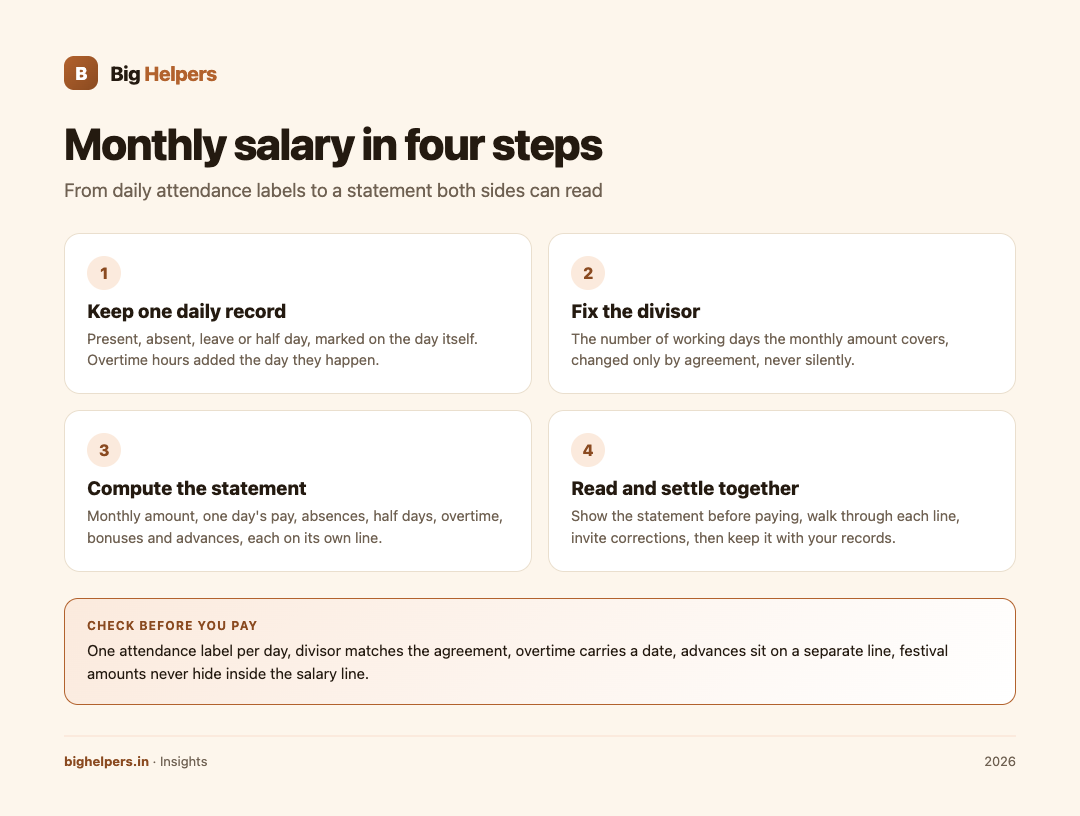
The four-step method
Step 1: Keep one daily record
Mark every scheduled day with one label: present, absent, leave or half day. Half days include late arrivals or early departures only if you both agreed how they count. Do this on the day itself, not from memory on the last day of the month. Add overtime hours on the day they happen.
Step 2: Fix the divisor
The divisor is the number of working days you both agreed the monthly amount covers. If Sunita's monthly amount covers 26 days in a month that actually has 27 working days, the divisor stays 26 unless you both agreed otherwise. The mistake to avoid is changing the divisor silently from month to month to suit one side.
Step 3: Compute the statement
Use this order so both of you can follow the maths:
| Line | Item | How it is computed |
|---|---|---|
| 1 | Monthly amount | The agreed figure |
| 2 | One day's pay | Monthly amount divided by the agreed working days |
| 3 | Unpaid absences | Absent days multiplied by one day's pay |
| 4 | Half days | Half of one day's pay, per agreed half day |
| 5 | Paid leave | Zero effect, by agreement |
| 6 | Overtime | Agreed rate multiplied by overtime hours |
| 7 | Festival or bonus amounts | As agreed, shown separately |
| 8 | Advances adjusted | Deducted only as agreed, shown as a separate line |
| 9 | Net payable | The final figure after every line above |
Step 4: Read and settle together
Show the statement before paying, not after. Walk through each line, invite corrections, then pay. Keep the statement with your records even after payment. If a question comes up weeks later, the settled statement is the answer.
A neutral worked example
Sunita works as a cook. The agreed monthly amount is Rs 9,000 covering 26 working days, with two paid leave days a month and Rs 100 per extra hour beyond the usual shift.
In one month with 27 working days, her record shows 23 present, 1 paid leave, 1 absent without leave, 1 half day, and 3 overtime hours. Her statement reads:
| Item | Working | Amount |
|---|---|---|
| One day's pay | 9,000 divided by 26 | Rs 346.15 |
| Unpaid absence | 1 day | minus Rs 346.15 |
| Half day | Half of one day | minus Rs 173.08 |
| Overtime | 3 hours at Rs 100 | plus Rs 300 |
| Net payable | Rs 8,780.77 |
Round the final figure to a whole rupee and say so on the statement: Rs 8,781. Rounding is fine when it is visible; it corrodes trust when it is silent. Notice that the paid leave and the extra 27th working day change nothing here, because the agreement was 26 days and two paid leaves. Both sides knew this in advance, so nobody argues on payday.
Verification checklist before you pay
Run through this list once each month. It takes five minutes and catches nearly every error:
- [ ] Every scheduled day has exactly one attendance label
- [ ] The divisor matches the agreed working days, not the calendar
- [ ] Every unpaid absence was actually communicated during the month
- [ ] Overtime hours carry a date and a rough task note
- [ ] Advance adjustments match the repayment agreed earlier
- [ ] Festival or bonus items appear on their own line, never inside the salary line
- [ ] The statement was shown and explained before payment
- [ ] One copy stays with your records after payment
Common mistakes
- Changing the divisor month to month. It quietly shifts value from one side to the other. Change it only by agreement.
- Silent deductions. Every deduction must sit on its own line with a reason. A lump sum that is simply smaller breaks trust.
- Rounding down only. Round to the nearest rupee, in whichever direction it falls.
- Mixing advances into the salary line. Adjust advances as a separate line so the worker can see the gross earned amount first.
- Reconstructing the month from memory. Attendance recorded on the day is evidence; memory is opinion.
- Explaining only when challenged. Read the statement aloud every month, even the quiet ones. Routine transparency is what makes the record believable on a hard month.
Where Grihini fits
Grihini by Big Helpers keeps attendance, leave, salary and payment records for household staff. Its store listing confirms it records present, absent, leave or half day for each staff member, shows the month on a calendar, and supports overtime entries. It prepares a salary statement from attendance, unpaid leave, overtime and bonuses, and lets you review the calculation before marking anything as paid. Grihini is available on iOS and Android. If you prefer a paper register first, run the method above for a month, then move the same records into the app. This guide is part of a wider insights library of practical records articles for Indian households.
One next step
Move your attendance and settlement workflow onto your phone. Grihini is available on iOS and Android, and its listing on the Big Helpers apps page shows the current status of every platform. Questions about household tools can also go straight to Big Helpers.
Frequently asked questions
Does a half day always mean half pay?
Only if you agreed to it. Agree on what counts as a half day and how it is paid before it occurs, then apply that rule consistently.
What if we never fixed how many days the salary covers?
Fix it now, kindly. Pick a divisor, write it down with the date, and apply it from the next cycle. For the current month, use the interpretation the worker understood and note the new agreement going forward.
Should the 31st day of a long month add pay?
It does not, as long as the monthly amount was agreed for a set number of working days rather than for the calendar. If you both prefer calendar counting, agree on that method instead and note it.
How long should we keep statements?
Keep at least one full year, ideally two, so that festival payments, advance recoveries and old questions can be cross-checked later.
Can the worker keep a copy of the statement?
Yes, and offering it is good practice. A statement both sides can read is the strongest protection for the person with less bargaining power.
Does this method decide what we legally owe?
No. This is an accounting method. Wage rules and entitlements vary by state and engagement, so check with your state labour department for anything that feels like a legal question.
This article offers a neutral record-keeping method and general information, not legal advice. Wage rules differ by state and by engagement; consult your state labour department for specific questions.
Sources & references
- Big Helpers apps page, store availability checked 29 August 2026
- Grihini App Store listing, official Apple iTunes metadata (id6791213662)
- Grihini Google Play listing
- Ministry of Labour and Employment, labour.gov.in
Pricing in this guide is verified as of the article date. Verify with vendors before committing budget — rates change quarterly.