
TL;DR: five folders, one boundary
A government employee's personal planning workspace should hold five things:
- Reference links
- Your own dates and deadlines
- Working calculations
- Personal task lists
- Drafts in progress
It should hold nothing from the official record: no files, no notes from office e-mail, no citizen or personnel data. Keep the two apart deliberately, follow your department's IT and conduct rules, and prefer tools that work when the network does not.
The boundary rule, stated first
Personal planning tools plan. Official systems hold the record. Whatever your department uses for files, e-mail, leave applications and service matters remains the only home for that material, and your department's information-security rules govern what may leave those systems. A personal workspace on your own phone holds your working notes about your own schedule, nothing more. When in doubt, the test is simple: if the material would appear on an office file, it does not belong in your pocket.
What "offline-first" means for planning
Offline-first means the workspace keeps working when connectivity drops: your notes open, your dates stay visible, your calculations recompute, whether or not you have signal. For field postings, inspection tours and commute planning, that reliability matters more than any cloud feature. The label describes a design goal, not a security classification; offline storage still lives on a device you must protect.
One drawer, five folders
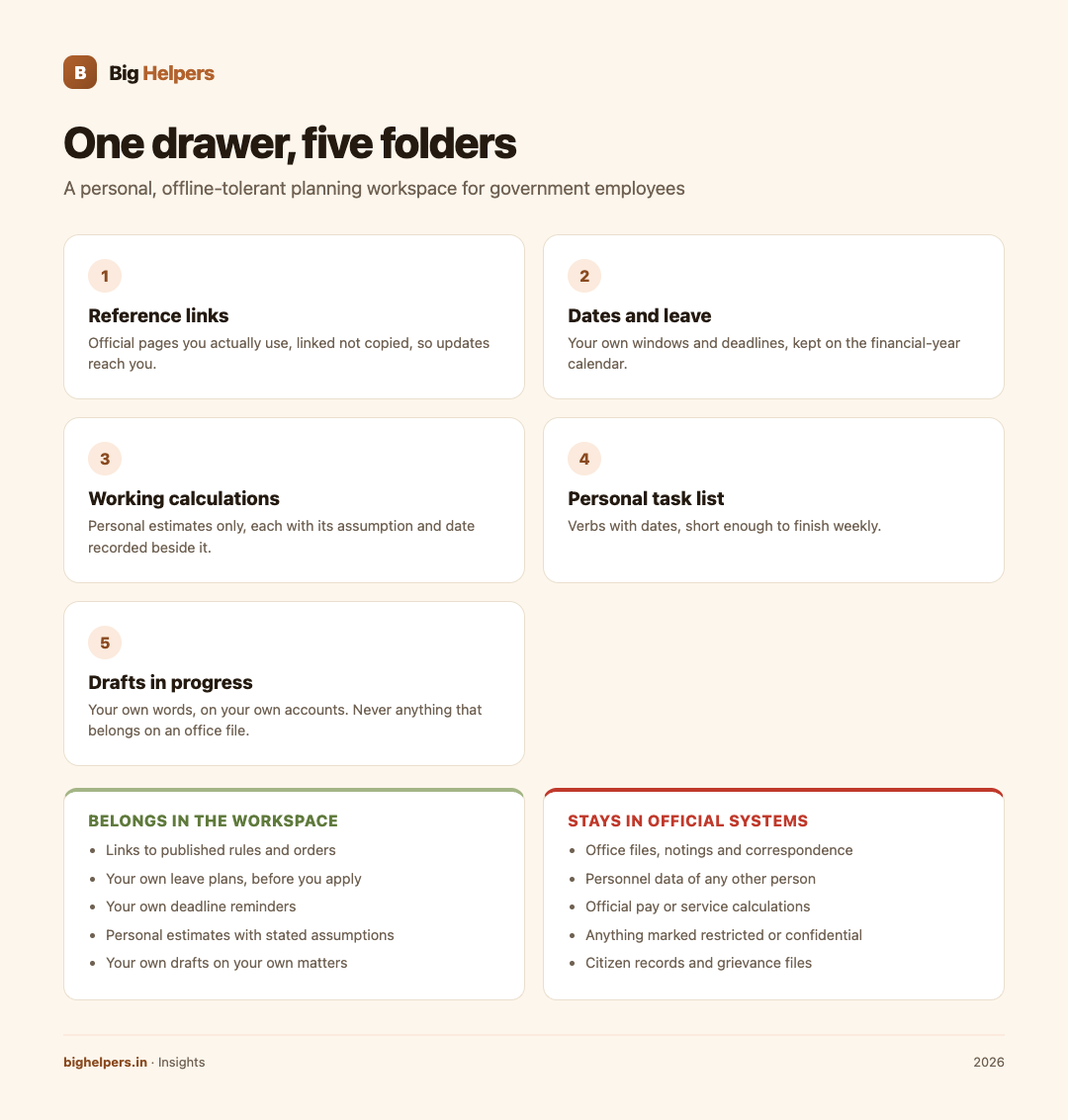
Folder 1: Reference links. A short list of official pages you actually use: your department's orders portal, the leave rules compilation for your service, pay-related instruction pages. For central government employees, the CCS (Leave) Rules, 1972 compilation on DoPT, updated as on 18 October 2023, is a good anchor to keep linked; state governments, PSUs and autonomous bodies have their own rules, so link the one that governs you. Links, not copies: if the order updates, the link keeps you current and a stale copy cannot mislead you.
Folder 2: Dates and leave. Your own dates only: planned leave windows you are considering, training dates, review meetings you must prepare for, the financial-year calendar that drives your work. Note the financial year deliberately; most government timelines, from appraisals to budget submissions, run on it, and personal calendars that default to the calendar year quietly misfile April and May.
Folder 3: Working calculations. Personal estimates: how many working days remain before a deadline, how much of your leave balance a two-week break would use, what a tentative retirement date implies. Record each calculation's assumption beside it and its date, because estimates age. Never paste the input data of an official calculation, such as another person's service record, into this folder; the calculation there belongs to the office system.
Folder 4: Personal task list. The plain to-do list: forms to gather for your own submission, questions to ask at the next review, personal development tasks. Write tasks as verbs with dates, and keep the list short enough to finish weekly.
Folder 5: Drafts in progress. Your own words: a draft representation about your own service matters, a study plan, notes for an exam. Keep drafts on your own accounts and devices, and never draft anything here that belongs on an official file, because drafts leak into final documents by habit.
What stays out: a separation table
| Belongs in the personal workspace | Must stay only in official systems |
|---|---|
| Links to published rules and orders | Office files, notings and correspondence |
| Your own leave plans, before you apply | Leave applications and sanctions |
| Your own deadline reminders | Personnel data of any other person |
| Personal estimates with stated assumptions | Official pay fixation or service calculations |
| Your own drafts on your own matters | Anything marked restricted, confidential or secret |
| Published circulars you would read in a library | Citizen records, grievance files, court papers |
The right-hand column is not exhaustive; your department's conduct and IT rules define the full list, and they prevail over this table.
A weekly review that takes fifteen minutes
Once a week, on the same weekday, sweep the drawer: strike completed tasks, refresh dates, re-check one assumption in the calculations folder, and delete anything that crept in from the right-hand column of the table. The sweep is also the moment to move anything official to the official system while it is still fresh. A workspace without a weekly sweep becomes an archive of good intentions.
About KaryaYogi, with its exact current status
We are building an app in this space. KaryaYogi appears on our apps page with the description "Private planning, calculation and reference tools for service workflows" and the status "Early access. The app remains in testing and review lanes." There is no public store listing yet; access is waitlist-first through that page. Because the app is not publicly released, this article claims no specific KaryaYogi feature; treat the five-folder model above as the requirement list any such tool must meet, and judge the app on its public listing when it ships. No tool of ours carries any official approval; approval of what you may use at work comes only from your department.
FAQ
Can I keep office files on my personal phone for convenience?
No. Official records stay in official systems under your department's rules, whatever the convenience. This article's whole boundary rests on that.
What about leave rules, can I keep a copy?
Keep the link. The DoPT compilation for central services is updated from time to time; a saved stale copy misleads, a link does not. If your rules allow offline copies, follow your office's instruction on it.
Are personal estimates of my own pay or leave safe to calculate?
Your own working estimates are personal planning. Record assumptions and dates beside them, and treat any calculator, official or otherwise, as an estimate to verify against current orders.
Does the five-folder model apply if my office gives me planning tools?
Yes; the model still governs what is personal. Use office tools for office work, and keep the personal drawer separate from them.
How do I move KaryaYogi from theory to use?
Check the apps page for its current status. Until a public release exists, the model above works with any notes app that respects the boundary.
Your next step
Create the five folders tonight, in whatever tool you already trust, and do one sweep on Sunday. If you work with or around government IT systems, our government and PSU page and the guide on HRMS alternatives for PSUs cover the organisational side of these decisions, and the FAQ page answers common questions about our work.
Disclaimer
This article is general information about personal organisation, not advice on any department's security or conduct rules, and it implies no official approval of any product. Your department's rules prevail. KaryaYogi's status quoted here reflects the apps page on 29 August 2026 and will change as the app matures.