
The short answer
Before you automate anything, run a two-week pilot with one workflow, one team and one number you count daily. Automation multiplies whatever process it touches, including the broken parts, so the pilot exists to show you the process worth multiplying. The method is a one-page contract you write before the pilot starts, and it costs you a fortnight of attention instead of a season of budget.

A pilot is not a trial of software. It is a trial of a process, with or without new software, and often the cheapest version needs none at all.
What a pilot is, precisely
Four boundaries define it:
- One workflow. Not "customer communication". One path: an enquiry becoming a quoted lead, or a bill becoming a paid bill.
- One team. The two or three people who already own that workflow today.
- One measurable outcome. A single number, counted the same way every day.
- A fixed window. Two weeks is usually right. Long enough for reality, short enough for focus.
Anything outside those four boundaries is deferred, written into a parking list, and not discussed until the pilot ends.
Write the one-page pilot contract
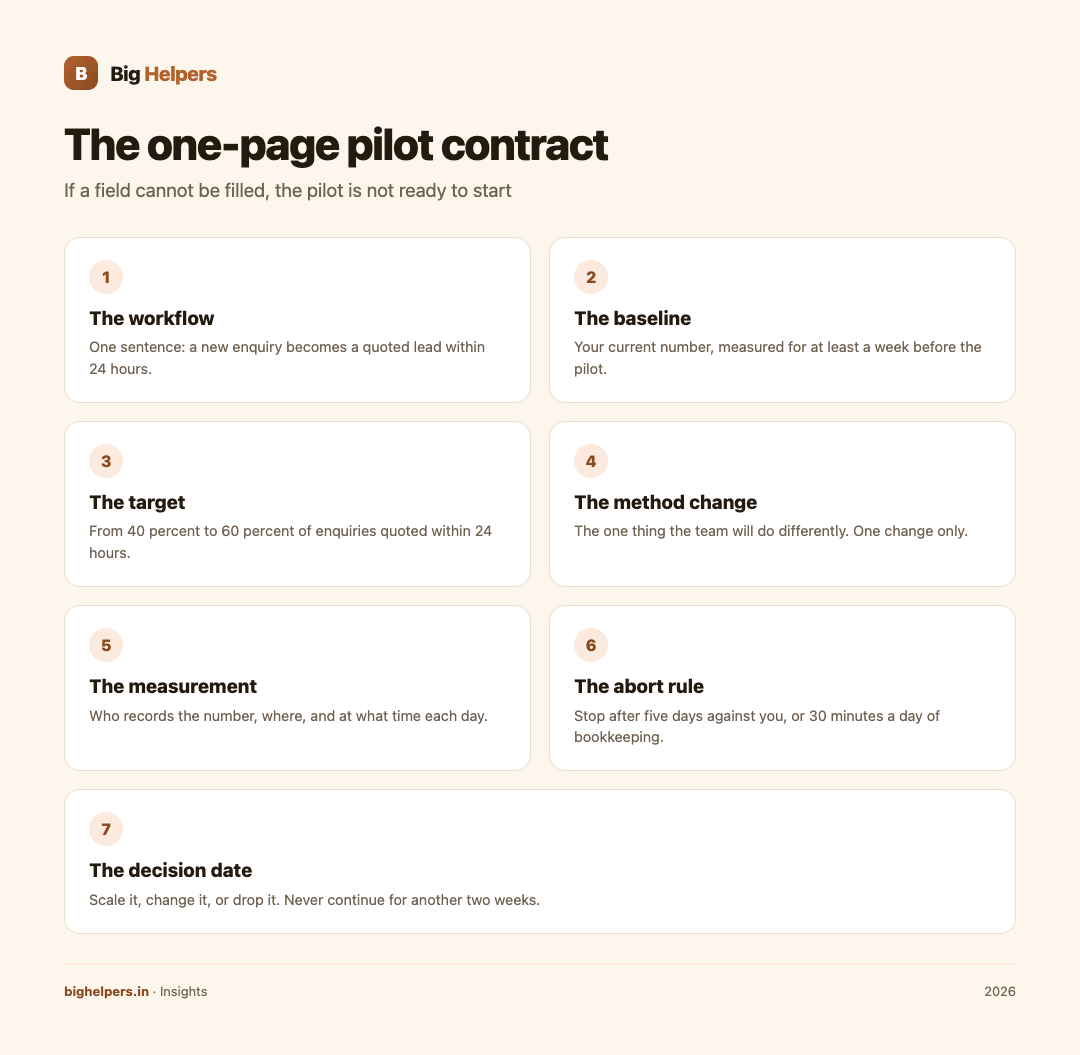
Before the pilot begins, fill in these seven fields on a single page. If a field cannot be filled, the pilot is not ready to start.
1. The workflow, in one sentence. "A new enquiry becomes a quoted lead within 24 hours."
2. The baseline. Your current number for the outcome, measured for at least a week before the pilot. If you do not know how many enquiries became quoted leads last week, spend that week finding out. Guessing a baseline is the most common way pilots produce meaningless results.
3. The target. The improvement you would consider worth acting on. Modest and specific beats ambitious and vague. "From 40 percent to 60 percent of enquiries quoted within 24 hours" is a target. "Better follow-up" is a wish.
4. The method change. The one thing the team will do differently. A single shared lead list checked each morning. A message template with the bill number and the pending amount. A named owner for every enquiry. One change, because a pilot testing three changes at once cannot tell you which one worked.
5. The measurement. Who records the number, where, and at what time each day. A paper register is a perfectly respectable pilot instrument.
6. The abort rule. The condition under which you stop early. If the number moves against you for five consecutive days, or the team spends more than 30 minutes a day on pilot bookkeeping, stop and read the result honestly. An abort rule protects you from the temptation to extend a failing pilot out of optimism.
7. The decision date and the three possible decisions. On a named date you choose exactly one: scale it, change it, or drop it. "Continue for another two weeks" is not one of the options, because a pilot with no end becomes a habit with no verdict.
Why manual-first works
The strongest version of a pilot usually changes the process without building anything. A shared sheet, a paper list at the counter, a message saved as a template on one phone. This is deliberate, for three reasons.
First, it isolates the process question. If a manual version of the new process does not improve the number, software will not save it, because the problem was never tooling.
Second, it reveals the real requirements. Two weeks of manual operation shows exactly which fields people actually fill, which steps they skip, and which exceptions appear. That is a requirements document money cannot buy.
Third, it keeps the exit free. Walking away from a sheet costs nothing. Walking away from a build costs a invoice and some face.
Only when the manual version improves the number do you have evidence that automation is worth buying, and a precise description of what to automate.
Example
Example: a three-person tailoring studio believes it loses orders to slow quotations. Their pilot contract sets the workflow as "enquiry to quotation within 24 hours", the baseline at 45 percent from one week of records, and the target at 70 percent. The single method change is a morning list of unquoted enquiries, reviewed at 10 am by the owner.
Two weeks later the number sits at 68 percent. The team logs two findings: quotations are fastest when fabric photos are attached, and every delay traces to waiting on a measurement visit. The decision is to scale the morning list permanently and, later, to add a simple quotation form with photo upload. The studio spent nothing on software to learn this.
Had the number stayed at 45 percent, the honest conclusion would have been that slow quotation is not the bottleneck, and a quotation tool would have been money spent on the wrong problem.
Reading the result
On the decision date, place your result in one of three boxes.
Scale. The number moved to target and the team kept the habit without prompting. The next step is to make the process permanent, first with the manual version, then with software if volume justifies it.
Change. The number moved partly, or moved but the habit needed constant pushing. Keep the pilot shape, alter the single method change, and run the window again with a fresh baseline. One change per iteration.
Drop. The number did not move, or moved at a cost in staff time that outweighs the gain. Record the result, thank the team, and stop. A clean negative result from a two-week pilot is one of the cheapest pieces of knowledge in business.
From pilot to automation
When a pilot scales, the brief for the build is already written: the workflow sentence, the fields actually used, the exceptions encountered and the number that matters. That is what you hand to whoever builds the permanent version.
Big Helpers delivers this way on the build side, with weekly demos on a staging URL so each week's working software can be checked against real use rather than against promises, as described in how the team works. For the automation itself, the business process automation service is the natural next step once a pilot has proved the hours are real, and for a first software product the MVP development service exists for exactly the smallest-buildable version mindset.
A coaching-institute chatbot case makes the same point at larger scale: support automation worked because the workflow it automated was understood and bounded first. The case study describes the context in which automation actually paid.
Common mistakes
- Piloting software instead of a process. The question is whether the work improves, not whether a tool is nice.
- Skipping the baseline week. Without a before number, any after number is decoration.
- Changing two things at once. Two changes means an unreadable result.
- Choosing a number nobody can count daily. If counting takes more than five minutes, choose a simpler number.
- Extending a failing pilot indefinitely. That is not patience, it is avoidance.
- Running the pilot on your best staff only. Pick the average performers, because they are the ones the permanent system must serve.
Frequently asked questions
How long should a pilot run?
Two weeks suits most small-business workflows. Use three only where the natural cycle is longer, such as monthly billing.
What if we cannot measure anything today?
Then your first pilot is a measurement pilot: one week, one number, no process change at all. Many businesses find that week alone changes their plans.
Who should run the pilot, the owner or the team?
The team runs the workflow; the owner runs the contract. If the owner runs the workflow too, the pilot proves only that the owner works hard, which you already knew.
What number should I choose?
One that connects to money or time and can be counted daily: enquiries quoted within 24 hours, bills paid within seven days, orders entered the same day. For estimating value before you begin, the website ROI calculator can help frame the before and after in rupee terms.
Your next step
Choose one workflow that annoys you weekly, write the seven fields on one page, and book your baseline week starting Monday. If the pilot proves the hours, bring the completed page and your recorded numbers to an automation conversation; Big Helpers starts with a free 20-minute call, and honest numbers on the table make that call worth double.
Sources & references
- Business process automation service: the build step after a pilot proves the hours.
- MVP development service: for the smallest-buildable first version.
- How Big Helpers works: weekly demos and the free 20-minute discovery call.
- Case study: AI chatbot for support: automation that worked on a bounded workflow.
- Website ROI calculator: for framing the before and after in rupee terms.
Pricing in this guide is verified as of the article date. Verify with vendors before committing budget — rates change quarterly.