
TL;DR: five questions, one sentence
A broad vision becomes shareable when it answers five questions in one sentence:
- What problem
- Which people
- What change
- What you will do
- Words that respect everyone who reads it
Write those five answers, compress them into 15 to 25 words, and you have a dream worth printing on a card.
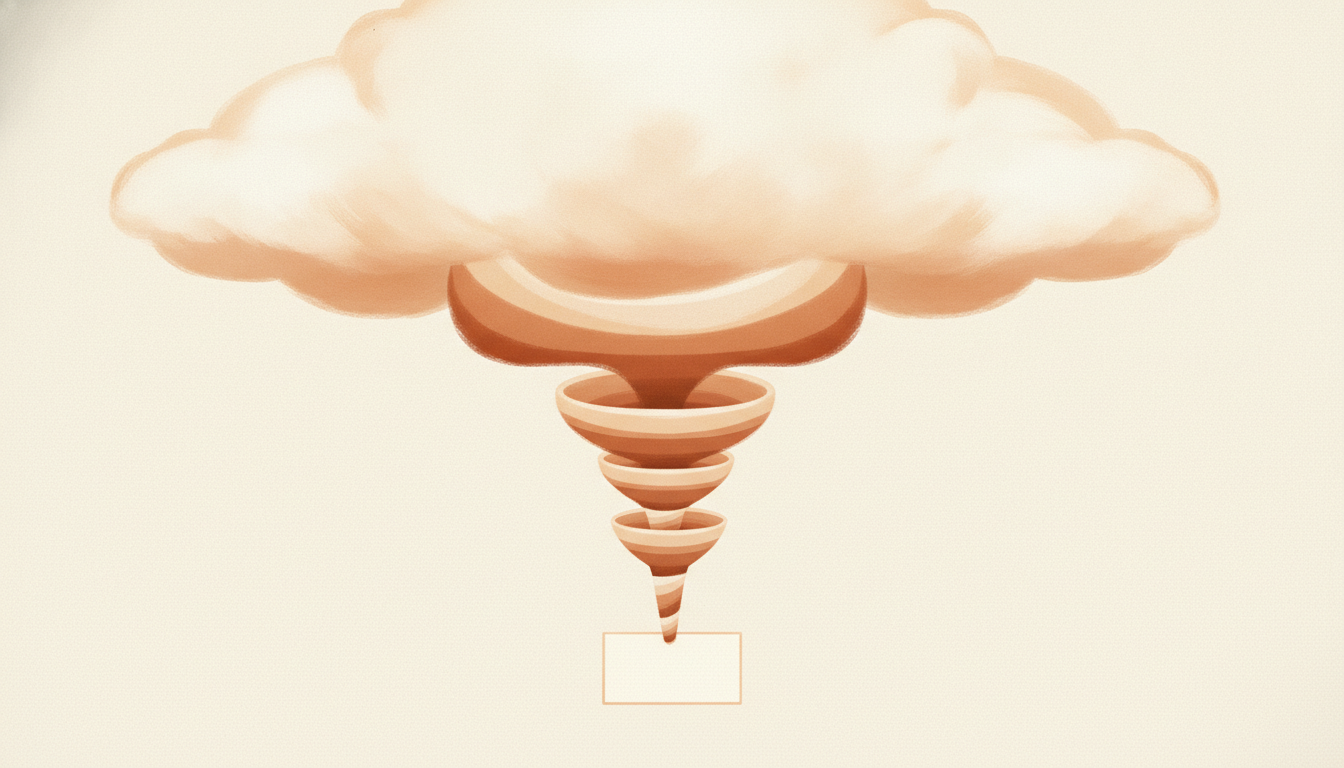
Why broad visions travel badly
"Better India" is a mood, not a dream. Moods cannot be shared usefully: nobody knows what to do with them, and they invite argument instead of reflection. A sentence that names a specific problem, a population and a personal contribution gives readers something to agree with, improve on or act on. The narrowing is not about smallness of ambition; it is about making one large ambition legible.
The five-question framework
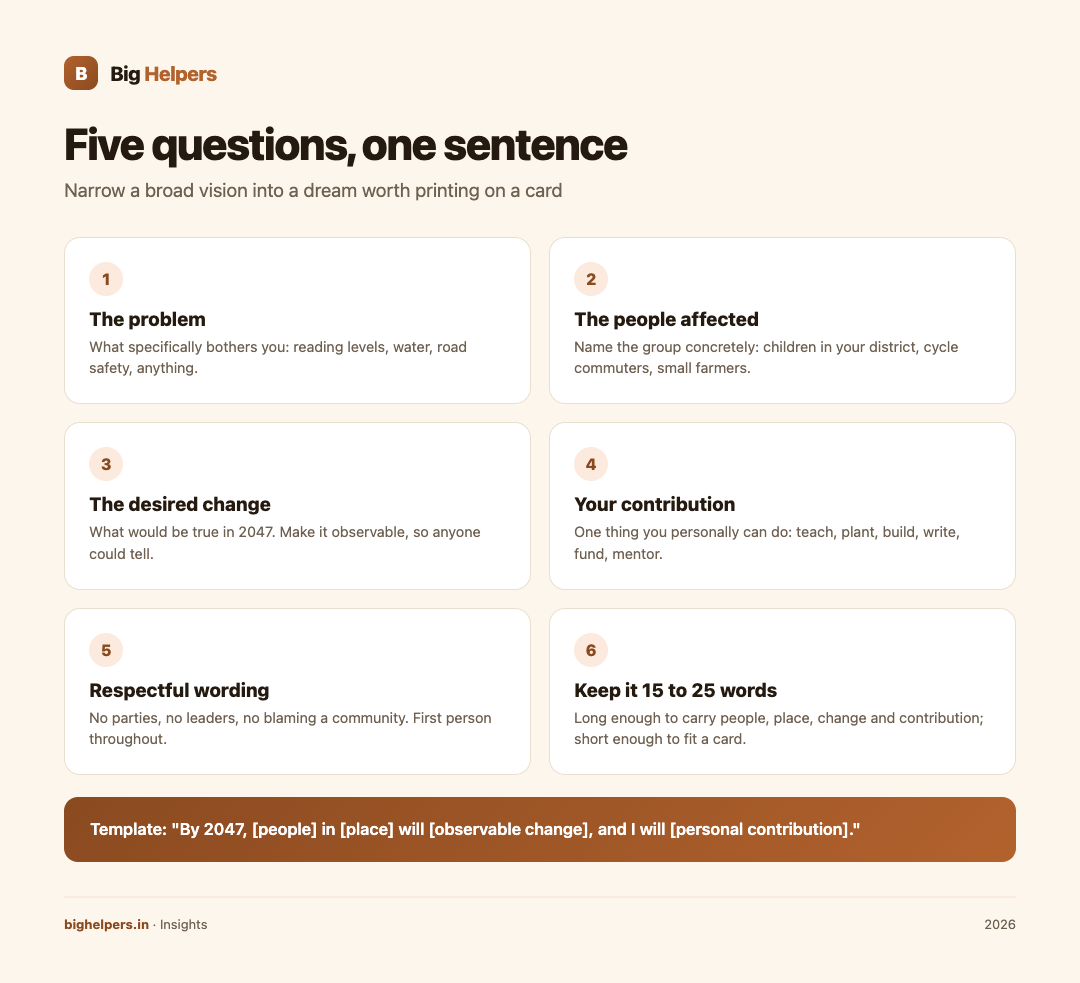
Answer each question in ten words or fewer, on separate lines, before writing the final sentence.
- The problem. What specifically bothers you: reading levels, water, road safety, loneliness of elders, repair culture, anything.
- The people affected. Name the group concretely: children in your district, first-generation students, cycle commuters, small farmers.
- The desired change. State what would be true in 2047 if the dream came partly true. Make it observable, so anyone could tell whether it happened.
- Your contribution. One thing you personally can do: teach, plant, build, write, fund, mentor. Keep it honest rather than heroic.
- Respectful wording. No names of parties or leaders, no blaming a community, first person throughout.
The fill-in template
"By 2047, [people] in [place] will [observable change], and I will [personal contribution]."
The template is deliberately plain. Adjectives can be added later; they rarely survive the 25-word limit, and the limit is the friend that makes the dream shareable.
Three rewrites, from broad to clear
| Broad version | After the five questions |
|---|---|
| I want India to be educated. | By 2047, every child in my block will read a book a month, and I will read aloud at the local library every Saturday. |
| India should fix its water crisis. | By 2047, my colony will harvest every rooftop's rainwater, and I will start with mine this monsoon. |
| We must respect our elders. | By 2047, no elder in my street will eat alone on a festival day, and I will set one extra place at my table. |
Notice what the rewrites gain. Each has a place, so it can be checked. Each has a personal action, so it cannot be outsourced entirely to others. Each avoids opponents, so the sentence makes allies instead of arguments. And each is short enough to sit on a card without shrinking the type.
Respectful wording, in practice
Three habits keep a sentence generous. Name the change, not the culprits. Use "my" and "our" rather than "they" and "their". Let the contribution be proportionate to one person, because an unkeepable promise reads as noise. When a draft feels sharp, test it by imagining it read aloud at a family dinner across generations; if a line would start a quarrel, it is not the line.
Two more traps deserve a name. The first is the borrowed dream: a sentence that paraphrases a headline or a speech rather than something you have actually seen. Readers can tell, and the sentence carries no weight. The second is the impossible scale: "I will teach every child in India" collapses under its own arithmetic on first reading. A dream you can begin this month and a nation you can address in the same sentence is the balance the five questions are engineered to strike.
Where the sentence can go: the INDIA 2047 card, transparently
Once your sentence exists, you can keep it in a notebook, and that is a complete outcome. If you want it as a visual card, we make a free app for exactly this. INDIA 2047 is listed on our apps page as "A multilingual Dream Card maker for sharing a personal vision for India", currently "Available on iOS. Android is in controlled testing." Per the store listing, it accepts speech or typing in 13 Indian languages, applies themes, card styles and accessible fonts, can include your own photos, saves cards to a private on-device shelf, and shares through the standard share sheet; it needs no phone number, email or login, and it is an independent project not affiliated with the Government of India. That is the full extent of the pitch; the framework above works entirely without it.
A quick editing ritual for your sentence
Cut every adjective you cannot defend. Replace any abstract noun, such as "development" or "awareness", with something you could photograph. Read the sentence aloud once; a stumble marks a clause to trim. Sleep on it and read again in the morning. Then share it where you choose, printed or digital, and let others copy the framework rather than your sentence.
FAQ
How long should the final sentence be?
Fifteen to 25 words. Long enough to carry people, place, change and contribution; short enough to fit a card.
Must I include my own contribution?
The framework says yes, because it keeps the dream personal and checkable. If you prefer, make it "I will start by" plus the smallest honest step.
Is it wrong to mention a problem caused by someone?
Name the problem plainly, but leave persons and parties out. The sentence should survive being read by anyone.
Can the dream be very small?
Small and specific beats vast and vague. A keepable promise about one street is a real dream.
Can I write it in my own language?
Yes. The card app supports 13 Indian languages for speech or typing, and paper has always supported all of them.
Your next step
Take ten minutes today: five answers, one sentence, one read-aloud test. If you want it as a card afterwards, check INDIA 2047 on our apps page; to see how this fits our wider milestones, read the milestones page, and for questions about our apps, the FAQ is open.
Disclaimer
This article is a writing framework for personal expression, not campaign material, and claims no affiliation with or endorsement by any government body. App features and availability are as listed on 29 August 2026 and may change; current status lives on the apps page.