
TL;DR: a 40-minute session plan
Run the activity as a structured expression session, not a campaign. In 40 minutes, a facilitator sets ground rules, shows one example, lets each participant write one personal dream for India in their own language, turns it into a Dream Card on the INDIA 2047 app or on paper, and closes with voluntary, consent-based sharing.
Neutrality, consent, accessibility and safeguarding guardrails are built into the plan below. Nothing here claims any official endorsement.
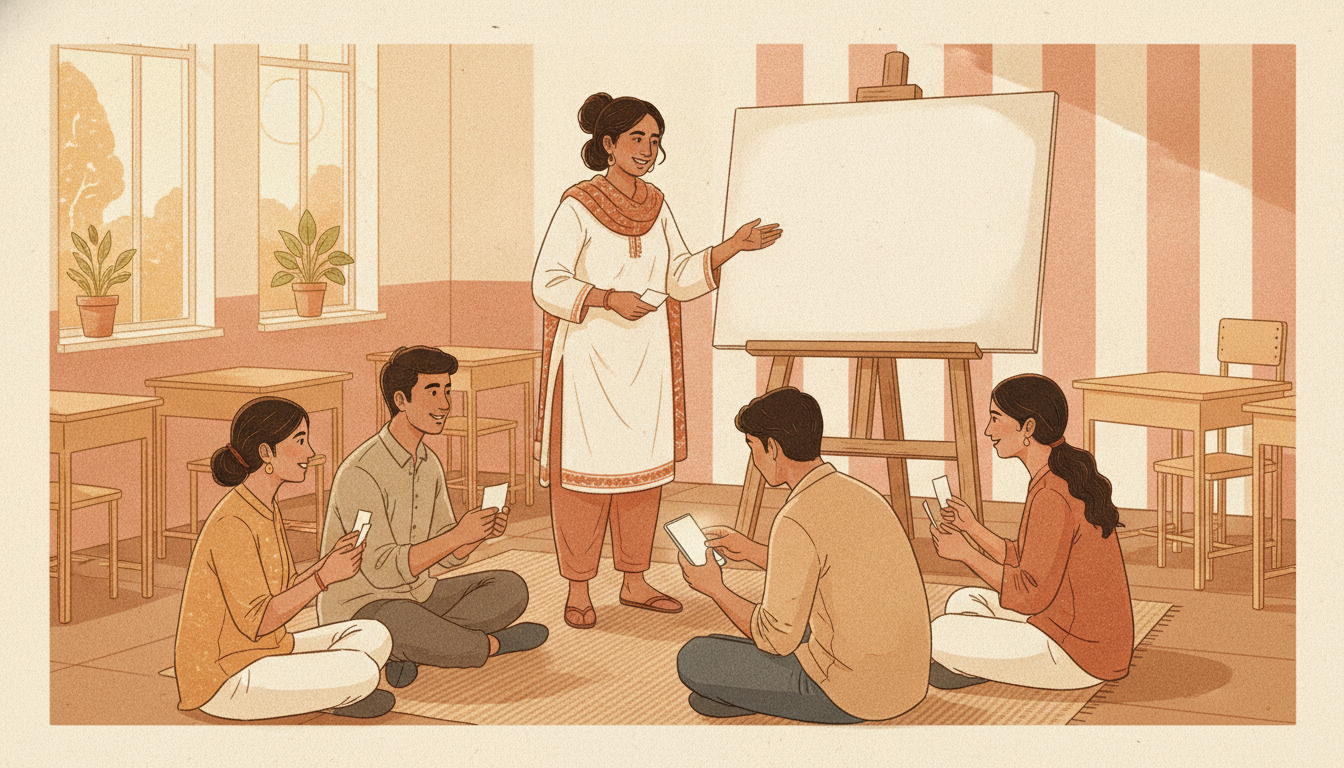
What you are facilitating, exactly
INDIA 2047 is listed on our apps page as "A multilingual Dream Card maker for sharing a personal vision for India", currently "Available on iOS. Android is in controlled testing." The store listing describes it as an independent civic-participation project, not affiliated with the Government of India, with no login needed for the essentials, on-device storage of cards, and input in 13 Indian languages by speaking or typing. Because Android is not publicly released, this plan works fully with paper and only optionally with the app. That also solves the device-ratio problem: where one phone exists between five participants, four make paper cards and one makes a digital card, and the session loses nothing.
Before the session: a five-item preparation list
- Venue and permissions: a room where participants can sit in a circle, with the institution's consent for a civic-expression activity.
- Materials: A5 cards, markers, one printed sample card, and optionally one or two iPhones with the app installed and microphone permission decided in advance.
- Ground-rules chart: written before participants arrive (wording below).
- Consent slips: two simple checkboxes per participant, permission to participate and separate permission to display or share the card publicly.
- A neutrality note to yourself: you will read no example that names a party, a leader or a controversy.
The 40-minute run sheet
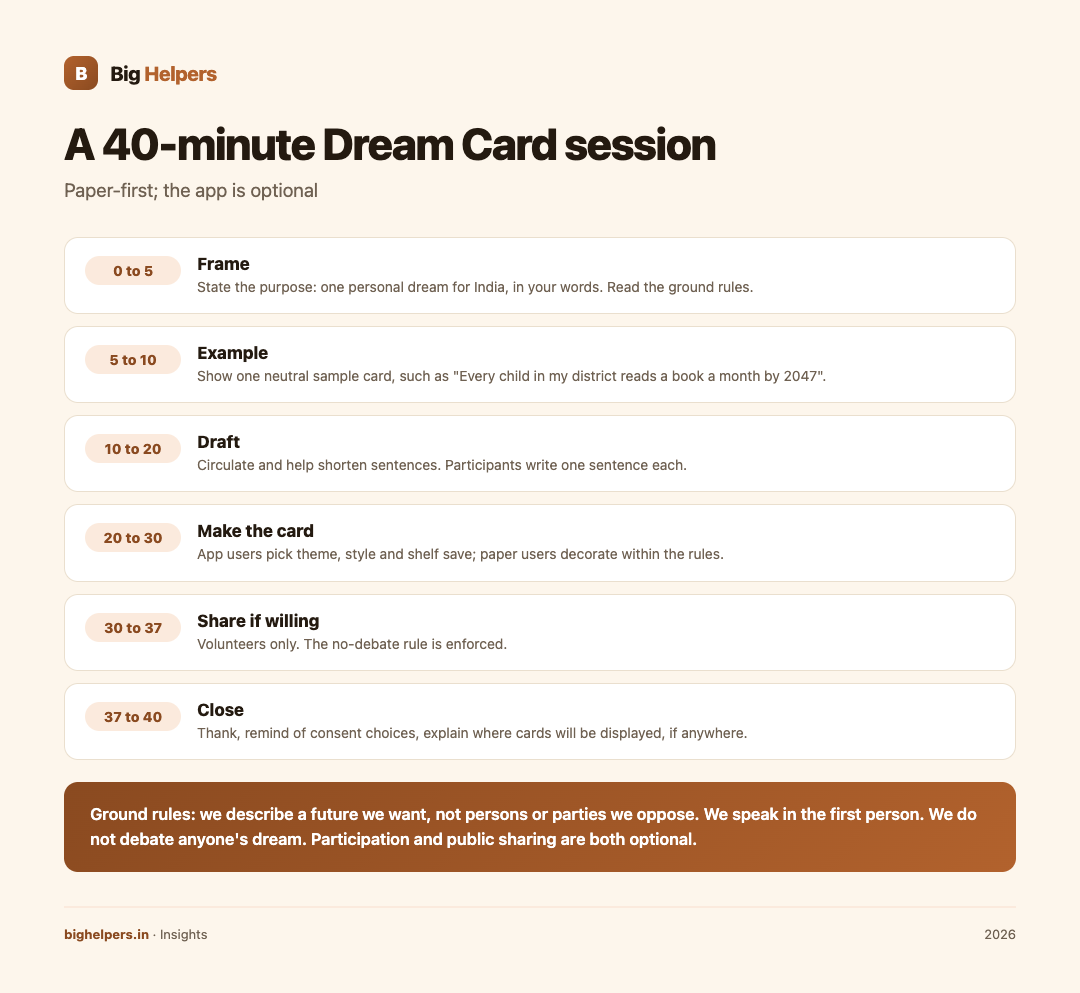
| Time | Segment | What the facilitator does | What participants do |
|---|---|---|---|
| 0 to 5 | Frame | State the purpose: "one personal dream for India, in your words"; read the ground rules | Listen, ask process questions |
| 5 to 10 | Example | Show one neutral sample card, such as "Every child in my district reads a book a month by 2047" | React, think of their own line |
| 10 to 20 | Draft | Circulate; help shorten sentences; offer the five-question framework quietly | Write one sentence each on paper or in the app |
| 20 to 30 | Make the card | Support app users through theme, style and shelf save; paper users decorate within the rules | Finish the card |
| 30 to 37 | Share if willing | Invite volunteers only; enforce the no-debate rule | Read out or display |
| 37 to 40 | Close | Thank, remind of consent choices, explain where cards will be displayed, if anywhere | Decide display consent |
Neutrality guardrails for the facilitator
The ground-rules chart, written large, should carry four lines. We describe a future we want, not persons or parties we oppose. We speak in the first person: "my dream is", not "they should". We do not debate anyone's dream in this room. Participation and public sharing are both optional. If a participant writes something partisan, the facilitator's move is procedural, not confrontational: ask them to name the outcome they want for people, and drop the names. If a card targets a group or community, it is not displayed, and the facilitator speaks with the participant privately afterwards.
Consent, in two separate layers
Layer one is participation consent, taken from a parent or guardian for minors on the institution's usual form. Layer two is sharing consent, taken from the participant: "I allow my card to be displayed on the classroom board", and separately, "I allow my card to be photographed and shared online". Default to no when in doubt. For the app, remind participants that cards stay on the device unless someone actively shares them, so a "no to online" choice is fully enforceable: the card simply stays in the shelf or on paper.
Accessibility adaptations
The app's listing mentions accessible fonts; use them, and add these session-level adaptations. For participants with low vision, offer the largest card style and read the example aloud twice. For those who find writing hard, voice input in their language is the point of the tool; where no device exists, a facilitator or peer scribes the spoken sentence. For non-verbal participants, allow a drawn card with a one-word caption. Keep the room quiet during drafting for anyone using speech input.
Safeguarding boundaries
Do not photograph faces with the cards unless the sharing-consent box for online use is ticked. Do not publish a minor's full name beside a card. Do not ask participants to disclose personal circumstances; a dream is a sentence about the future, not a testimony. If a participant's dream reveals distress, follow the institution's usual welfare procedure rather than continuing the activity with that participant. The facilitator never takes cards home; they stay with the participant, or, if displayed, stay inside the institution.
After the session
Collect nothing except what participants choose to give: display consents. A short debrief with two questions works: "what surprised you in others' dreams" and "what is one thing you could do yourself before 2047". The second question connects to our wider work with schools and education providers, which you can see on our education industry page, and general questions about Big Helpers are answered on the FAQ page.
FAQ
Can we run this without any phones?
Yes. The plan is paper-first; the app is an optional finish, which also covers the fact that Android is not publicly released.
Is this activity linked to any government programme?
No. The app listing itself states the project is independent and not affiliated with the Government of India, and the activity plan claims no endorsement.
What age is this suitable for?
From about age ten with simplified wording. For minors, participation consent comes from guardians and sharing consent from the child.
What if a participant writes something political?
Redirect to the outcome: what change they want for people by 2047. If it remains partisan or targets a group, it is not displayed.
Who owns the cards?
The participants. Paper cards go home with them; app cards stay on their device unless they choose to share.
Your next step
Copy the run sheet, adapt timings to your group, and print the ground-rules chart before the day. If you want the digital option, check current availability of INDIA 2047 on our apps page first, and read our step-by-step Dream Card guide for how a card is made.
Disclaimer
This activity plan is general guidance for neutral, consent-based group sessions. It is not affiliated with, endorsed by or connected to any government body or campaign. Institutions should apply their own consent, safeguarding and photography policies, which override anything written here.