
The short answer
Choose white-label when an existing product already fits your workflow and you only need your logo, colours and domain. Choose custom software when the workflow itself must change, when you need the source code, or when per-seat subscriptions stop making financial sense. Big Helpers offers both: BusinessSetu white-label at ₹5,000 one-time plus ₹500 per month for custom domain and branding, and custom builds with written INR ranges and code you own from day one.

The mistake is treating this as a taste question. It is an ownership question, and ownership has levels.
The three levels of ownership
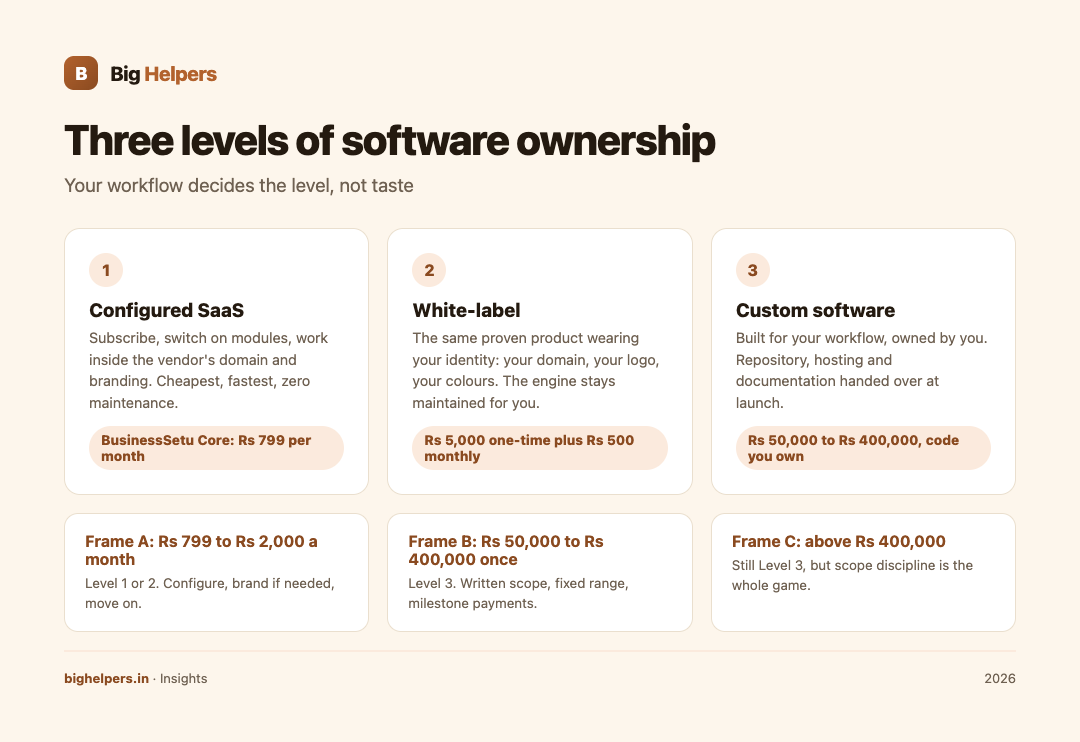
Level 1: Configured SaaS. You subscribe, switch on the modules you need and work inside the vendor's domain and branding. Cheapest, fastest, zero maintenance. BusinessSetu Core at ₹799 per month with optional add-on modules is exactly this level.
Level 2: White-label. The same proven product, wearing your identity: your domain, your logo, your colours. On BusinessSetu this is ₹5,000 one-time plus ₹500 per month, listed on the pricing page as custom domain and branding. You look like the software company to your customers; the product company keeps running the engine.
Level 3: Custom software. Software built for your workflow, owned by you. Big Helpers quotes custom CRM and software work from ₹50,000 to ₹400,000, hands over the repository, hosting and documentation at launch, and states plainly: you own the source code on day one.
There is a fourth direction people jump to too early, "build a platform", and it is usually Level 3 with unbounded scope. Ignore it until Level 3 has been lived in.
The six questions that place you
| Question | Points to Level 2 | Points to Level 3 |
|---|---|---|
| Does the standard product do the job? | Yes, entirely | No; the workflow itself must change |
| Whose brand must the customer see? | Yours, on a working product | Yours, on software that is yours |
| Who else needs the tool? | My customers, lightly | My team, daily, in a specific process |
| Integrations | Standard ones already offered | Your Tally, your bank, your legacy system |
| Maintenance | Handled by the product company | Yours; budget for it deliberately |
| Budget this year | Thousands per month | Lakhs once, then modest upkeep |
Three or more answers in the right column and custom is worth quoting. Three or more on the left, and white-label is the honest answer.
What white-label actually buys, and what it does not
White-label buys perception: your customers open your domain, see your brand, and never learn the product company's name. For consultants, associations and small networks reselling a billing or records tool to their members, that perception is the product. It also buys speed, because the engine underneath is already running, already tested and already maintained.
What it does not buy: workflow change. The screens stay the screens. If your dealer network needs a commission ladder the product never modelled, branding will not summon it. It also does not buy code ownership. The vendor improves the product on their schedule; you ride along. Exit means exporting your data, not taking the software with you.
What custom actually buys, and what it costs you
Custom buys the workflow. The software models your dealer rules, your regional pricing, your approval chains, the exact thing off-the-shelf tools charge per-seat fees to almost do. It buys the code: Big Helpers hands over repository, hosting and documentation at launch, with NDA and code escrow available. It buys exit freedom, because the software is yours to keep, host anywhere or hand to another team.
It costs you three things: money upfront, lakhs not thousands; time, a custom CRM typically runs four to ten weeks; and responsibility, because after launch the maintenance question is yours, and it should be budgeted in the same conversation as the build.
Three budget frames, honestly
Frame A: ₹799 to ₹2,000 a month. Level 1 or 2. Your problem is running the business, not the software. Configure, brand if needed, move on.
Frame B: ₹50,000 to ₹400,000 once. Level 3 territory: a custom CRM or operations tool replacing five spreadsheets and a WhatsApp scroll. Big Helpers quotes this band for custom CRM work, in writing, with the range fixed unless the scope moves. Pay per milestone, with weekly demos so you see working software before each payment.
Frame C: above ₹400,000. Still Level 3, but scope discipline is the whole game. Insist on a written scope, a phased build and code escrow if the system is core to revenue.
The trap between frames: paying Frame C money for Frame A problems. If a ₹799 product with your logo does the job, the honest consultant says so.
A short decision path
- Write down the three workflow steps that hurt most today.
- Find a configured product that already covers them. If yes, stop at Level 1 or 2.
- If no product covers them, ask why: is it branding, or is it the process? Branding is Level 2. Process is Level 3.
- At Level 3, demand code ownership in writing, milestone payments, and a handover of repository, hosting and documentation at launch.
- Whatever you choose, confirm you can export your data on the day you start.
Fit and non-fit, said plainly
White-label fits consultants, coaches, associations and small networks whose members need a standard billing or records tool under a trusted local brand. Custom fits distribution businesses, dealer networks, multi-branch operations and anyone whose competitive advantage lives in a process no standard product models.
Custom does not fit a business that has not stabilised its process yet. Building software around a workflow you still change monthly buys you an expensive monument to last quarter's idea. Stabilise first, then automate.
Frequently asked questions
Is white-label the same as owning the software?
No. You own the brand and the customer relationship, not the code. The product company owns the engine and maintains it.
What exactly do I own in a custom build?
The source code, from day one. Big Helpers hands over the repository, hosting and documentation at launch, and states this in the engagement.
Can I start white-label and go custom later?
Yes, and it is often the wise order. You learn what your users actually need, then fund the build with proof instead of guesses. Your data should export cleanly either way.
How fast is each path?
White-label runs on the existing product, so branding and domain are configuration, not a project. A custom CRM is typically four to ten weeks from kickoff to live, with weekly demos.
What keeps custom costs from running away?
A written scope with a fixed range before work starts, milestone payments tied to working software, and the discipline to keep version one small.
What about maintenance after a custom build?
Budget it from day one. Owning code means owning its upkeep; treat a maintenance allowance as part of the purchase price, not a surprise.
Pick your level with a conversation
Describe how your business works today in three lines. You will get a range and a plan, and a plain answer if you do not need custom work yet.
Message Big Helpers on WhatsApp or use the contact page. Explore custom software development and custom CRM work, or see how pricing works and the service list. For the configurable and white-label side, current module and integration prices are on the BusinessSetu pricing page.
Sources & references
- BusinessSetu pricing page: Core, modules, white-label rates
- Custom CRM development, Big Helpers
- Custom software development, Big Helpers
- How Big Helpers pricing works (written scope, fixed range)
- Contact Big Helpers
Pricing in this guide is verified as of the article date. Verify with vendors before committing budget — rates change quarterly.