
TL;DR: the five-step funnel
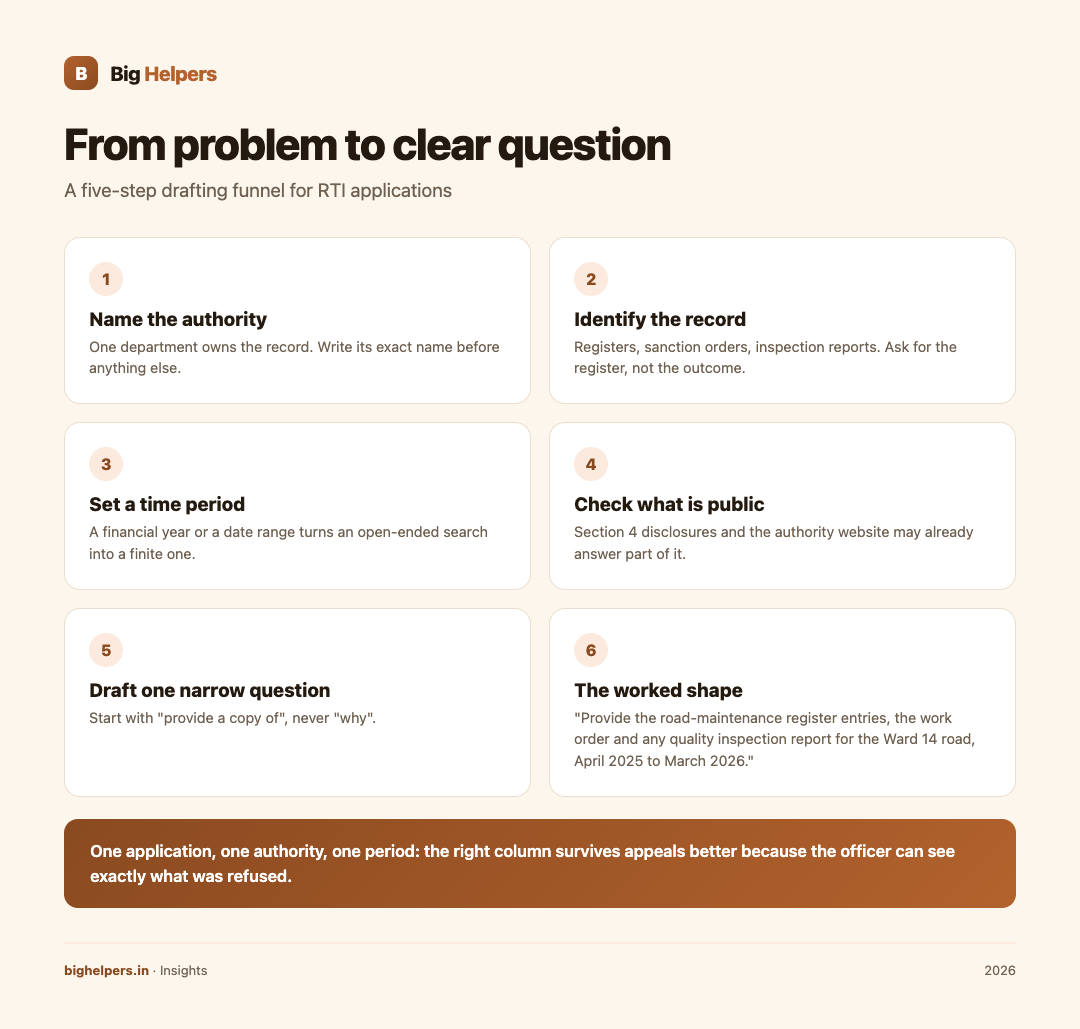
Most RTI applications fail to help because they describe a grievance instead of asking for a record. The fix is a five-step funnel:
- Name the public authority
- Identify the record that would exist
- Set a time period
- Check what is already public
- Draft one narrow question
This guide walks the funnel with a worked example. The deeper law and filing procedure live on RTI Wiki, and this article links there for each step.

Why the wording matters more than the anger
Section 6(1) of the Right to Information Act, 2005 lets you request information from a public authority. Section 6(2) adds that you need not give reasons. What the law does not do is convert a complaint into a question for you. A PIO can only supply records that exist. So the discipline is simple: stop writing what happened to you, start writing what document the department must already hold.
The official Act text is on the DoPT portal, and the plain-language beginner guide on RTI Wiki covers the same ground for first-time applicants. This article stays on one narrow skill: turning a problem into a question an office can actually answer.
The five-step funnel
Step 1: Name the public authority, not the problem
One department owns the record. A broken streetlight question can belong to a municipality, a cantonment board or a housing society depending on the road. Write the authority's exact name at the top of your notes before anything else. If you are unsure which authority holds the file, that uncertainty itself becomes a smaller, earlier question: ask the district collectorate or the department's PIO to identify the custodian.
Step 2: Identify the record that would exist
Every office produces paper: registers, sanction orders, inspection reports, measurement books, utilisation certificates. Ask for the register, not the outcome. The record you name tells the PIO exactly what to search, and it makes a refusal easier to challenge later.
Step 3: Set a time period
Bound the request. "Last one year", "financial year 2025-26" or "since April 2025" turns an open-ended search into a finite one. Wide periods invite the PIO to reply that the search would "disproportionately divert resources". Narrow periods rarely do.
Step 4: Check what is already public
Before filing, look at the authority's proactive disclosures under Section 4 of the Act, its website, and its annual reports. Five minutes of checking prevents an application that merely asks for something already downloadable, and it sharpens the question you finally send.
Step 5: Draft one narrow question
One application can hold a few related questions, but each should point at a record inside your stated period. If you catch yourself writing "why", rewrite the sentence to start with "provide a copy of" or "provide the relevant extract from".
Vague complaint versus record-focused question
| Vague framing | Record-focused framing |
|---|---|
| Why is our ward road full of potholes? | Provide the inspection report and repair register entries for Ward 14 roads from April 2025 to March 2026. |
| Nobody acts on encroachment complaints. | Provide the register of encroachment complaints received by the municipal office in 2025-26, with action taken columns. |
| The school fund was misused. | Provide the utilisation certificate and audit note for the school development fund, financial year 2025-26. |
| My pension file is stuck. | Provide notings on file for pension application number X between March 2025 and the date of reply. |
The left column is a grievance. The right column is information a PIO can locate, copy and send. The right column also survives appeals better, because an appellate officer can see exactly what was refused.
A worked example: the ward road file
Suppose a resident wants accountability for a patched-and-broken road. The funnel produces this sequence:
- Authority: the municipal corporation's zonal office, confirmed from the corporation website.
- Record: the road-maintenance register, work-order file and third-party quality inspection report, if any.
- Period: April 2025 to March 2026, one clean financial year.
- Cross-check: the corporation's tender portal already shows the contractor name and sanction amount, so the question targets the register and inspection papers only.
- Draft: "Please provide copies of the road-maintenance register entries, the work order and any quality inspection report for the Ward 14 road resurfacing work carried out between April 2025 and March 2026."
Two sentences. Specific authority, named records, bounded period, no adjectives. RTI Wiki's guide on why RTI applications get rejected lists the failure modes this drafting avoids, and its how-to-file pillar page takes over from here with formats, fees and dispatch.
Common drafting traps
- Asking "why" or "how" instead of "provide".
- Naming three authorities in one application. Split the request per authority.
- Requesting opinions, suggestions or action, which the Act does not cover.
- Leaving out the period, which invites a "clarify" reply and costs weeks.
- Bundling unrelated subjects, which gives the office an easy partial-refusal route.
Reading and drafting on the go
For citizens who want the reference material on a phone, the RTI Wiki app is listed on our Big Helpers apps page as "RTI knowledge, practical guides and citizen tools in a mobile experience", with availability noted as "Available on iOS. Android is in controlled testing." The store listing describes it as an independent, unofficial educational app with plain-language guides and drafting help; it does not file applications for you, and it is not affiliated with the Government of India. Treat it as a companion for reading and drafting, not a filing channel. For governance questions about our own articles, see the Big Helpers FAQ, and for more decision guides browse the insights library.
FAQ
Does a narrow question weaken my complaint?
No. A record-focused request is the fastest route to the evidence that supports any later complaint. The complaint can follow; the record comes first.
Can I ask two or three questions in one application?
Yes, if they concern the same authority, subject and period. If a question needs a different office, file a separate application there.
What if I cannot identify the authority at all?
Ask the office you suspect to state, as information, which authority holds the record. That reply becomes your map for the next application.
Do I need to explain why I want the information?
No. Section 6(2) of the Act says an applicant need not give reasons. Keep the reason out of the draft; it only adds text to misread.
Where do I verify the exact fee and format before sending?
Check the filing route pages on RTI Wiki and the authority's own RTI page, because fees and modes differ between the central government and states, and they change over time.
Your next step
Pick one problem you already have, run the five-step funnel on paper, and end with a single sentence that starts with "provide". When you want the full legal background, formats and filing routes, start with the RTI Wiki beginner guide and draft from there.
Disclaimer
This article is general information, not legal advice. Rules, fees and timelines change; verify current requirements on the official portal of the public authority concerned before filing. RTI Wiki is an independent resource and is not affiliated with the Government of India.