
TL;DR: the readiness drawer
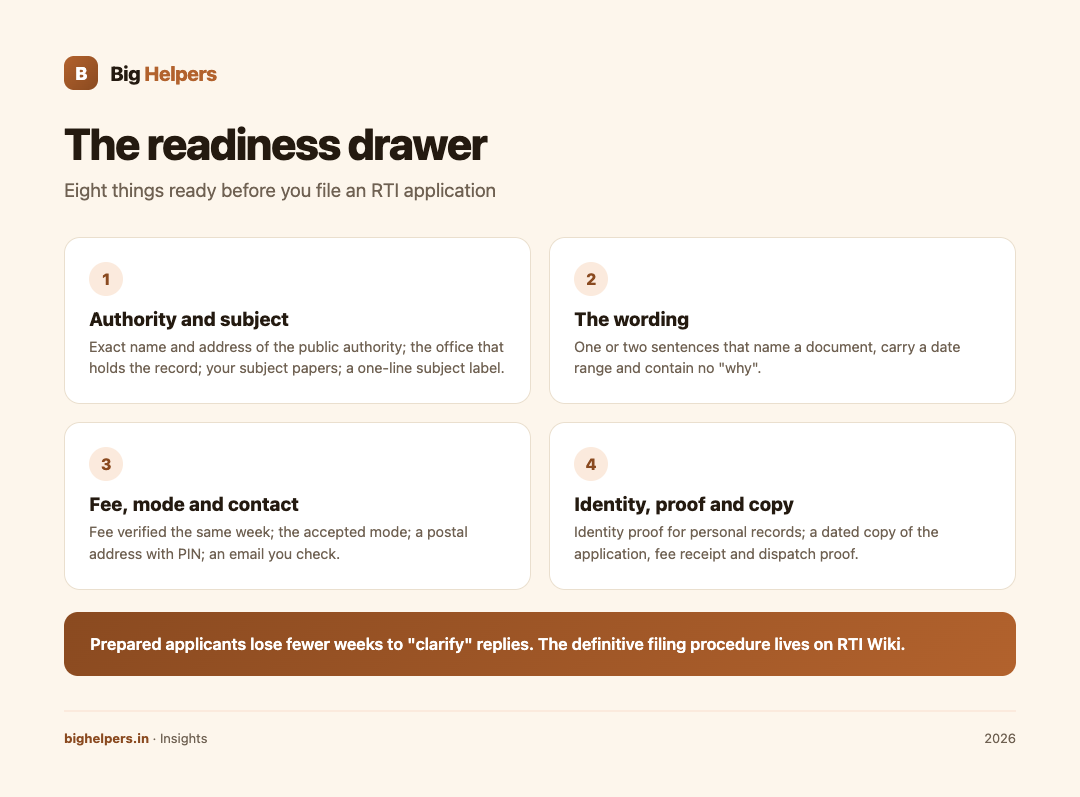
Before you file an RTI application, keep eight things ready:
- The exact public authority
- The subject papers
- Your draft question
- The fee and payment mode
- Your contact details
- Identity proof if you seek personal records
- A copy for your own file
- The current official guidance for that authority
Prepared applicants lose fewer weeks to "clarify" replies. This checklist covers readiness only; the definitive step-by-step filing guide lives on RTI Wiki and is linked below.

Why readiness, not another filing guide
Most filing delays are not caused by wrong portals. They are caused by missing inputs: an authority named loosely, a question without a period, a fee paid in a mode the office does not accept. The RTI Wiki beginner guide and its filing route pages already explain formats, fees and dispatch authoritatively. This article deliberately stays one step earlier: the drawer you assemble before you touch a form.
The readiness drawer: four clusters
Cluster 1: Authority and subject
| Keep ready | Why it matters | Where it comes from |
|---|---|---|
| Exact name and address of the public authority | The application must reach the right PIO; wrong office means transfer delay | The authority's website, letterhead or the state RTI directory |
| The office that holds the record (zonal, district, divisional) | Requests routed to the custodian office are answered faster | The department's organisational page |
| Your subject papers: bill, order number, property record, complaint number | These anchor your question and the period | Your own file |
| One-line subject label, such as "Water supply billing, FY 2025-26" | The subject line travels into registers and reply tracking | You write it |
Cluster 2: The wording
Keep the drafted question in front of you, one or two sentences that ask for a record inside a stated period. Check it against three tests. It names a document. It carries a date range. It contains no "why". If it fails any test, redraft before opening the portal. If you want drafting help, the AI RTI drafter on RTI Wiki builds an application, authority line, fee note and filing checklist around your inputs.
Cluster 3: Fee, mode and contact
The central application fee is Rs 10, and the beginner guide notes that applicants below the poverty line are exempt. States set their own fee schedules and accepted payment modes, and these change over time, so confirm both on the authority's RTI page or the state portals directory on RTI Wiki before paying. Keep ready:
- The fee amount for that authority, verified the same week you file.
- The accepted mode: online payment, Indian Postal Order, court fee stamp or demand draft, as applicable. For postal filings, write the IPO number on your own copy before the order leaves your hand.
- Your postal address with PIN code, and an email address you check.
- A phone number, optional but useful for delivery coordination.
Cluster 4: Identity, proof and your own copy
For records about yourself, such as service matters or medical files, keep an identity document ready; some offices ask for it to process third-party or personal information. Whatever you file, keep a full copy: the application, the payment receipt and the dispatch proof, whether a portal acknowledgement, an IPO counterfoil or a courier receipt. Date every item. These copies are the spine of any first appeal later, and rebuilding them after the fact is far harder than keeping them now.
Official guidance worth one read
Two official sources settle most doubts before filing. The RTI Act, 2005 text hosted by DoPT settles what you can ask. The RTI Online portal is the central government's filing route and its pages state current fees and portal rules. For state authorities, always prefer the state portal listed in the directory above; central rules do not automatically govern state filings.
A worked example: the delayed pension file
A retiree wants the status of a pension revision pending since March 2025. The drawer before filing looks like this: authority named as the pay and accounts office serving the department; subject papers are the pension payment order number and two office receipts; the question asks for "copies of notings on the pending revision file from March 2025 to the date of reply"; fee Rs 10 ready for online payment; contact details and an identity proof kept at hand; and a printed copy of the application filed in the personal records folder. Filing takes ten minutes because nothing had to be searched mid-way.
Common readiness gaps
- Authority written as "the government" instead of a named office with address.
- No period stated, prompting a clarification reply.
- Fee paid in a mode the authority's rules do not list.
- Only the portal acknowledgement saved, with no copy of the application text itself.
- Personal-information requests sent without an identity document the office can use.
FAQ
Do I need identity proof for every application?
No. Identity proof matters mainly when you seek personal information or when an office's rules require verification. Keeping it ready costs nothing.
Is the fee always Rs 10?
The central fee is Rs 10 as stated in the beginner guide, but states fix their own fees and modes, and these are revised from time to time. Verify for the specific authority before paying.
Should I file online or by post?
Both are valid for central authorities; the portal route gives an instant registration number. Some state authorities still work mainly on paper. Choose after checking the directory entry for your state.
How many copies of the application should I keep?
Keep at least one full copy with the fee receipt and dispatch proof attached, stored where you can find it on a bad day.
Can someone else file on my behalf?
Yes, but the application should clearly identify the person seeking the information, and the record of who filed what stays in your drawer either way.
Your next step
Assemble the drawer today for one pending matter: authority line, subject papers, draft question, fee mode, contact details, identity proof and a copy. When you are ready to file and want the authoritative procedure, formats and portal routes, use the RTI Wiki how-to-file guide.
Disclaimer
This article is general information, not legal advice. Fees, modes and procedures differ between authorities and change over time; confirm current requirements on the official portal of the authority concerned before filing. For an overview of how we write and maintain guides, see the Big Helpers FAQ, and for templates and checklists browse our resources section. Our apps page lists the current status of every Big Helpers application.