
TL;DR: the seven-layer appeal file
A first appeal under the RTI Act is mostly paperwork done well. Build one file, in order:
- Your application copy
- The fee and dispatch proof
- The PIO reply, if any
- A dated timeline
- Your grounds
- The relief you seek
- Proof of appeal dispatch
Section 19(1) gives you 30 days from the reply, or from the day the reply was due. Nothing here promises success; it only keeps your appeal complete, dated and ready.

What the Act actually asks of you
Under Section 19(1), an applicant who is refused information, or who does not receive it in time, may prefer a first appeal to an officer senior in rank to the PIO, the First Appellate Authority. The Section 19 page on RTI Wiki, which quotes the Act with its official source, records the practical clock: the appeal goes within 30 days of the PIO's reply or of the lapsed deadline; no fee applies on the central side, though some states charge a nominal fee; and the authority should decide within about 30 days, extendable to 45 in writing. The Act text on DoPT is the primary document to quote from.
Build the appeal file in seven layers
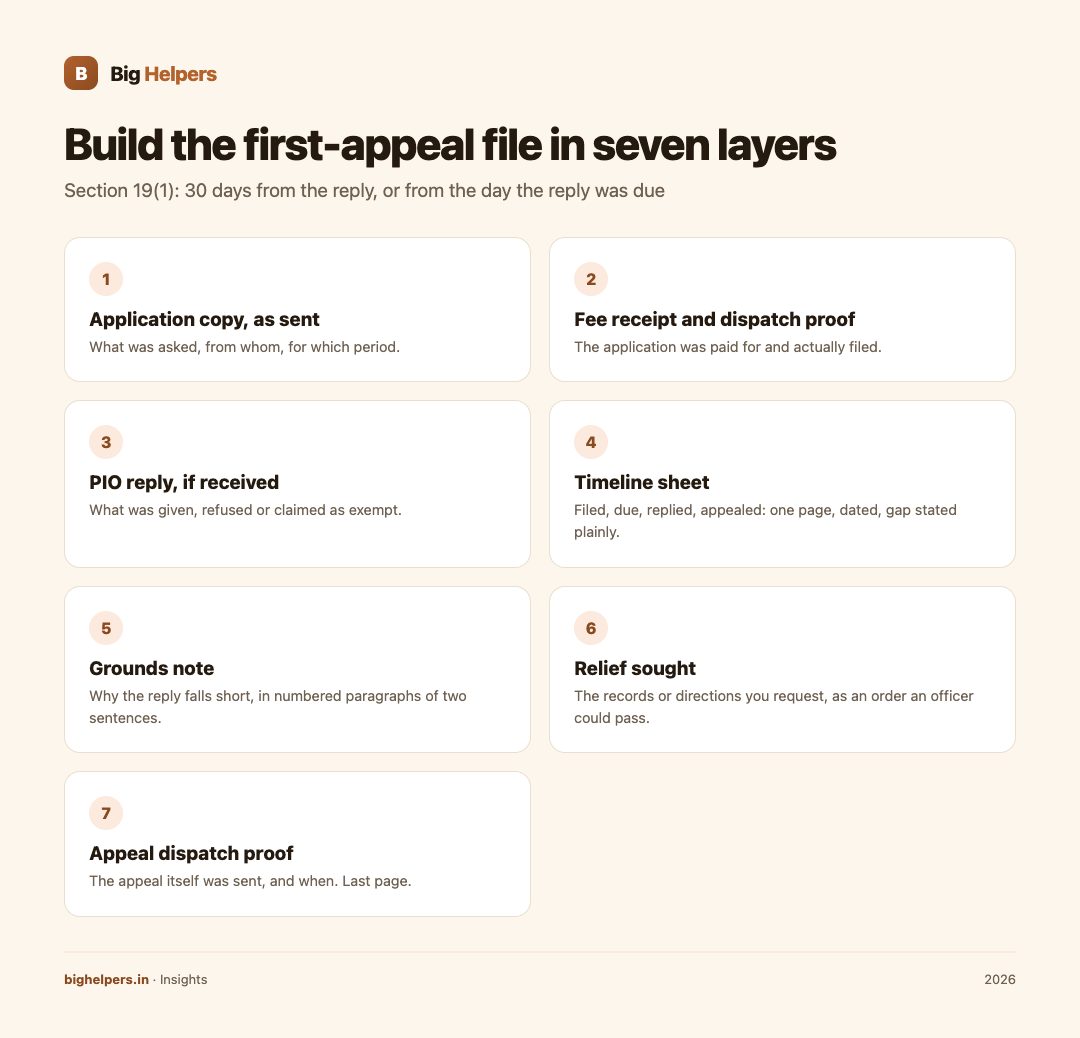
| # | Document | What it proves | Where it sits |
|---|---|---|---|
| 1 | Copy of the RTI application, as sent | What was asked, from whom, for which period | Top of file |
| 2 | Fee receipt and dispatch proof | The application was paid for and actually filed | Behind item 1 |
| 3 | PIO reply, if received | What was given, refused or claimed as exempt | After dispatch proof |
| 4 | Timeline sheet: filed date, due date, reply date, appeal date | Your appeal is within time | Single page, dated |
| 5 | Grounds note | Why the reply is incomplete, wrong in law or unreasonably delayed | One page |
| 6 | Relief sought | The specific records or directions you request | One paragraph |
| 7 | Appeal dispatch proof | The appeal itself was sent and when | Last page |
A file that reads in this order lets an appellate officer verify everything without asking you for anything. That is the entire craft of a first appeal.
The timeline sheet: one page that decides admissibility
Write four dates and one calculation. Date filed. Date reply was due, which is 30 days after filing for most matters, or 48 hours where life or liberty is involved. Date reply actually arrived, if it did. Date of appeal. Subtract, and state the gap plainly: "Appeal filed on day 21 of 30." If your gap is near the limit, say so and, where the facts allow, note any time lost to a transfer between offices, because the clock runs on the authority that finally held your request. If you prefer a tool to arithmetic, the RTI timeline calculator works out the dates from your inputs.
Grounds: short paragraphs, no heat
A ground is a reason the reply fails, tied to the record. Three patterns cover most cases:
- Incompleteness: "The reply provides the sanction order but not the utilisation certificate named in the application."
- Misreading the request: "The application asked for register entries from FY 2025-26; the reply covers only 2024-25."
- Unexplained delay: "No reply was received within the statutory period, and none has arrived to date."
Write grounds as numbered paragraphs, each two sentences at most. Quote your own application, then the reply, then the shortfall. Never argue the merits of the underlying dispute; the appeal is about the record.
Relief: ask for records, not vengeance
The relief paragraph should read like an order an officer could actually pass: "Direct supply of the register entries and inspection report for the stated period, free of charge to the extent the delay was unexplained, within a stated time." Ask for what the Act can give. If you want a tool to structure all of this, the first-appeal builder on RTI Wiki assembles the document around your dates and grounds, and the appeal templates page offers starting formats.
A dated example of the whole file
An application is filed on 1 March with a Rs 10 fee receipt. The reply is due on 31 March. A reply arrives on 28 March, providing two of five named records. The applicant's timeline sheet reads: filed 1 March, due 31 March, replied 28 March, appeal filed 12 April, day 15 of 30. Ground one: incomplete supply of named records. Ground two: exemption claimed without naming a section for one document. Relief: supply of the remaining three records and section-wise reasons for any refusal. Dispatch proof for the appeal is stapled last. The file is eight pages, and every assertion in it points to a page behind it.
Where the first appeal goes
Central government appeals can be filed through the RTI Online portal, which carries the application history with it. For state authorities, send the appeal to the First Appellate Authority named on the authority's RTI page, by the mode that authority accepts. If the first appeal fails, the second appeal lies to the Information Commission under Section 19(3); the Central Information Commission site is the reference point for central cases. Keep this article's checklist beside you for the first appeal, and let the Commission's own procedure pages govern the second.
FAQ
What if the PIO never replied at all?
Then the appeal is against deemed refusal. Your timeline sheet becomes the heart of the file: filing proof, due date passed, no reply. File within the Section 19 window.
Is there a fee for a first appeal?
No fee applies on the central side; some states charge a nominal fee, as the Section 19 guide notes. Check the authority's current rules before sending.
Can I add new records to my request in the appeal?
Stick to what your application asked. New requests are better filed as a fresh application, which keeps the appeal clean.
How long should the grounds note be?
One page is plenty. Numbered paragraphs, each naming the document, the shortfall and the rule at issue.
What happens if my appeal is late?
Late appeals can be rejected at the threshold. Where delay has an explanation, state it briefly and factually, but do not build a strategy around condonation.
Your next step
Open your RTI file today and assemble the seven layers in order, starting with the timeline sheet. When the file is ready and you want structured drafting support, use the RTI Wiki first-appeal builder. For questions about Big Helpers guides themselves, the FAQ page is the place, our apps directory shows the current status of the RTI Wiki companion app, and the insights library carries the rest of our citizen decision guides.
Disclaimer
This article is general information, not legal advice, and it does not promise any outcome. Timelines and fee rules are revised from time to time and differ between authorities; verify current rules on the official portal or the order of the authority concerned before acting.