
TL;DR: use both, by task
For RTI work, use both surfaces for what each does best today.
- Website: long legal guides and specialist tools, including case-law search and Hindi voice drafting
- App: plain-language guides, drafting applications and first appeals, and the whole Act with sources
Neither surface files your RTI; both point you to official portals.

What each surface is
The website, righttoinformation.wiki, is the full reference: its homepage lists citizen help across 180-plus situations, filing routes for 36 states and union territories, the Act text with rules and templates, case-law search, and a tools index that includes the AI RTI drafter, AwaazRTI voice drafting in Hindi and regional languages, a PIO reply analyser and a timeline calculator.
The app, listed on our apps page with the status line "Available on iOS. Android is in controlled testing.", is described in the store listing as an independent, unofficial reference and education app: 1,100-plus plain-language articles, the 180-plus citizen situation guides, free drafting tools for applications and first appeals, the full Act section by section with the official source beside it, CPD courses and quizzes, the RTI Playbook companion, bookmarks, and an official sources screen. The listing also states that no login is required to read articles, guides or the Act, and that optional registration uses only an email address.
Task-based comparison
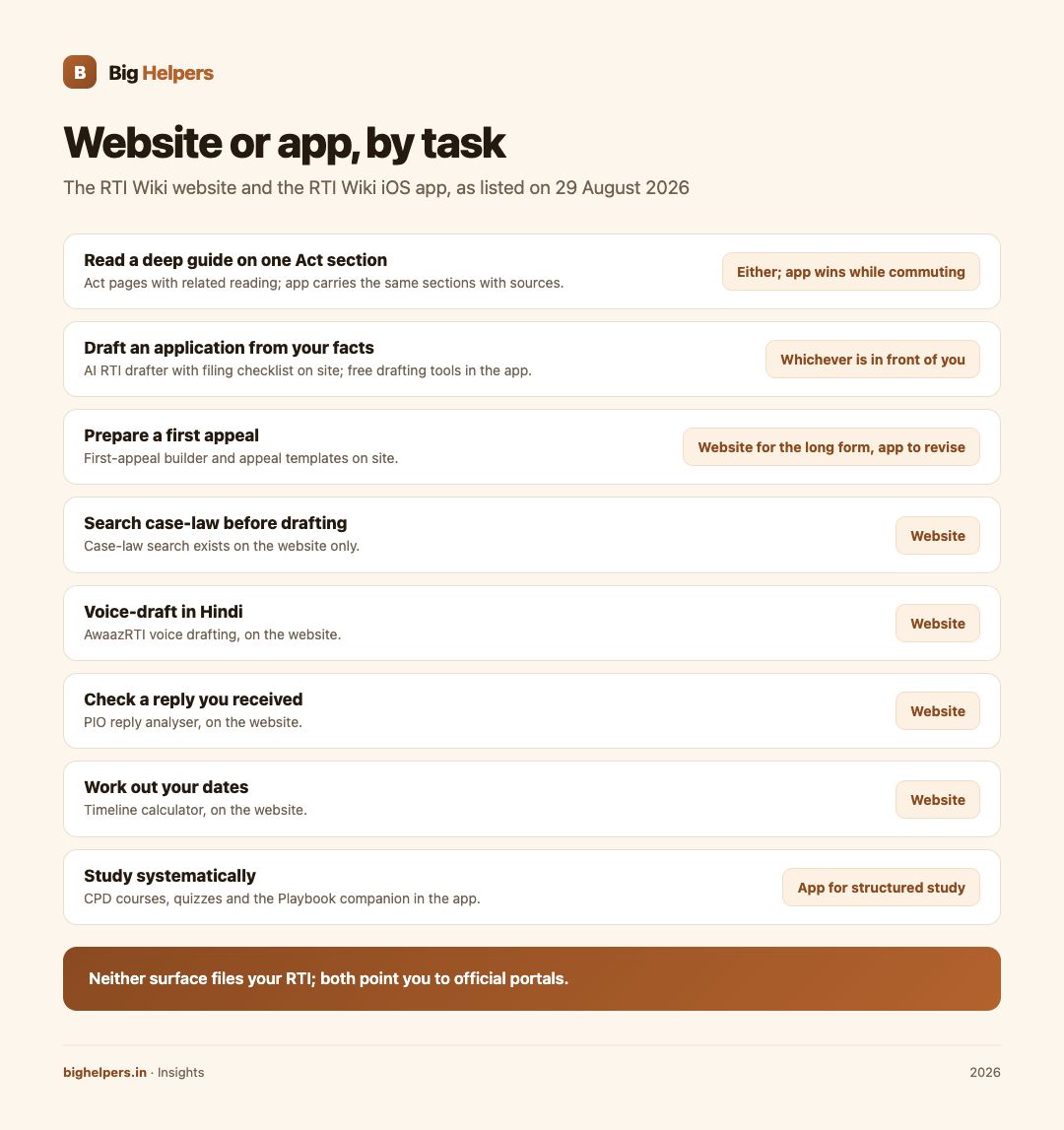
| Your task right now | Website today | App today | Sensible pick |
|---|---|---|---|
| Read a deep guide on one Act section | Full guides, Act pages, related reading | Same Act section by section, sources linked | Either; app wins while commuting |
| Draft an application from your facts | AI RTI drafter with filing checklist | Free drafting tools in hand | Whichever is in front of you |
| Prepare a first appeal | First-appeal builder and appeal templates | Drafting tools carry over to appeal prep | Website for the long form, app to revise |
| Search case-law before drafting | Case-law search exists on site | Not stated in the listing | Website |
| Voice-draft in Hindi | AwaazRTI | Not stated in the listing | Website |
| Check a reply you received | PIO reply analyser on site | Reading guides help interpret | Website for the tool |
| Work out your dates | Timeline calculator on site | Not stated in the listing | Website |
| Read on a phone, offline-travel-tolerant reading | Browser tabs, depends on connection | App reading needs no login; offline capability is not claimed | App, with the caveat below |
| Study systematically | Practical guides hub, CPD pages | CPD courses, quizzes, Playbook companion | App for structured study |
One honest caveat: the store listing makes no offline claim, so do not plan around reading without a connection until the app itself says so. Equally, the listing is explicit that the app does not file RTI applications on your behalf; filing happens on official portals, and both the site and the app link to them.
Two short scenarios
A student with one question about university records grabs the phone, opens a situation guide, drafts a two-line request, then files on the official portal from the same device. A researcher comparing commission orders on a exemption clause sits at a desk, runs case-law search on the website, and only then drafts. Same law, different tools, both correct.
How the two surfaces share one workflow
A single RTI matter can pass through both surfaces in one week. Day one: read the beginner guide and the relevant situation guide on the website, at a desk, with notes open. Day two: draft the application with the site's drafter, or re-draft on the phone app while commuting, since the drafting tools travel with you. Day three: file on the official portal the app links to, from either surface. When the reply arrives, analyse it with the site's reply analyser, then read the relevant Act section on whichever surface is nearby while you decide whether a first appeal is worth filing. The surfaces are not rivals; they are the same library with two doors, and the door you use should be the one your day allows.
Follow-up work
Follow-up is mostly record-keeping, covered in our first-appeal checklist as a dated paper trail. For the law behind a stalled reply, the website's Section 19 page is the deep reference; the app's section-by-section Act view with sources is the pocket version for reading it again on the way to the post office.
Where each surface is going
App availability changes; Android is in controlled testing rather than released, and store listings get updated. When an Android build reaches a public release, the reading rows of the table above will deserve a second look; until then, treat phone reading on Android as a website task. Our apps page is the status of record for platform availability, and our changelog and roadmap pages are the status of record for what Big Helpers ships next. Check those before quoting this article to a friend in six months.
FAQ
Does the RTI Wiki app file my application?
No. The listing states plainly that it is a reference and education app and does not file RTI applications on your behalf. It links the official portals you file on.
Do I need an account to read in the app?
No. The listing says no login is required to read articles, guides or the Act; optional registration uses an email address.
Can I use the app on Android?
Not as a public release. The apps page lists Android as "in controlled testing". Use the website on Android today.
Is the app or the website official?
Neither. RTI Wiki is an independent, unofficial resource, not affiliated with the Government of India or the commissions. Official filing is through government portals.
Which should I open first as a beginner?
The website's beginner guide first, for the full picture, then the app to carry the guides and drafting tools with you.
Your next step
Pick tonight's actual task from the table above and open the matching surface. If you are starting from zero, read the beginner guide on RTI Wiki on the website, and keep the tools index bookmarked beside it.
Disclaimer
This article is general information, not legal advice. Feature lists reflect the live website and store listing as reviewed on 29 August 2026 and change over time; the apps page carries current platform status. RTI Wiki is independent and unofficial, and official filing always happens through government portals.