
The direct answer
You need a custom analytics dashboard when repeat reporting starts costing more than a build would: typically several properties to check, multiple data sources that must reconcile, role-based access for different people, and the same report assembled by hand every week. If you run one site, check one account monthly and everything fits in the platform's own reports, you do not need custom software; native reports, a review routine, and preview tools like AdScore for layout ideas are enough.
The threshold test
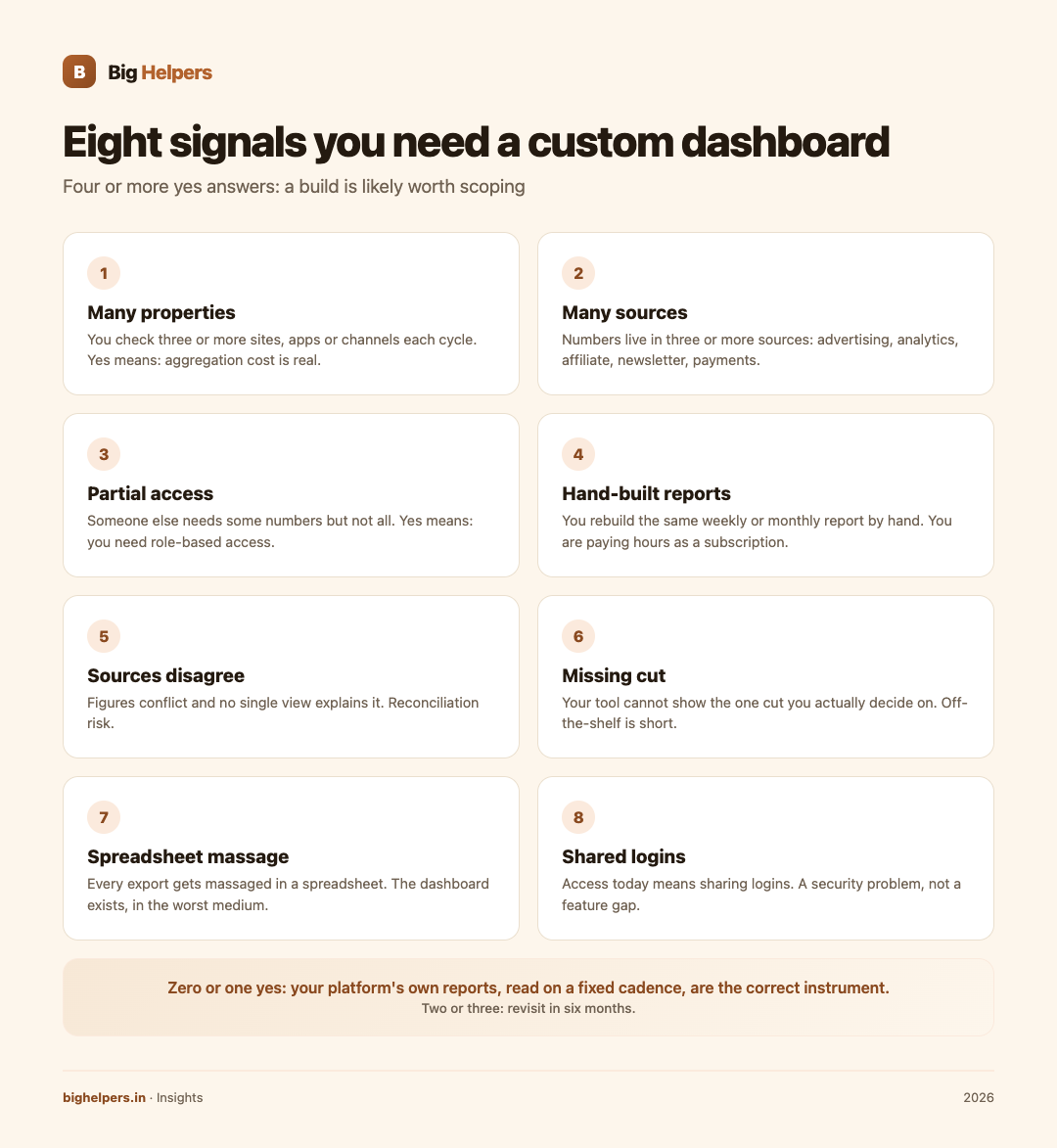
Answer yes or no, honestly:
| # | Signal | Yes means |
|---|---|---|
| 1 | You check three or more properties (sites, apps, channels) each cycle | Aggregation cost is real |
| 2 | Your numbers live in three or more sources: advertising, analytics, affiliate, newsletter, payments | Reconciliation is manual |
| 3 | Someone else needs access to some numbers but not all | You need role-based access |
| 4 | You rebuild the same weekly or monthly report by hand | You are paying hours as a subscription |
| 5 | You have found figures disagreeing between sources and no single view explains it | Reconciliation risk |
| 6 | Your reporting tool cannot show the one cut you actually decide on | Off-the-shelf is short |
| 7 | You export to a spreadsheet and massage it every time | The dashboard already exists, in the worst possible medium |
| 8 | Access today means sharing logins | A security problem, not a feature gap |
Four or more "yes" answers: a custom dashboard is likely worth scoping. Two or three: revisit in six months. Zero or one: stop reading tooling articles and go write; your platform's own reports, read on a fixed cadence, are the correct instrument.
What "custom" buys that tabs do not
Custom software earns its cost in three specific ways, none of which is a nicer chart.
One authorised connection per source. A dashboard that legitimately reads your advertising data does so through the official route. Google, for example, publishes an AdSense Management API, described in its documentation as a way to get reports on AdSense earnings, with standard metric definitions for earnings, clicks, impressions and RPM. Authorised connections mean no credential sharing and no copy-paste of CSV exports.
One reconciliation rule, applied every time. When two sources disagree, a custom dashboard holds your chosen rule for which is authoritative, and shows the gap instead of hiding it. Manual spreadsheets enforce rules inconsistently; that inconsistency is where bad decisions come from.
Access on your terms. Role-based access control means an editor sees content performance, an accountant sees payments, and nobody sees everything. Our custom software service builds this in as standard: the service page lists role-based access control with full audit logging and DPDP-aligned data handling among its standard inclusions.
What custom does not buy
Be equally clear about the boundaries. A dashboard does not create data; it only reports what your sources hold. It does not make estimates final; Google's own metric descriptions call earnings figures estimated. And it does not replace judgement: a custom dashboard that displays your numbers still cannot tell you why they moved, as our anomaly-checking practice covers. If anyone promises a tool that "explains" revenue without evidence, that is a claim to walk away from.
The learning step before the build
Before commissioning anything, know your own reading habits. Big Helpers' AdScore, a free iOS app, is deliberately positioned for this stage: its App Store listing describes it as an "Ad revenue dashboard preview" that uses demonstration data, does not connect to a live Google AdSense or Google AdMob account, and states that no financial decisions should be based on the sample values. Its value is that you can learn which layouts, comparisons and privacy modes matter to you, at zero cost and zero account risk, then specify those preferences in a real build. Its status, available on iOS with Android in controlled testing, is listed on the Big Helpers apps page.
This distinction, demonstration data versus live connected data, is the single most important thing to hold on to. A preview proves usability. Only an authorised connection produces your numbers.
How a build like this is scoped
For context, since publishers ask: Big Helpers' custom software service states an indicative range of Rs 80,000 to Rs 600,000 excluding GST, with most projects taking 6 to 14 weeks to go live. Its stated terms for this work: you own the source code from day one, GitHub access begins from the first commit, scope is locked in writing during discovery with wireframe sign-off before code, weekly working software demonstrations during the build, and 30 days of post-launch support for in-scope fixes. Those are the published facts of the service; whether a build pays for itself depends on the hours your reporting currently consumes, which only you can count.
The comparison that matters before any call is between configuring existing tools and building: our custom software versus SaaS comparison sets out the decision, and the internal tool framework guide walks the same logic for reporting tools inside a business.
A sensible sequence if you are at four "yes" answers
- For two weeks, log every minute spent on reporting, and every login shared to get it.
- Write down the one report you would read weekly if it existed, in columns.
- List your sources and which is authoritative when they disagree.
- Decide who needs which slice of access.
- Take that document to a builder and ask for a fixed scope against it.
That document is the difference between a dashboard project and a money pit.
FAQs
Is a custom dashboard the same as business intelligence software?
BI tools are configurable platforms you feed data into; custom software is built around your exact sources, reconciliation rule and roles. The comparison guide above covers when each wins.
Can a custom dashboard connect to my AdSense account legitimately?
Yes, through Google's official AdSense Management API and its authorisation flow. Any builder proposing password sharing should be dropped immediately.
Will it make my numbers final?
No. Google describes earnings as estimates that can be revised; a dashboard displays them, it does not settle them.
What does it cost?
Big Helpers' custom software service states Rs 80,000 to Rs 600,000 excluding GST and 6 to 14 weeks as its indicative range. Your scope decides where in that range a project lands.
I only have one site. Do I need this?
Almost certainly not yet. Native reports plus a weekly routine cover one property well; revisit when the threshold test changes.
Your next step
If you ticked four or more thresholds, count your reporting hours for two weeks and then talk to Big Helpers about a fixed-scope analytics dashboard, or start with the custom software development page to see exactly what the service includes.
Sources & references
- Google AdSense Management API documentation: developers.google.com/adsense/management (fetched 29 August 2026)
- Google AdSense Management API v2 metric reference: developers.google.com/adsense/management/reference/rest/v2/Metric
- AdScore App Store listing: apps.apple.com/in/app/adscore/id6797173652, and Big Helpers apps page: bighelpers.in/apps/
- Big Helpers custom software development service: bighelpers.in/services/custom-software-development-india/
Pricing in this guide is verified as of the article date. Verify with vendors before committing budget — rates change quarterly.